Volkswagen boost pressure sensor failures cause power loss and limp mode activations, worsened by humidity and carbon fouling. Diagnosing these European turbo systems requires live data logging and voltage drop checks. Professional local diagnostics and component replacement help restore factory performance and protect your engine from costly long-term turbocharger damage.
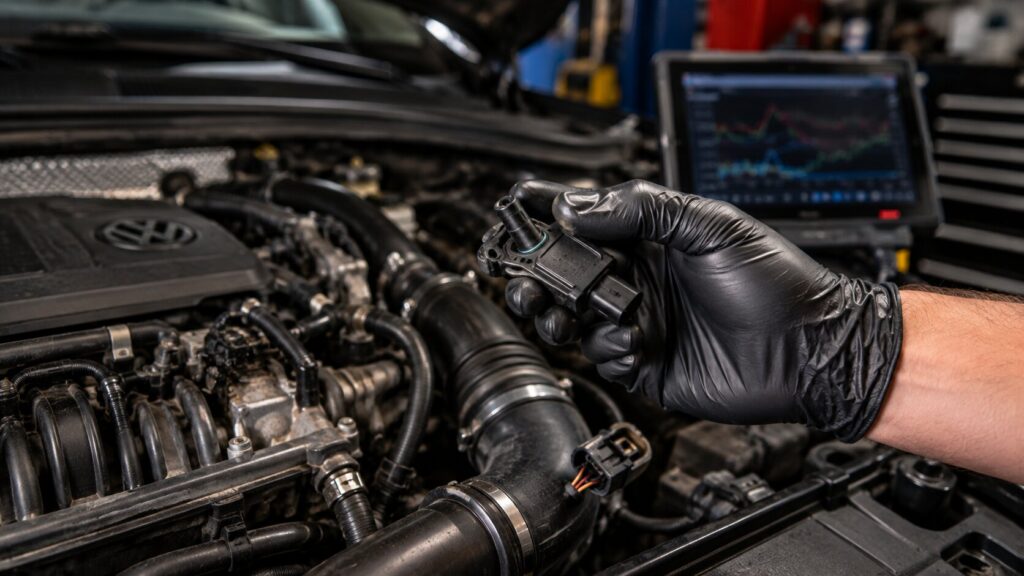
Humidity rising off Lake Minnetonka cooks wiring harnesses on late model Volkswagen turbochargers idling near County Road 15, leaving drivers stranded with sudden limp mode activations. Boost control faults on the 2.0T TSI platform rarely clear themselves once carbon fouling coats the sensing diaphragm. Local conditions across Spring Park accelerate thermal degradation inside the intake tract long before standard maintenance intervals arrive.
Understanding Volkswagen Boost Pressure Sensor Failures
When the MAP (Manifold Absolute Pressure) sensor malfunctions, the engine control unit receives inaccurate boost data from the turbocharger. This failure ruins engine performance, causing sudden power loss, slow acceleration, or limp mode. These drivability issues are particularly common in modern direct-injection powertrains that frequently undergo short trips in humid regional climates.
Symptoms of a Bad Volkswagen Boost Pressure Sensor
Catching signal drift early prevents uncontrolled overspeed conditions that wipe out compressor turbine bearings. A failing sensor frequently triggers the check engine light alongside a flashing glow plug indicator on diesel variants or reduced power warnings on gasoline models. When I test these vehicles, drivers often describe an unpredictable power delivery that points directly toward corrupted manifold pressure data.
Check Engine Light and Dashboard Warnings
A failing boost pressure sensor immediately flags the engine control unit, triggering the check engine light on the dashboard. On diesel variants, drivers will often notice a flashing glow plug indicator alongside this warning. Meanwhile, modern gasoline models typically display direct reduced-power or drivetrain malfunction alerts on the instrument cluster.
Unpredictable Power Delivery and Boost Surge
Corrupted manifold pressure data causes the engine computer to miscalculate turbocharger output and wastegate timing. This leads to erratic, unpredictable acceleration where the vehicle hesitates or surges unexpectedly under throttle. Drivers frequently report that power feels completely inconsistent during normal everyday driving.
Sudden Power Loss and Limp Mode
When sensor readings become entirely implausible, the engine computer intentionally triggers a failsafe state to protect internal components. This forces the car into a protective “limp mode” characterized by severely restricted throttle response and a drastic lack of power. Fixing this sensor problem quickly stops the turbocharger from overspeeding and ruining expensive parts.
How Heat and Moisture Damage Volkswagen Boost Sensors
Normal driving depends on accurate electrical signals from the sensor to manage power and boost. High ambient moisture mixes with blow by oil vapors passing through the intercooler piping, creating an acidic sludge that settles directly onto the sensing element. This contaminant layer insulates the piezo-resistive material from rapid pressure fluctuations during spooling.
Heat-soaking from the hot turbocharger housing bakes this oily film into a hardened varnish, causing the sensor output to flatline or drift completely out of calibration due to thermal fatigue and chemical delamination.
Advanced Diagnostics For European Turbo Systems
Catching a failing sensor requires measuring live data logs rather than simply reading stored diagnostic trouble codes. In my shop, I execute a rigorous testing sequence to pinpoint the exact failure point:
- Connect a specialized factory level diagnostic interface to monitor actual versus specified boost pressure under heavy third gear engine loads.
- Probe the sensor connector wire to measure voltage drops higher than normal while under a five-volt reference load.
- Remove the sensor for a thorough physical inspection of the sensing tip to check for oil contamination, pitting, and carbon bridging.
If the 5V reference drops under a heavy load while signal voltage flatlines above 4.2V despite vacuum drop, discard the unit—cleaning will only mask internal micro-fractures in the silicon wafer.
Exploring Volkswagen Turbocharger Monitoring Systems
Modern Volkswagen engines use backup sensors to keep the turbocharger safe from spinning out of control. The engine computer constantly checks data from the manifold pressure sensor, outside air sensor, and airflow meter all at the same time. If these sensors disagree with each other, the computer gets confused about how much air is entering the engine.
To stay safe, it automatically opens the wastegate to let extra boost pressure out. Understanding how these computer checks work makes it much easier to figure out if your car has a simple electrical glitch or a physical air leak.
Preventing Long Term Turbocharger Damage and Wear
Ignoring weird boost problems makes your turbo spin dangerously fast because the computer is guessing blindly, which can completely destroy the turbo’s shaft and bearings. Pinpointing the exact electrical issue also saves you from replacing entire wiring harnesses and waiting weeks at a repair shop. Taking your car to an independent European mechanic helps you dodge high dealership prices and long wait times.
Dealing with electronic boost problems right away gives you some major practical benefits:
- Skip the dealership scheduling backlogs for agile local diagnostics.
- Restore factory air fuel ratios and prevent unexpected roadside limp mode events.
Before suggesting expensive parts, I always double-check the electrical voltage to find the real issue first. If you are experiencing boost pressure issues, contact Certified Auto Repair located at 4700 Shoreline Drive, Spring Park, MN 55384 for expert service.
Frequently Asked Questions
Can a faulty boost pressure sensor cause limp mode on a Volkswagen?
Yes. When sensor data doesn’t match airflow readings, the computer forces limp mode to protect your engine from overboosting.
Is it safe to drive with a failing boost sensor?
No. Continued operation risks severe catalytic converter damage and abnormal turbocharger wear due to uncontrolled air and fuel ratios.
Will cleaning a dirty boost sensor permanently fix the problem?
No. Chemical degradation and micro-fractures on the internal silicon wafer require complete component replacement to restore factory tolerances.
Does cold Minnesota weather affect turbo pressure sensors?
Yes. Rapid temperature shifts cause moisture condensation inside the sensor housing, leading to erratic electrical resistance and false fault codes.