Jeep throttle position sensors often fail due to moisture ingress and resistive track wear, causing hesitation and reduced power alerts. This issue is particularly common in humid climates where temperature shifts cause internal condensation. Expert diagnostics involve monitoring real time voltage signal jitter using bi directional tools to distinguish sensor failure from broader electrical or mechanical system faults.
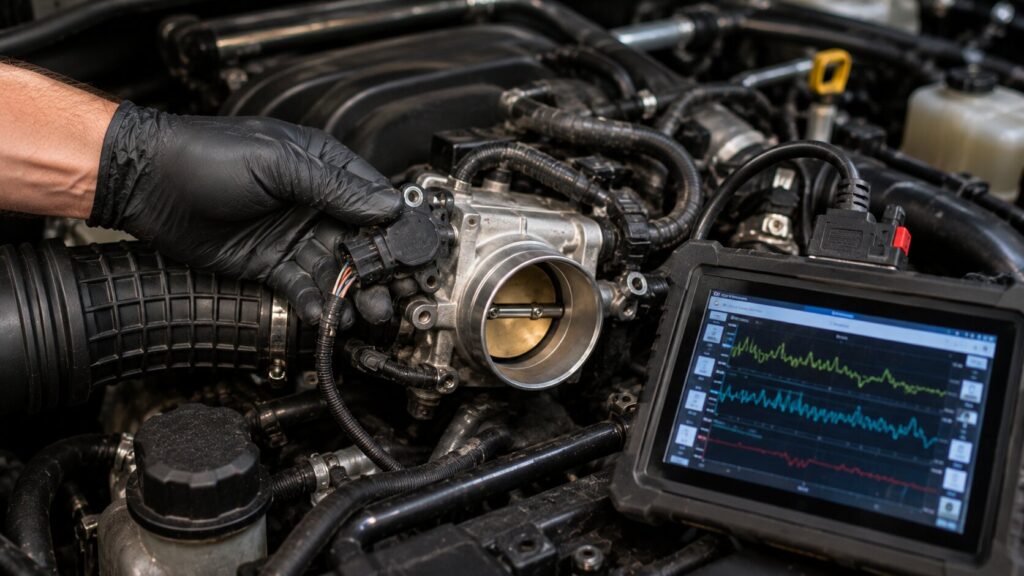
Jeep Wrangler and Grand Cherokee models frequently experience sudden acceleration hesitation and reduced power warnings when the electronic throttle position sensor fails during the humid, fluctuating temperature cycles common to the Lake Minnetonka region. Navigating the stop and go traffic on Shoreline Drive often reveals that sensor signal degradation frequently masks itself as transmission slippage or fuel delivery inconsistencies.
| Primary Symptom | Target Component | Specialized Tooling | Local Environmental Stressor | High Risk Profile |
| Delayed throttle response | Electronic Throttle Body (ETC) Sensor | Bi directional scan tool | High humidity and condensation | Daily commuters on Shoreline Drive |
Why Throttle Signals Degrade Under Local Climatic Stress
The throttle position sensor functions as a variable resistor that provides the engine control module with a precise voltage signal corresponding to the pedal angle. Proper sensor operation depends on the wiper arm sliding seamlessly over the resistive track, which generates the smooth voltage transition the computer requires.
Humidity near the lake accelerates the oxidation of these internal contacts. Moisture ingress causes the resistive material to become pitted and uneven. When the wiper arm traverses these microscopic craters, the voltage signal fluctuates rapidly. The engine control module perceives these spikes and drops as invalid data. This forces the system into a fail safe mode to protect the engine, which manifests as a dead pedal or aggressive acceleration lag during cold starts on damp Minnesota mornings.
If you are seeing a 10%–15% variance in your scan tool’s live TPS data while holding the pedal at 25% on a flat grade, the sensor is failing. Do not attempt a recalibration. If you see ‘staircase’ voltage drops, the wiper contact is physically pitted—the component is failed, not just dirty.
Professional Diagnostic Protocols for ETC Systems
Identifying true sensor failure requires looking past simple fault codes. I use specialized diagnostics to catch signal jitter that basic tools completely overlook, preventing guesswork and wasted service time.
- Connect a bi directional scan tool to the OBD II port and monitor Throttle Position Sensor One and Two simultaneously.
- Observe the voltage sweep while the engine is off but the ignition is in the run position.
- Look for erratic signal drops or flat lines as the pedal is depressed slowly from zero to one hundred percent.
- Perform a comparative analysis against factory specified voltage tolerances for your specific Jeep engine trim.
Shop Secret. If the voltage signal shows noise while the engine is vibrating at idle but remains steady during static testing, check the wiring harness grounds near the engine block for galvanic corrosion caused by road salt.
Interpreting Symptoms on Shoreline Drive
You might notice the lightning bolt warning light flickering on your dashboard while navigating the hills near Spring Park. I’ve pulled three Wranglers this week where the customer requested a transmission rebuild for a ‘slip,’ but the root cause was a 2% signal drop in the TPS during the Shoreline Drive uphill climb.
I see many vehicles where severe track wear causes the computer to lose the throttle position entirely. This results in an engine that idles poorly or refuses to climb in RPM. Ignoring these symptoms forces the transmission to compensate for erratic throttle inputs, leading to accelerated wear on the drivetrain as the gearbox hunts for the correct gear.
Environmental Factors and Component Longevity
The climate around Lake Minnetonka presents specific challenges for Jeep electronic components. Frequent transitions between heated garage environments and sub zero outdoor temperatures cause condensation to form inside the throttle body housing. Over time, this moisture carries microscopic contaminants that settle on the sensor tracks.
I have seen late model Wranglers with fewer than 50000 miles suffering from early sensor failure because of the localized salt air and moisture intensity. Driving habits matter as much as geography. If you frequently take short trips, the engine does not reach the operating temperature required to evaporate the moisture trapped within the intake system.
Thermal Overload and Throttle Motor Resistance
Beyond the sensor itself, the mechanical integrity of the throttle body assembly plays a significant role in longevity. The butterfly valve inside the housing must close and open with zero resistance. If carbon buildup accumulates around the edge of the valve, the motor driving the throttle must work harder to overcome the friction.
This increased electrical load creates heat within the throttle motor housing. Heat soaking is a silent killer for electronic sensors. As the motor heats up, the resistance values shift. What was a perfect signal reading at room temperature becomes erratic once the engine bay reaches operating temperature. I notice this failure pattern most often in the summer, triggered by the combination of rising humidity and the stop-and-go strain of lake-side traffic.
The cooling fans cycle on and off, changing the electrical load of the entire vehicle, and the marginal sensor finally gives out under the pressure of these fluctuating demands.
Mapping Failure Signatures in Scan Data
Throttle sensor failures rarely follow a single pattern. Some manifest as a gradual, long-term power loss that you might not notice for months, while others hit instantly, causing the vehicle to lurch violently as the throttle plate loses its alignment.
When I inspect these units, I look for specific patterns in the signal data. A smooth, linear slope is the goal. If the graph shows a staircase pattern, the resistive track is physically worn down to the substrate.
If the graph shows jagged peaks, there is likely debris or corrosion interfering with the electrical contact. Identifying these signal patterns tells me immediately whether a thorough cleaning will suffice or if the unit is too far gone to avoid a full replacement.
Maintaining Your Jeep for Peak Performance
Ignoring a glitchy TPS does more than just cause a ‘dead pedal.’ As the sensor sends erratic data, the ECU constantly fluctuates fuel trims to compensate. This forces the engine into a rich-running state, which will eventually foul your spark plugs and overheat the catalytic converter to the point of failure. Don’t wait for a check engine light to turn into a four-figure exhaust repair.
If you’re feeling that hesitation on Shoreline Drive, bring your Jeep to Certified Auto Repair at 4700 Shoreline Drive, Spring Park, MN. I’ll run a live-data sweep to catch the signal jitter before it destroys your ignition components.
Frequently Asked Questions
Does a clean throttle body fix sensor signal errors?
No. Cleaning the throttle plate only removes carbon; it cannot repair a worn internal resistive track. If your scan data shows voltage spikes or signal ‘noise,’ the sensor hardware is compromised and requires replacement.
Is it safe to drive with a flickering lightning bolt light?
No. Never ignore this light; the system often triggers a limp mode that kills your throttle response, making it nearly impossible to merge or accelerate out of harm’s way.
Can I calibrate the sensor myself?
Yes. You can attempt a pedal relearn procedure by cycling the ignition, but this only works if the sensor hardware is still physically capable of providing a steady signal.
Will a generic code reader identify a bad sensor?
No. Generic readers only show the error code after the system has already failed, which does not provide the live data needed to see the signal jitter.