The Ford 3.5L EcoBoost engine relies on precise VCT solenoid performance to manage camshaft timing. Minnesota’s extreme temperature swings thicken engine oil and accelerate sludge buildup, causing VCT solenoids to fail. This creates severe timing instability and a loss of torque. I use advanced waveform diagnostics to pinpoint these electronic faults, saving the engine from internal fracturing and total failure.
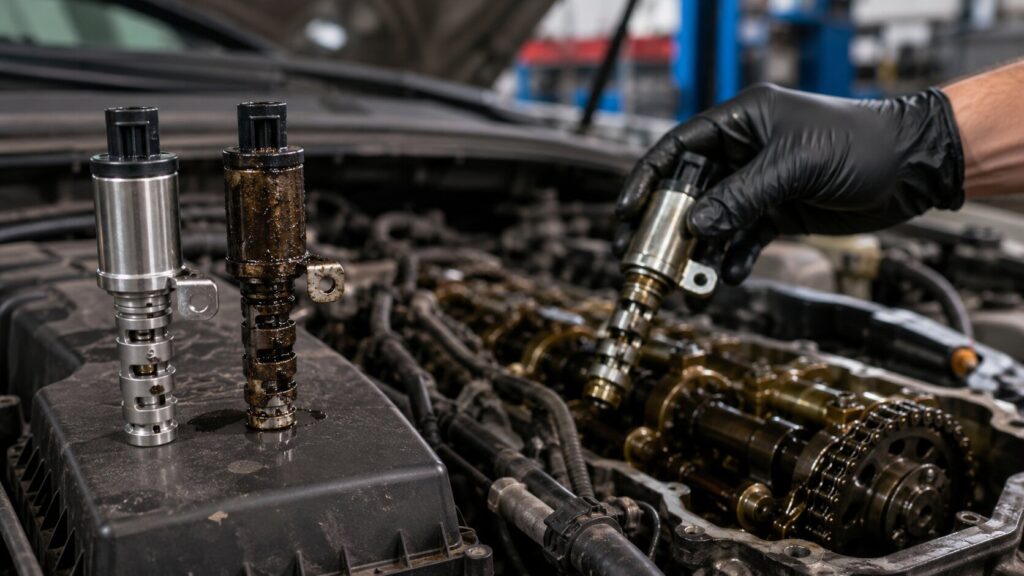
Ford 3.5L EcoBoost engines frequently suffer from Variable Camshaft Timing (VCT) solenoid failures during Minnesota seasonal transitions. Drivers on Shoreline Drive commonly encounter timing issues and engine stalling as the local shift from summer humidity to freezing fall air stresses the VCT system.
Hydraulic Actuation and Solenoid Mechanical Failure
When the oil viscosity changes due to the Minnesota climate or becomes contaminated with carbon deposits, the internal plunger within the solenoid begins to lag. This lag prevents the camshaft from reaching the commanded timing advance. Instead of a smooth transition, the engine suffers from timing drift. The mechanical result is a misfire event as the intake and exhaust valves overlap at the incorrect crankshaft degree.
Varnish accumulation binds the solenoid spool, pinning the oil passage in a fixed position and forcing a permanent deviation in camshaft timing. This degradation is often hidden until the engine oil reaches operating temperature. As the oil thins under high heat, the pressure drop across a clogged solenoid screen becomes more pronounced. The solenoid fails to hold its position, causing the camshaft to oscillate wildly. This oscillation is what you feel as a rhythmic shudder or a hesitation during steady-state acceleration.
Advanced Diagnostic Process for Timing Irregularities
I diagnose these issues by moving past simple OBDII fault codes. A generic code reader might suggest a sensor replacement, but the underlying issue is often oil pressure regulation or debris in the oil control valve.
- Verify base engine oil pressure using a mechanical gauge at operating temperature.
- Connect an oscilloscope to the VCT solenoid circuit to capture the Pulse Width Modulation (PWM) signal.
- Analyze the waveform for irregularities that indicate an electrical short or an internal mechanical bind.
- Monitor live data streams for Desired Camshaft Position versus Actual Camshaft Position.
- Inspect the VCT filter screens for metallic debris or sludge accumulation.
If the Desired vs. Actual Camshaft Position delta exceeds 5° for more than 2 seconds, the VCT solenoid is failing and cannot be “cleaned”—it is ready for replacement to prevent timing chain stress.
Thermal Stress and Environmental Impacts on Timing
Spring Park commuters face unique challenges. During the transition from summer to fall, engine oil undergoes significant thermal stress. High summer temperatures break down additive packages in synthetic oil, while sudden fall cold starts increase oil density. This density change forces the VCT solenoids to work harder against thicker fluid.
Skipping regular oil service reduces hydraulic responsiveness, leaving the solenoid spool too slow to execute the timing adjustments commanded by the engine control unit. This condition creates a performance gap. The engine stumbles because it cannot accurately predict valve overlap. I see this most often in vehicles that sit in local traffic where prolonged idling with varying engine temperatures accelerates the buildup of sludge inside the delicate VCT oil galleries.
Locally, the humidity levels near the shoreline also contribute to moisture condensation within the crankcase. This moisture emulsifies with the oil, creating a light sludge that specifically targets the fine mesh screens found on the VCT solenoids. Once these screens are partially obstructed, the hydraulic response time drops. The result is an engine that feels sluggish one day and relatively normal the next, depending on how much sludge has migrated into the valve body.
Preventing Catastrophic Timing Chain Damage
A flashing Check Engine Light (CEL) while experiencing hesitation is a precursor to catastrophic timing chain stretch. The VCT system relies on clean oil pressure to maintain chain tension. When the system malfunctions, the chain experiences oscillating loads that exceed design specifications.
This eventually causes the chain guide to shatter, depositing plastic debris into the oil pickup tube. The debris then starves the entire oiling system, creating a vicious cycle of further degradation. Do not wait until the engine requires a complete timing chain overhaul. My shop utilizes factory-level diagnostic tools to isolate VCT failures before they destroy internal engine components.
For precise timing calibration and expert inspection of your Ford engine, reach out to Certified Auto Repair at 4700 Shoreline Drive, Spring Park, MN 55384, or call (952) 471-0471 to schedule your service.
Frequently Asked Questions
What causes my Ford to idle roughly after a cold start?
Increased oil viscosity and VCT solenoid lag. During cold mornings in Spring Park, engine oil thickens, making it difficult for the VCT solenoids to adjust camshaft timing quickly. The engine will idle roughly or hesitate until the oil reaches the proper operating temperature and flows freely through the solenoid ports.
Can I just clean the VCT solenoid instead of replacing it?
Yes, in specific cases. If the VCT failure is caused solely by superficial sludge or debris blocking the fine mesh screens, cleaning the component can restore proper hydraulic function. However, if the solenoid displays internal electrical coil resistance or physical wear on the spool valve, cleaning will not provide a permanent fix, and replacement is required.
How often should I change my oil to protect the VCT system?
Every 5,000 miles. I recommend this interval specifically for Minnesota drivers to prevent the accumulation of varnish and moisture-based sludge. Maintaining fresh, high-quality synthetic oil is the single most effective way to keep VCT oil galleries clear and ensure the solenoid responds instantly to timing commands.
Will driving with a VCT fault damage my engine?
Yes. A malfunctioning VCT system prevents the engine from managing camshaft timing, which forces the hydraulic timing chain tensioners to operate under erratic, oscillating loads. This stress leads to premature timing chain stretch, guide failure, and the potential for plastic debris to clog the oil pickup tube, starving the engine of oil.