Jeep 3.6L Pentastar engines commonly suffer from oil pressure sensor failures where oil leaks into the electrical connector, causing erratic readings. Expert diagnostics require manual pressure verification; this process filters out phantom sensor codes to confirm if the lubrication system is truly failing.
Are you seeing a low oil pressure warning light on your dashboard during your morning commute along the humid Shoreline Drive? You are likely dealing with a failing oil pressure sending unit, not a blown engine. In this climate, the rapid freeze-thaw cycles near Lake Minnetonka accelerate plastic housing fatigue in these sensors, causing them to send phantom low pressure signals to your Jeep computer.
Anatomy of the Oil Pressure Sensor Failure
The oil pressure sending unit on these engines relies on a thin internal diaphragm to convert hydraulic oil pressure into an electrical signal sent to the Powertrain Control Module. Under normal operating conditions, the unit maintains a specific voltage drop relative to the oil column pressure. However, the internal plastic housing often develops hairline fractures, allowing oil to bypass the seal and saturate the electrical connector pins.
Dielectric Breakdown and Signal Corruption
Once oil reaches the internal circuitry, the sensor experiences signal drift or complete grounding. Locally, the intense humidity of the Spring Park area exacerbates this issue. As moisture enters the compromised sensor housing and mixes with leaking oil, the resistance values fluctuate wildly. This creates a ghost signal that the vehicle computer interprets as a critical drop in pressure. The sensor isn’t actually detecting low oil pressure; it’s sending a false signal caused by an internal electrical short.
Systematic Verification of Oil Pressure Integrity
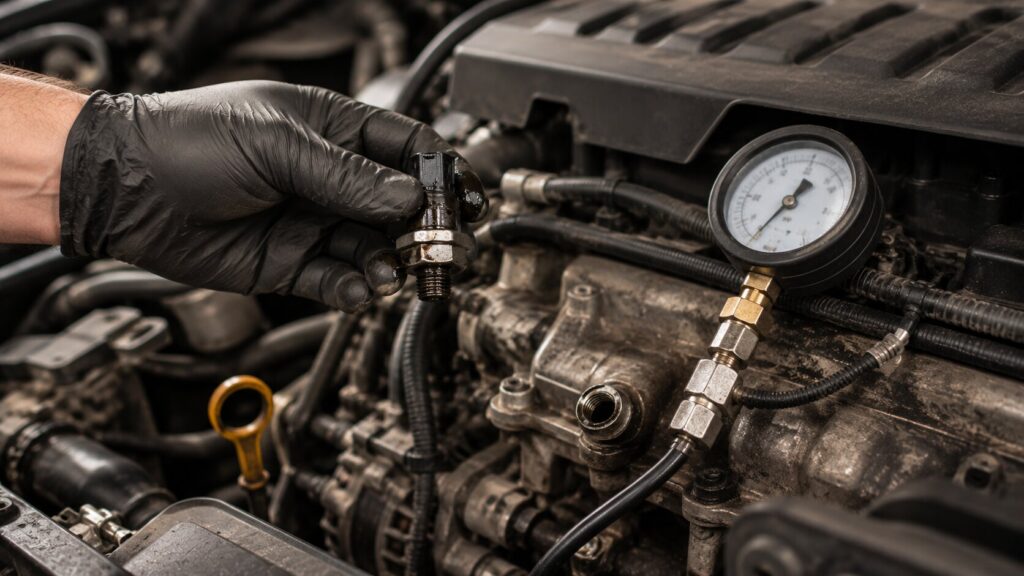
I treat every low oil pressure warning as a genuine emergency until physical verification proves otherwise. My diagnostic process separates the sensor from the engine, allowing me to verify if you just need a simple part replacement or if there is a deeper mechanical issue.
- Verify oil level and inspect the oil filter housing for external leaks or signs of heat soaking.
- Remove the faulty sensor located near the oil filter adapter.
- Install a calibrated mechanical gauge directly into the engine block port.
- Run the engine to full operating temperature.
- Compare mechanical gauge readings against the factory specifications of 10 PSI at idle and 30 to 60 PSI at 3000 RPM.
If the mechanical gauge reads below 6 PSI at hot idle or fails to climb to 25 PSI by 2,000 RPM, stop the engine immediately. Anything above these numbers with an erratic dash light confirms a sensor electrical failure, not an oil pump collapse.
Advanced Mechanical Inspection Points
Beyond the sensor, I evaluate the oil filter housing for secondary failure signatures. The Pentastar engine utilizes a plastic oil filter housing that is prone to warping. If this housing warps, it compromises the sealing surface, leading to oil pressure loss that is independent of the sensor. Checking the oil pickup screen for debris, often plastic remnants from the housing, is a step I never skip during a deep diagnostic investigation.
Risks of Delayed Sensor Replacement
Ignoring a flickering oil pressure gauge is a direct path to total engine failure. While the sensor is often the culprit, a true failure of the oil pump or a clogged pickup screen will starve the valvetrain of lubrication within seconds of high-load operation. If your Jeep displays erratic readings, do not drive the vehicle under high load or at highway speeds.
Regional Environmental Impact on Components
In this region, the freeze-thaw cycle stresses brittle plastics and seals. When the temperature shifts rapidly, the thermal expansion and contraction of the sensor housing increase the likelihood of the hairline fractures that lead to oil intrusion. Extreme temperature swings in our region act like a stress test for your vehicle, which is why early detection of sensor failures is key to keeping your Jeep on the road longer.
To mitigate these environmental stressors, I recommend checking sensor connections during every oil change. A quick inspection for oil staining on the wire harness can identify a leaking sensor before it reaches the flickering light stage.
Commercial Action for Local Owners
I focus on identifying these failures before the sensor shorts out entirely. If you are noticing inconsistent readings during your commute along Shoreline Drive, bring your vehicle in for a definitive mechanical pressure test. Waiting for the light to stay solid usually results in catastrophic bearing wear that could have been avoided with a simple sensor replacement.
Schedule your diagnostic appointment at Certified Auto Repair, located at 4700 Shoreline Drive, Spring Park, MN 55384, or call us today to secure your spot.
Frequently Asked Questions
Is a flickering oil pressure light always a sign of engine failure?
No. A flickering oil pressure light is often caused by a faulty electrical sensor, not mechanical engine damage. However, you must verify the internal pressure with a mechanical gauge immediately to rule out a failing oil pump.
Can I continue driving if the low oil pressure light comes on?
No, you should pull over and shut off the engine as soon as it is safe to do so. Operating an engine with true low oil pressure will destroy the internal components in minutes.
Does high humidity in Minnesota affect these sensors?
Yes, moisture intrusion into the sensor connector often accelerates the corrosion of the electrical pins. This creates the erratic signal behavior commonly seen in this specific Jeep engine platform.
Will replacing the sensor fix the warning light permanently?
Yes, if the diagnostic test confirms that the engine oil pressure is within manufacturer specifications. Replacing the sensor restores the correct signal flow to the computer and eliminates the false alarms.