Dealing with multiple sensor codes and a check engine light can feel overwhelming, but it rarely means several parts failed at once. Usually, a shared electrical wire or computer network issue triggers the whole chain reaction. Professional diagnostic testing pinpoints the exact electrical root cause, protecting your vehicle from unnecessary part replacements.
Why Your Dashboard Suddenly Looks Like a Christmas Tree
When cars roll into my bay with a dashboard lit up like a Christmas tree after a heavy Minnetonka Boulevard salt application, drivers always panic. Heavy road salt and sub-zero Minnesota winters regularly sneak into unsealed wiring plugs under the hood, triggering a sudden chain reaction of four or five distinct warning codes at once. When a handful of unrelated codes pop up together, your car usually does not have four different mechanical breakdowns. Instead, it almost always points to a single electrical problem shared by those systems.
On modern engines, a single point of failure on a main power supply line instantly mirrors itself across multiple computer monitors. My scanner doesn’t know your wiring harness is wrecked by salt water; it only reads the resulting power drop as multiple sensors failing all at once.
How One Bad Connection Triggers Multiple Codes
Modern car engines rely on complex sensor networks that need steady, exact electrical power to work right. These parts run on a steady 5-volt reference line sent straight from the main engine computer. Normally, individual sensors change this return signal voltage based on physical pressure, temperature, or position, sending back precise digital data.
Salty winter brine destroys this steady baseline. When road salt and moisture bridge unsealed plug pins near the front wheel wells, micro-leaks of electricity happen across different metals. This causes corrosion that pits the pins and changes internal electrical resistance.
Voltage drops across the damaged plug, starving downstream sensors of the power they need. The computer reads these weak feedback signals as total failures across the manifold pressure sensor, throttle position sensor, and camshaft sensor all at the same time. When this happens, rushing out to replace the MAP sensor or throttle body is a costly mistake. The sensors themselves are innocent. The real issue is the damaged wiring feeding them power.
Understanding Your Car’s Digital Network (The CAN Bus)
Modern cars no longer use miles of separate wires for every switch and gauge. Instead, they use a digital communication highway called the Controller Area Network, or CAN bus. This system lets various onboard computers talk to each other rapidly over a twisted pair of copper wires.
When a single electrical fault or communication glitch disrupts this digital highway, multiple modules lose connection at once. Knowing how these computers interact helps me trace complex faults without tearing apart your entire interior wiring harness.
- The Engine Control Module manages fuel injection and ignition timing while broadcasting real-time data packets across the network.
- The Transmission Control Module relies on those same packets to calculate shift points and manage torque converter lockup.
- The Anti-lock Brake System module constantly shares wheel speed data, so a corrupted signal on one bus can instantly turn off traction control.
- Gateway modules translate between different network speeds, and a voltage drop here can cause every connected system to log communication error codes.
If the high-speed computer network experiences resistance issues due to water leaks or frayed insulation, data packets drop instantly. When packets drop, modules log error codes saying they lost connection with the engine computer, even though the computers themselves are completely healthy.
How We Find the Real Electrical Root Cause
Tracking down phantom codes means looking for the common electrical denominator instead of replacing parts unthinkingly. When cars enter the bay with a wall of trouble codes, avoiding shotgun parts replacement is our top priority.
Our diagnostic approach isolates the core issue through targeted electrical testing:
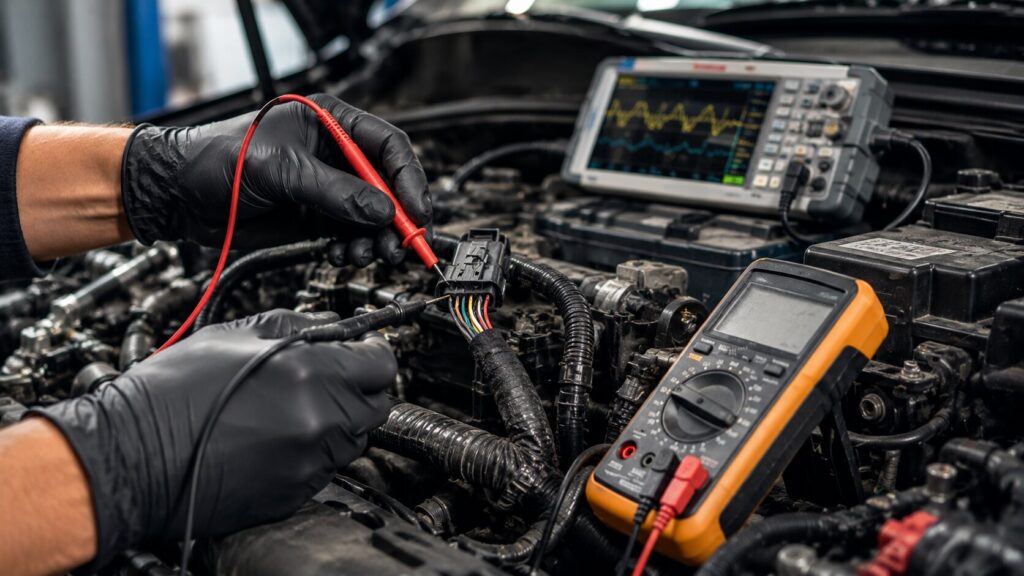
- Live Voltage Drop Testing: We connect a digital multimeter and an advanced oscilloscope directly to the main 5-volt power wire at the sensor harness closest to the firewall, monitoring voltage stability under load.
- Baseline Verification: In a healthy system, we expect a steady reading between 4.95V and 5.05V. Any drop below 4.85V immediately confirms a power supply fault.
- Branch Circuit Testing: We unplug individual sensors one by one until the master reference voltage snaps back to normal, pinpointing the shorted component.
- Chassis Ground Inspection: We check intermediate ground points (like ground G102 near the front frame rail) for green corrosion and high resistance.
- Data Integrity Probing: Finally, we probe the communication lines to check for waveform distortion caused by shorted module shielding.
Diagnostic Verdict: Multi-code cascades driven by road salt are power-supply failures, not sensor component failures. Always test the 5V reference rail and inspect grounds before authorizing any parts replacement.
Protecting Your Vehicle From Costly Secondary Damage
Leaving a multi-code cascade alone allows localized wiring shorts to heat-stress wire insulation, risking permanent engine computer failure and a massive complete harness replacement. While traditional dealership networks often default to long wait times and expensive subassembly swaps, my independent shop focuses on isolating the exact electrical fault to fix the root cause.
If your dashboard is currently lighting up, see me at Certified Auto Repair, located at 4700 Shoreline Drive, Spring Park, MN 55384, for precision electrical diagnostics.
Frequently Asked Questions
Why do multiple engine codes appear at the same time?
Multiple engine codes appear simultaneously because modern vehicle sensors share a single stabilized 5-volt power circuit managed by the engine computer. When road salt corrosion bridges a shared ground terminal, the reference voltage drops across the entire network, causing the engine computer to log multiple sensor failures at once.
Can a weak car battery cause multiple sensor codes?
Yes. A failing battery with high internal resistance can drop system voltage below 9.5 volts during cranking, forcing control modules to reset and log false communication error codes.
Is it safe to drive with multiple check engine codes active?
No. Multiple active fault codes frequently trigger a fail-safe limp mode that restricts throttle response unexpectedly while dumping raw fuel that can permanently ruin catalytic converters.
How do mechanics find the root cause of electrical faults?
Technicians isolate the core issue by connecting an advanced oscilloscope to the primary 5-volt power wire to catch waveform distortion and voltage drops under real-world load conditions.