Minnesota winter conditions and road salt frequently damage Toyota ABS wheel speed sensors, triggering dashboard warning lights. Corroded wiring and frozen slush degrade sensor signals, disabling traction control. Professional diagnostics use OBD2 scanners and oscilloscopes to pinpoint circuit faults, followed by zero-point calibration during sensor replacement to restore full vehicle safety systems.
Minnesota road salt and constant sub-zero freeze-thaw cycles on Shoreline Drive are brutal on your vehicle. If you drive a Toyota, these harsh winters often cause premature failure of your ABS wheel speed sensors. When these sensors break, your dashboard lights up with warnings for the ABS, traction control, and stability system. Local salt brine destroys these seals years ahead of the OEM service interval.
How Toyota Wheel Speed Sensors Work
Modern Toyota vehicles use Hall effect sensors at each wheel. These magnetic devices monitor a notched metal “tone ring” that spins with the wheel. As each notch passes, the sensor generates a pulse in an electrical signal. The vehicle’s computer counts these pulses to determine individual wheel speed.
By comparing data from all four wheels, the computer detects slipping during acceleration or locking during braking. It then modulates brake pressure to the specific wheel to maintain traction. The computer relies on a steady electrical signal. If the connection drops, it cuts the ABS and stability systems to keep the brakes from locking up unpredictably.
Why Minnesota Winters Destroy Sensors
The culprit is a combination of moisture and aggressive road chemicals. We use heavy sodium chloride and magnesium chloride mixtures on Minnesota roads to combat ice. When this conductive, corrosive brine splashes into the wheel well, it penetrates aged, brittle rubber grommets and micro-cracked plastic seals.
Once moisture bridges the internal wiring pins, galvanic corrosion degrades the fine copper windings. The physical stress of winter accelerates this: as slush packs into the wheel knuckle and freezes overnight, expanding ice exerts mechanical shear force on the sensor body. This can snap internal solder joints or crack the casing. Once the connection is severed, the signal drops to zero and the dashboard alerts trigger.
Identifying the Symptoms of a Failed Sensor
You will know the sensor has failed when your instrument cluster triggers multiple warning lights. If the computer can’t verify how fast your wheels are spinning, it kills both the ABS and traction control since they both rely on that sensor data.
You will notice a change in vehicle handling. On icy roads near Lake Minnetonka, a failed sensor means your wheels are more likely to lock up during panic stops, significantly increasing stopping distance. While you can still stop the car, you lose the digital safety systems designed to keep the vehicle steady when you steer.
Professional Diagnostic Workflow for Sensor Issues
When you bring your Toyota into the shop with these lights, I follow a strict diagnostic process to isolate the failure rather than guessing:
- Scan for Diagnostic Trouble Codes: I use an OBD2 scan tool to pull specific fault codes. While these codes tell us which wheel has the issue, the sensor itself might be fine; the problem often hides in damaged wiring, a corroded connection, or a blocked tone ring.
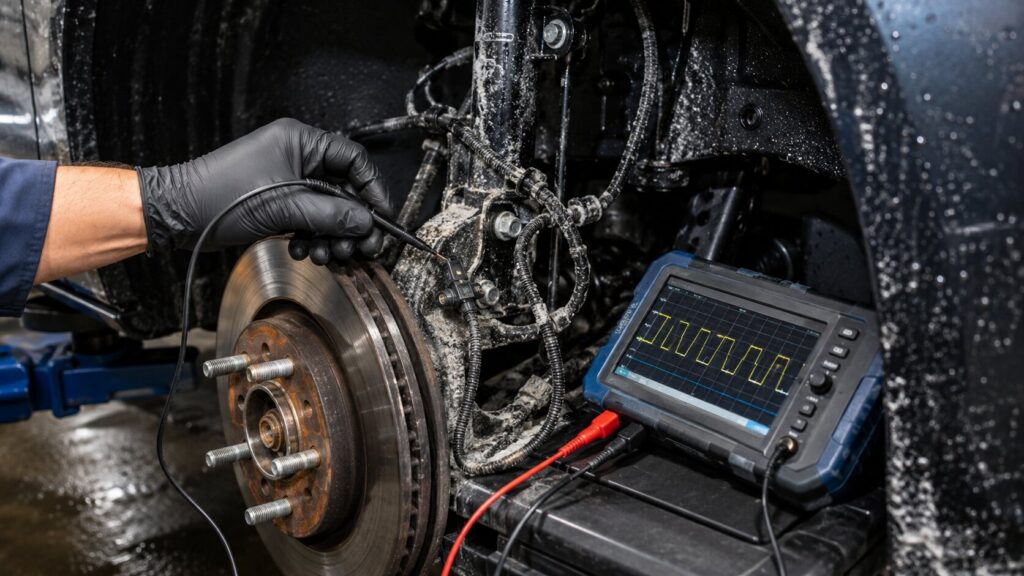
- Inspect the Signal with an Oscilloscope: I connect a digital oscilloscope to the sensor wiring to monitor the square-wave signal during wheel rotation. A noisy or intermittent signal indicates high resistance in the circuit.
- Perform a Harness Wiggle Test: I inspect the wiring pigtails and flex the harness near the strut mount—where suspension travel causes the most stress—using live data monitoring to pinpoint exactly where the signal interruption occurs.
Technician’s Note: If your scan tool shows a ‘Low Input’ code, don’t buy the sensor yet. 90% of the time, the issue is green, crusty corrosion inside the wheel-well connector—not the sensor itself. I clean the pins with contact cleaner first to save you the cost of the part.
Environmental Maintenance and Prevention
While you cannot control the harsh road treatments around Lake Minnetonka, you can proactively stop this brine from destroying your electrical connections. If you notice your ABS and traction lights flickering intermittently over bumps, addressing the compromised connector immediately prevents permanent internal corrosion. Regularly flushing your undercarriage with high-pressure water physically blasts away corrosive road salt before it can degrade your delicate rubber seals.
If you frequently commute on heavily treated routes, requesting a visual wheel-well inspection during routine service intervals is highly recommended. Technicians can easily spot early signs of wire chafing or cracked grommets before they develop into complete electrical failures. Keeping these critical wiring harnesses clean and properly secured is your best defense against premature electronic stability malfunctions.
Why You Should Choose Independent Specialists
We prioritize isolating the exact electrical failure point rather than defaulting to full harness replacements. When a new sensor is necessary, our technicians utilize factory-level scan tools to perform a mandatory zero-point calibration, baselining the computer data to prevent false traction control activations on slippery roads.
If your dashboard lights are on, or your traction control feels erratic, bring the vehicle to us at Certified Auto Repair, located at 4700 Shoreline Drive, Spring Park, MN 55384. Stop by for an inspection so we can get your safety systems back online before the next big snowstorm hits.
Frequently Asked Questions
Is a sudden ABS and traction control warning light on a Toyota always caused by a bad wheel speed sensor?
No. Don’t just blame the sensor; these lights also pop up due to damaged wiring harnesses, corroded electrical plugs, dirty tone rings, or wheel bearings that push the sensor out of range. We run a diagnostic scan to identify the specific component failing before attempting repairs.
Can I safely drive my Toyota through Minnesota snowstorms with an active ABS warning light?
Yes, but do so with extreme caution. Your standard hydraulic brakes will function, but the anti-lock braking system and electronic stability control will be completely disabled. Your wheels will lock up if you slam on the brakes, leaving you without electronic help to keep the car stable on slippery patches.
Will a simple car wash remove the road salt causing my intermittent sensor faults?
No. A car wash will not fix a sensor that has already failed. Once winter brine penetrates the internal housing and initiates corrosion on the internal copper pins, the damage is permanent. Washing your undercarriage is an excellent preventative measure, but once the electrical circuit breaks, the component must be replaced.
Does replacing a rear Toyota wheel speed sensor require reprogramming the vehicle computer?
Yes. Modern Toyota stability control modules require a zero-point calibration reset after a sensor replacement to ensure the computer correctly interprets the signal from the new part. Failing to perform this reset results in inaccurate data, causing your traction control system to activate unnecessarily while driving.