Experiencing engine hesitation or rough idling on your daily commute often points to underlying check engine light symptoms and causes. Local temperature shifts and moisture frequently compromise sensitive components like mass airflow and oxygen sensors. Catching these electrical and mechanical failures early protects your engine and prevents costly converter damage.
Navigating Dashboard Warnings Along Lake Minnetonka
Stuck idling on County Road 15 during a humid Lake Minnetonka freeze-thaw cycle, a sudden check engine light combined with engine hesitation means your powertrain control module is dumping raw fuel into a flooded catalytic converter. When thermal shock or severe moisture ingress compromises critical monitoring loops, your vehicle enters a protective default mapping state. I see this exact scenario hit local commuters every season when the weather shifts rapidly from damp mornings to freezing afternoons along Shoreline Drive.
Understanding Why Sensors Fail Under Local Conditions
Operating under normal daily driving conditions, the Mass Airflow (MAF) sensor exposes a microscopic platinum wire to incoming air, maintaining a precise electronic current to measure density and temperature. Heavy moisture, combined with road salt aerosolized by local traffic, pushes this delicate wire past its thermal limit.
At the moment of failure, the physical reaction can involve thermal shock fracturing, oil-varnish baking onto the sensor filament, or internal solder-joint separation caused by continuous vibration and extreme temperature swings. When the heated element can no longer accurately calculate air mass density, the engine control computer relies on backup lookup tables, instantly destroying your fuel economy and throwing your air-fuel ratio completely out of spec.
Mapping Core Sensor Failures
- Oxygen Sensors: Positioned in the exhaust stream, these track unburned oxygen levels. When internal heater circuits fracture, signal switching drops below the required 0.1V to 0.9V sweep rate, forcing the PCM into rich open-loop operation.
- Mass Airflow Sensors: These measure incoming air mass. Salt residue and oil contamination cause sensor drift, leading to severe off-idle hesitation and lean misfires.
- Coolant Temperature Sensors: These regulate thermal feedback. An out-of-spec thermistor tricks the PCM into remaining in cold-start enrichment indefinitely, fouling spark plugs.
- Throttle Position Sensors: These track accelerator pedal angle. Microscopic wear on internal potentiometer tracks creates signal dead spots during light acceleration affecting acceleration response.
How We Diagnose Sensor Failures Accurately
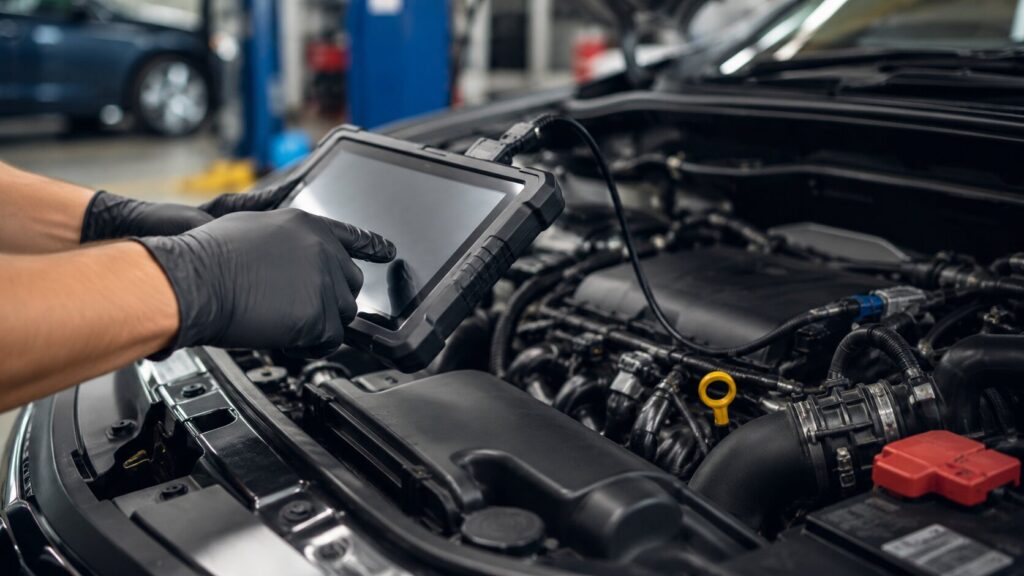
Catching these issues early requires bypassing generic code reading and diving straight into live data streams using advanced diagnostic protocols in the bay:
- Live Data Stream Analysis: Connecting a bidirectional scan tool to observe MAF gram-per-second readings at a stabilized idle. A baseline requires roughly 1g/s per liter of displacement; deviations indicate contamination or vacuum leaks.
- Borescope Inspection: Visually examining the sensor filament under high magnification to spot microscopic pitting or baked-on blow-by varnish.
- Circuit Testing: Backprobing the signal return wire with a digital multimeter while flexing the harness to expose voltage drops exceeding 0.5V or pin corrosion caused by sensor wiring failures.
- Fuel Trim Evaluation: Analyzing short-term and long-term fuel trims. Combined trims exceeding +10% under steady load confirm unmeasured air entering the engine.
Preventing Secondary Damage from Ignored Warnings
Failing to address a minor sensor glitch triggers a cascade of expensive mechanical failures. When an oxygen sensor or mass airflow meter degrades, it forces combustion chambers to run either too lean or excessively rich. Over time, unburned raw fuel washes past piston rings into the oil pan or ignites inside the catalytic converter honeycomb, melting the internal substrate and turning a minor component repair into a major exhaust overhaul.
Protecting Your Engine Performance Before Minor Issues Grow
Ignoring early warning signs can turn a minor sensor cleaning into catastrophic component failure, including ruined spark plugs, oil dilution, and melted catalytic converters. Dealership service networks often force long wait times and expensive complete harness replacements when precise component-level troubleshooting solves the root issue faster.
Most sensor problems are manageable when an experienced technician catches them early and knows how to analyze raw PID data streams. If your dashboard is throwing codes and your vehicle is surging on your daily commute, visit us today at Certified Auto Repair located at 4700 Shoreline Drive, Spring Park, MN 55384 for professional diagnostic testing.
Frequently Asked Questions
Can I keep driving with an intermittent check engine light flashing on my dashboard?
No. A solid check engine light allows short-term driving with caution, but a flashing light indicates active engine misfires that can rapidly destroy catalytic converters. Pull over safely as soon as traffic permits to prevent permanent internal engine damage.
Why does my car idle rougher on humid mornings than during dry afternoons?
Atmospheric moisture coats dirty sensor elements and distorts thermal conductivity readings. High humidity mixes with dust inside the intake tract, tricking the computer into delivering an incorrect air-fuel mixture until the engine compartment fully heat-soaks.
Will cleaning a dirty sensor fix the issue permanently?
No, cleaning only fixes surface contamination. While electrical contact cleaner removes light oil residue, internal micro-fractures, degraded heater circuits, and thermal fatigue require total component replacement.
How do mechanics know if the problem is the sensor or the wiring harness?
Technicians perform dynamic voltage drop tests while manipulating the harness. If signal voltage fluctuates on a digital multimeter during physical harness movement, pin tension loss or wiring corrosion is at fault, not the sensor.