Predictive vehicle maintenance diagnostics identifies component fatigue before a check engine light triggers. By tracking live sensor data, voltage trends, and fuel trims via factory-level equipment, technicians detect sluggish sensors and minor faults early. Routine diagnostic monitoring prevents sudden breakdowns, improves fuel economy, and protects expensive engine parts from costly secondary damage.
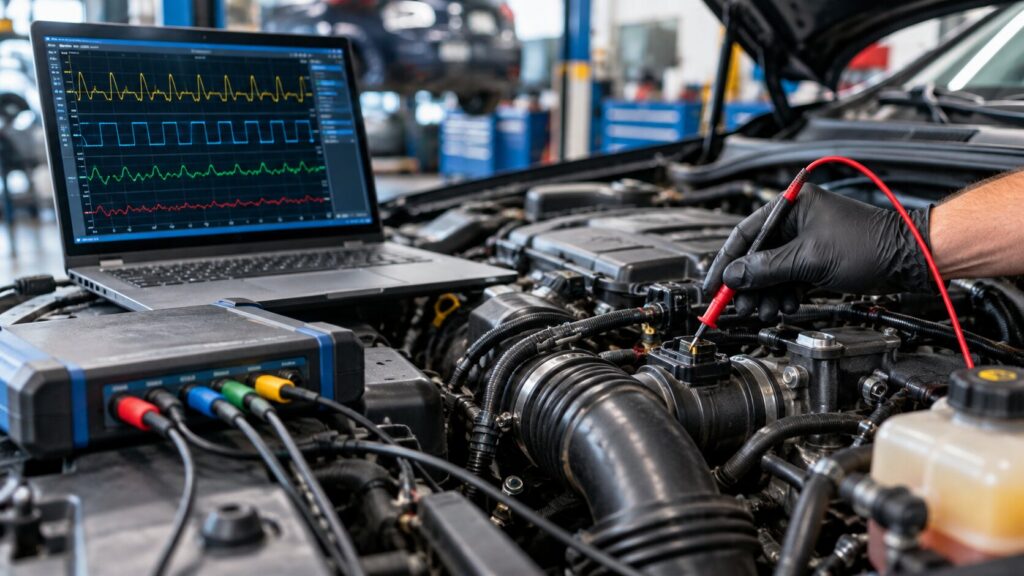
When your check engine light illuminates, your car’s ECU has already logged a hard fault threshold violation. Using predictive diagnostics on our bay computers, I monitor live PID streams, micro-voltage shifts, and waveform signal degradation long before a total component failure leaves you stranded along Highway 15 or idling roughly on Shoreline Drive.
Moving Beyond Reactive Repair Work
Waiting for a trouble code to pop usually means secondary engine damage has already started. Monitoring live sensor response times under heavy engine load catches drift before it ruins expensive catalytic converters or fouls turbochargers. Catching a lagging Mass Air Flow (MAF) sensor early stops unburnt fuel from loading up exhaust components during short winter trips around Lake Minnetonka.
How Vehicle Diagnostic Data Reveals Hidden Problems
Modern Controller Area Network (CAN bus) platforms constantly adjust timing, fuel injection, and valve overlap based on real-time sensor feedback loops. Sensors rarely fail overnight; they slow down, drift out of calibration, or drop transient voltage spikes long before setting a permanent fault code.
Tracking these specific data metrics allows our diagnostic technicians to see exactly how hard the engine computer is working to compensate for developing mechanical wear:
- Fuel Trim Tracking: Short-term and long-term fuel trims (STFT/LTFT) show how hard the engine computer works to maintain stoichiometry (14.7:1 air-fuel ratio). A continuous +12% to +18% fuel trim trend at idle during Minnesota sub-zero cold starts typically points to unmetered air pulling past a hardened intake gasket—not a bad sensor.
- Voltage Response Testing: Healthy zirconia oxygen sensors switch rapidly between 0.1V and 0.9V at a frequency of 1Hz to 3Hz. An aging sensor drops switching frequency down to 0.2Hz, slowing throttle response long before an official P0133 code latches.
- Thermal Cycle Analysis: I run high-density logging streams during engine heat-soak cycles. Micro-cracks in internal sensor substrate boards expand under heat, causing signal dropouts that vanish the moment the engine bay cools off.
Identifying Common Sensor Failures Early
Components mounted low in the engine bay take an absolute beating from severe Lake Minnetonka winter humidity, heavy road salt brine, and extreme thermal swings. Predictive diagnostics allows us to catch these specific component failures before they escalate:
- Mass Air Flow (MAF) Sensors: Road salt micro-crust and oil vapor bake onto the hot-wire element inside the intake tube. The sensor underreports incoming air density, leading to lean-burn conditions and cold-start hesitation..
- Coolant Temperature Sensors (ECT): Thermistor internal resistance drifts higher over time. The ECU falsely assumes the engine is constantly in warm-up mode, dumping extra fuel into the cylinders, fouling spark plugs, and washing down cylinder walls.
- Wheel Speed Sensors: Mounted directly inside the wheel hub assemblies, these hall-effect sensors get pelted with winter road salt brine along County Road 15. Signal drops generate erratic ABS activation during low-speed stopping before throwing a dash warning.
- Camshaft and Crankshaft Position Sensors: These hall sensors map exact engine timing. Sluggish pulse signal edges cause long cranking times or sudden engine stalls when coming to a stop at local light intersections.
The Role of Advanced Diagnostic Tools
Reading diagnostic codes with a basic handheld reader only gives a snapshot of a past failure. To run true predictive checks, I back-probe signal lines and attach a 4-channel PicoScope 4425A digital storage oscilloscope alongside BMW ISTA-D factory software to analyze raw analog voltage signals in real time.
When the PicoScope trace reveals ground-line voltage spikes, rounded square waves on Hall sensors, or flat spots in an analog signal sweep, I know the sensor’s internal substrate is breaking down. Analyzing these live physical signals allows me to determine if a part simply needs terminal tension repair, cleaning, or preventive replacement.
Schedule a Factory-Level Diagnostic in Spring Park
Don’t wait for a glowing dash light to leave you stranded in freezing weather or cause severe secondary engine damage. If you’re noticing sluggish acceleration, rough cold idling, or dropping fuel economy, bring your vehicle in for a full PicoScope waveform analysis and live PID logging.
Visit our shop at Certified Auto Repair, 4700 Shoreline Drive, Spring Park, MN 55384, or call us directly at (952) 471-0471 to schedule your predictive diagnostic health check today
Frequently Asked Questions
Can a car sensor fail without turning on the check engine light?
Yes. A sensor can operate 10% to 15% outside its optimal operating spec without crossing the factory threshold required to set a hard trouble code.
How often should my vehicle undergo diagnostic data monitoring?
We recommend running a live data stream diagnostic check at least once a year or every 10,000 miles, easily paired during your routine factory maintenance intervals.
Will predictive vehicle maintenance diagnostics improve gas mileage?
Yes. Restoring correct sensor response times restores optimal air-to-fuel ratios, typically improving fuel economy by 10% to 15%.
Do predictive vehicle maintenance diagnostics work on older cars?
Yes. Any vehicle using an OBD-II interface (1996 and newer) provides live fuel trims, coolant temperatures, and O2 sensor switching rates needed for predictive analysis.