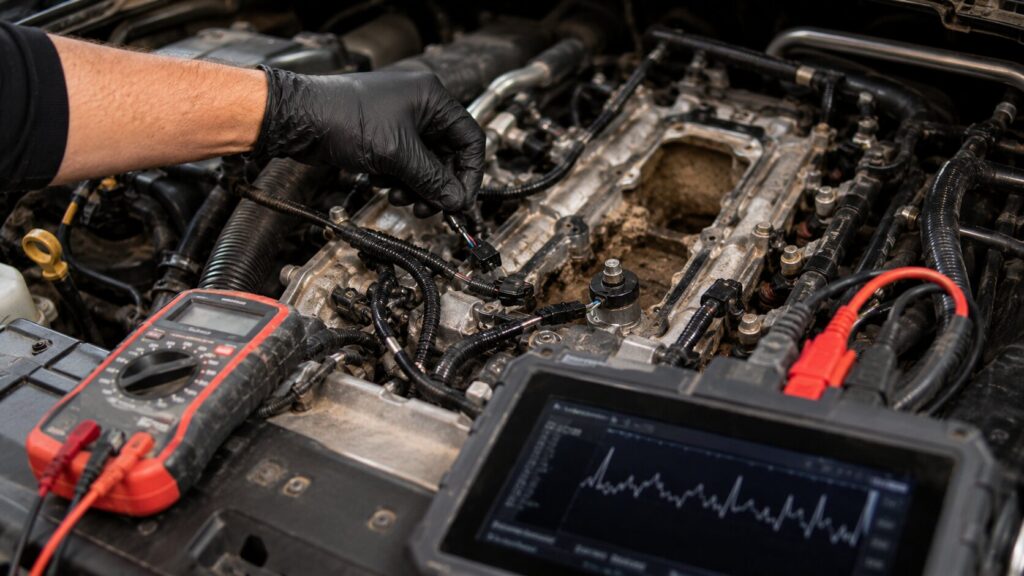
Chevy Silverado knock sensor failure symptoms include a persistent check engine light, poor acceleration, and increased fuel consumption. In Minnesota, road salt and condensation cause corrosion in the engine valley, damaging the sub-harness and sensors. Confirm the engine management system maintains accurate timing by measuring circuit resistance and voltage drops during load.
Hesitation on cold mornings often indicates more than just a sensor glitch. Our local climate triggers knock sensor failure through road salt, extreme temperature shifts, and persistent moisture.
| Metric | Detail |
| Primary Symptom | Check Engine Light with P0327 or P0332 codes |
| Target Component | Knock sensor and sub-harness |
| Specialized Tooling | Digital multimeter and scan tool with live data logging |
| Local Stressor | Calcium chloride road salt and thermal shock |
| High Risk Profile | 2000-2006 Silverado models with over 150k miles |
Why Silverado Engine Power Drops in Cold Weather
Cold starts in Spring Park or Minnetonka put massive thermal stress on older trucks. The cast-iron engine block heats up rapidly while the ambient winter air remains well below zero. This temperature differential causes moisture to condense inside the engine valley, directly beneath the intake manifold.
The engine control module detects the resulting sensor fault and enters a timing retardation loop. This defensive programming reduces spark advance, causing sluggish performance. When accelerating onto a highway or pulling a load, the truck lacks necessary low-end torque. The vehicle works harder, consuming more fuel while delivering less power.
The Physics of Salt Corrosion Under Your Intake Manifold
The knock sensors rely on a piezoelectric crystal to convert engine vibrations into electrical signals. Under normal conditions, this crystal generates low AC voltage that fluctuates based on combustion frequency. The engine control module uses this signal to optimize timing for power and efficiency.
Liquid calcium chloride on winter roads introduces a corrosive element to this environment. Salt-laden spray enters the engine bay and seeps under hardened, high-mileage intake manifold gaskets. Once this saline solution reaches the cast-iron valley cover, galvanic corrosion begins.
Salt water attacks the sensor housing and the copper pins inside the electrical connector. Terminals become pitted and corroded, creating a high-resistance path. Signal voltage drops, falling out of spec. The computer receives an erratic, low-voltage input. Thermal heat-soaking and chemical corrosion eventually cause the internal crystal to delaminate, rendering the sensor blind to engine vibrations.
Identifying Chevy Silverado Knock Sensor Failure Symptoms
Common Chevy Silverado knock sensor failure symptoms include a persistent check engine light with diagnostic trouble codes P0327 or P0332. These codes signify low input voltage from the front or rear sensors.
Beyond warning lights, drivers notice a severe drop in throttle response. Hesitance is obvious when climbing hills or carrying loads. Under heavy load, you might hear metallic pinging or rattling from the engine bay. This indicates the engine is knocking, but the computer cannot adjust timing due to missing sensor data. Ignoring these symptoms leads to carbon buildup on valves and spark plugs, further degrading performance.
Diagnostic Verdict: If I pull P0327 or P0332, I don’t just clear the code or swap the sensor. I check the sub-harness integrity at the PCM pin-out first. If you’re only replacing the sensor and ignoring the harness corrosion, I’ll be seeing that truck back in my bay within six months.
A Professional Approach to Sensor and Wiring Replacement
For P0327/P0332 codes, I perform a voltage drop test before swapping components. I measure resistance across the harness connector pins; a healthy sensor must fall between 93,000 and 107,000 ohms at room temperature. Always replace the sub-harness alongside the sensors, as the internal wiring suffers from chronic corrosion. Torque sensors to 15 ft-lbs. Over-tightening crushes the piezoelectric crystal, causing it to read out of spec, while under-tightening prevents vibration registration and triggers repeat codes.
Long Term Prevention Strategies for Harsh Climates
Preventing future failures requires modifying installation to withstand our local environment. I apply high-quality RTV silicone sealant around the top edge of the sensor rubber boots to form a moisture-deflecting dam.
I leave a small gap at the back of this dam to allow trapped condensation to escape. I coat electrical connectors with dielectric grease to act as a hydrophobic barrier against salt water. I also inspect intake manifold sealing surfaces for air leaks and replace old gaskets with updated carrier-style seals to keep the valley dry.
The Hidden Risks of Ignoring Knock Sensor Faults
Beyond poor fuel economy, ignoring knock sensor faults prevents the computer from detecting engine knock, leaving pistons vulnerable to pre-ignition. Uncontrolled explosions inside the cylinder can crack piston rings or melt piston crowns, turning a minor electrical issue into a catastrophic engine failure.
If you’re seeing P0327/P0332 codes and want to ensure your intake manifold is sealed to withstand our harsh Minnesota winters, bring your truck to Certified Auto Repair at 4700 Shoreline Drive, Spring Park, MN 55384. Rather than just resetting your check engine light, we thoroughly diagnose the underlying issue and ensure all connections are properly sealed against the weather. Our goal is to keep your Silverado running reliably through the next thaw and beyond.
Frequently Asked Questions About Silverado Sensor Failures
Can I continue driving my truck if the knock sensor light is on?
No. You should avoid long distances or heavy loads with an active sensor code. The engine control module retards timing to protect the engine, which severely reduces fuel economy and leads to carbon buildup.
Is it necessary to remove the intake manifold to replace the sensors?
Yes. The sensors are located inside the engine valley underneath the intake manifold. Replacing them requires removing fuel rails, intake gaskets, and the manifold to gain access to the engine block.
Will a bad knock sensor cause my truck to fail an emissions test?
Yes. An active check engine light for a sensor fault results in an immediate failure during state inspections. The vehicle must be free of all diagnostic trouble codes to pass.
Does replacing the sensor fix the poor gas mileage?
Yes. Installing functional sensors allows the engine control module to optimize the air-fuel ratio and timing advance. This restores engine efficiency and eliminates sluggishness caused by defensive timing maps.