Cold starts in Minnesota demand precise sensor data for proper fuel enrichment. When a Subaru coolant temperature sensor failure occurs, the Engine Control Module receives false thermal readings. Incorrect thermal data causes the computer to over-fuel and retard ignition timing, resulting in immediate cold-start stalling and high consumption.
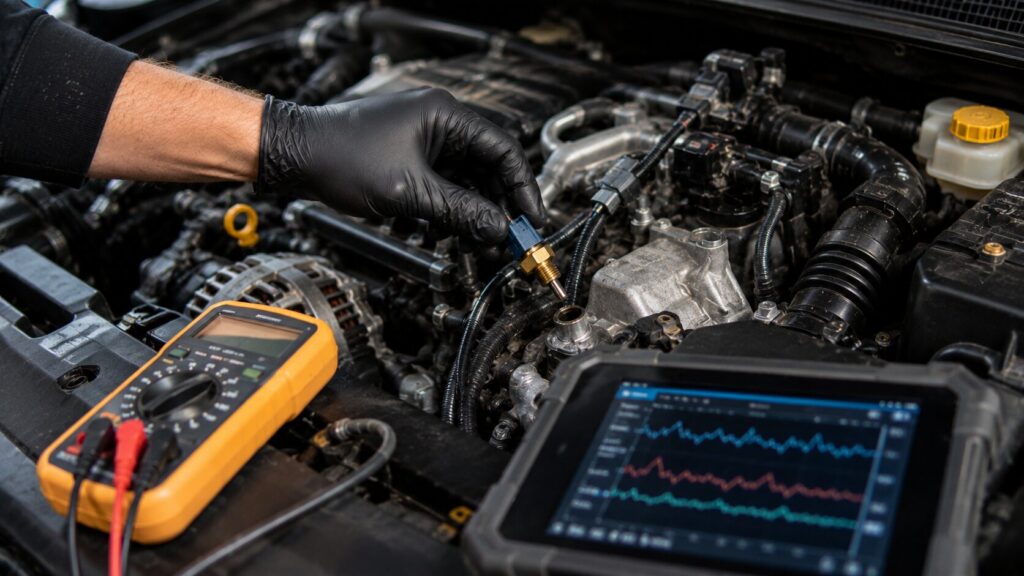
Subaru coolant temperature sensor failure causes erratic fuel trim and stalling in 2.5L and 3.6L engines during rapid thermal cycling. When ambient temperatures drop near Lake Minnetonka, these sensors report inaccurate data to the Engine Control Module, preventing the transition from open-loop to closed-loop fueling.
| Primary Symptom | Target Component | Specialized Tooling | Local Environmental Stressor | High Risk Profile |
| Rough idle at cold start | Coolant Temperature Sensor | PicoScope / OBDII Scanner | Sub-zero thermal cycling | Short commute drivers |
Thermal Degradation and Engine Performance Loss
The coolant temperature sensor functions as a negative temperature coefficient thermistor. Its internal electrical resistance decreases as coolant temperature increases. The sensor transmits a proportional voltage signal to the Engine Control Module to calculate fuel trims against the engine’s real-time thermal load.
Minnesota climate extremes force these components into rapid thermal expansion and contraction. November mornings in Spring Park subject the sensor to extreme thermal shock, pushing it from freezing ambient air to 190°F nearly instantly. This aggressive cycling accelerates microscopic cracking of the internal ceramic substrate.
Once this substrate cracks, the sensor develops an intermittent open circuit or high resistance. The Engine Control Module interprets this electrical instability as a colder engine. It responds by dumping excessive fuel into the combustion chamber. This condition, known as running rich, causes spark plug fouling and cylinder wash, where unburned fuel strips protective oil films from cylinder walls.
Humidity and Galvanic Corrosion Impact
The Spring Park area presents unique challenges for Subaru owners. High humidity from Lake Minnetonka accelerates oxidation on connector terminals. When a seal on the coolant sensor housing degrades, moisture ingress creates a path for galvanic corrosion.
This corrosion increases contact resistance at the plug. Because the Engine Control Module relies on precise voltage thresholds to calculate temperature, even a minor increase in resistance causes a significant offset in the reported engine temperature. Damp morning air exposes this issue, as oxidation on the terminals disrupts signal continuity.
Subaru Coolant Sensor Diagnostic Methods
I use a testing workflow to catch a Subaru coolant temperature sensor failure before it triggers a check engine light or leaves a vehicle stranded. Scanning for error codes is only the beginning.
- Baseline Resistance Check: Measure sensor resistance while the engine is cold. Compare this raw ohm value against the manufacturer temperature versus resistance chart. Any variance outside of five percent indicates internal degradation.
- Voltage Drop Analysis: Back-probe the sensor connector while the engine runs. Observe the signal wire on an oscilloscope. A healthy sensor produces a smooth, linear voltage decline as the engine warms. A failing sensor displays rapid, jagged spikes in the waveform, signaling internal contact breakage.
- Thermal Bench Test: If the sensor tests poorly, remove it and submerge the tip in a controlled hot water bath while monitoring resistance. This replicates the thermal stress it faces during road use.
Effects on Engine Management Systems
The Engine Control Module uses the coolant temperature sensor signal for several engine functions. Beyond fuel enrichment, the sensor data informs the ignition timing map and idle air control strategy.
When a Subaru coolant temperature sensor failure persists, the computer may fail to enter closed-loop operation. In a properly functioning vehicle, oxygen sensors take over fueling control once the engine reaches a specific temperature. If the coolant sensor remains stuck or reports an incorrect low temperature, the engine stays in open-loop mode indefinitely. This results in the computer ignoring oxygen sensor feedback, leading to poor fuel economy and high emissions.
These failures often manifest as stalling when shifting from park to drive. Sudden transmission loads require precise idle speed adjustments. If the computer believes the engine is still in a cold-start phase, the idle speed remains artificially elevated. The interaction between transmission load and the incorrect fuel mixture creates a stumble that frequently causes the engine to die at busy intersections.
Cold Start Fuel Enrichment Dynamics
During a cold start, the engine requires a rich air-fuel mixture to overcome the lack of fuel vaporization at low block temperatures. The coolant temperature sensor is the primary controller for this process. Minnesota’s massive daily temperature swings demand high sensor accuracy to prevent engine flooding.
Internal resistance biasing the sensor to a cold reading causes the injectors to remain open past their required duration. This leads to carbon buildup on the intake valves and top of the pistons. Over several thousand miles of this cycle, the engine loses efficiency and throttle response, eventually requiring a deep carbon cleaning to restore factory performance.
Long Term Maintenance and Component Longevity
For Subaru owners, this includes verifying the integrity of the engine management sensors most susceptible to cold-start errors.
I recommend performing a resistance check on the coolant sensor every forty thousand miles. This interval aligns with other cooling system services, such as thermostat replacement and coolant flushes. Swapping the sensor when resistance values drift stops unburned fuel from reaching and destroying the catalytic converter.
Mitigating Secondary Engine Damage
Constant over-fueling degrades the catalytic converter prematurely as raw fuel burns within the exhaust system. This transforms a simple sensor repair into a multi-thousand dollar emissions replacement. Dealing with these issues now prevents the vehicle from entering a failsafe mode during a blizzard.
Don’t let a failing sensor turn a routine cold start into a mid-winter breakdown. At Certified Auto Repair, we go beyond standard diagnostic scans. Bring your Subaru to our shop at 4700 Shoreline Drive, Spring Park, MN 55384 for a pre-winter PicoScope health check. We’ll verify your sensor’s warm-up curve against factory specifications to ensure your engine is fueling correctly before the first deep freeze leaves you stranded.
Frequently Asked Questions
Will a bad coolant sensor trigger a check engine light immediately?
No. The engine computer often accepts erratic data for several ignition cycles before the signal becomes inconsistent enough to set a permanent diagnostic trouble code. Many drivers notice driveability issues like rough idling long before a warning light appears on the dashboard.
Can I test this sensor myself without professional tools?
Yes. Checking cold resistance with a multimeter provides little value if you lack the specific thermal chart required for comparison. A professional shop utilizes lab scopes to see the signal drop in real-time, which identifies intermittent faults that static tests miss.
Does high humidity near the lake affect the sensor?
Yes. Moisture can penetrate damaged sensor housings or corrode the electrical connector pins, which introduces additional resistance into the circuit. This galvanic corrosion acts as an extra variable that makes the sensor report colder temperatures than the reality of the engine block.
Is it necessary to replace the sensor if the car only hesitates for a few seconds?
Yes. That short hesitation indicates the sensor is already failing to communicate the proper warm-up curve to the computer. Checking cold resistance with a multimeter provides little value if you lack the specific thermal chart required for comparison.