GMC fuel rail pressure sensor problems cause engine hesitation, power loss, and limp mode activation during heavy towing. Failure stems from moisture-induced galvanic corrosion within the sensor pins, leading to signal drift. Diagnosis requires an oscilloscope to verify circuit integrity, 5-volt reference stability, and ground path resistance, distinguishing electrical faults from mechanical fuel system failures.
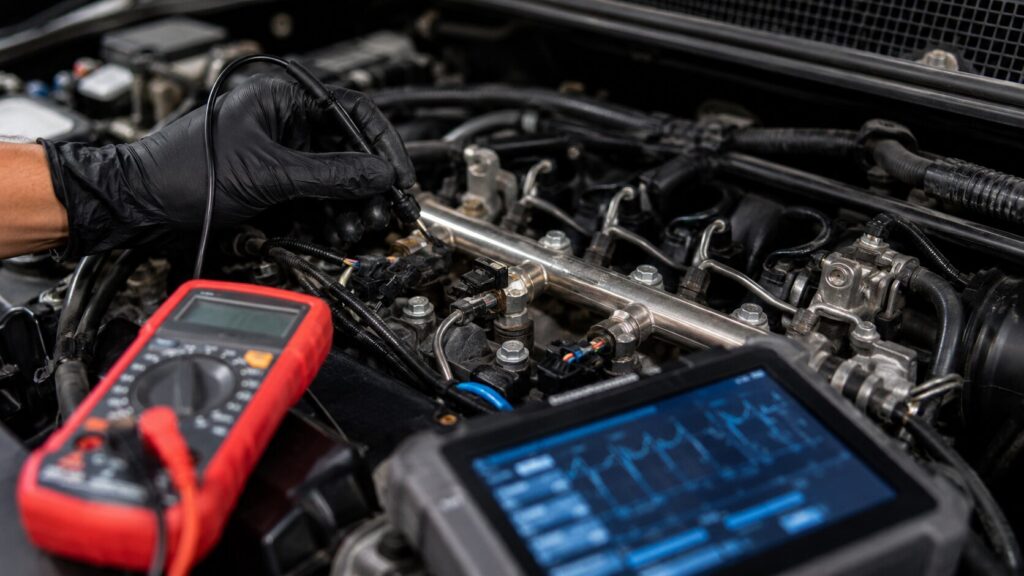
High humidity and road salt exposure in Spring Park frequently cause GMC fuel rail pressure sensor issues during extended highway towing. Load-induced signal skew forces the engine control module to misinterpret fuel pressure, leading to hesitation and power loss while accelerating. A malfunctioning fuel rail pressure sensor causes power loss while towing on Minnesota highways.
GMC Fuel Rail Pressure Sensor Technical Specifications
| Metric | Detail |
| Primary Symptom | Hesitation during heavy acceleration or towing |
| Target Component | Fuel Rail Pressure Sensor (FRP) |
| Specialized Tooling | Oscilloscope and bi-directional scan tool |
| Local Stressor | Extreme temperature swings and road salt corrosion |
| High Risk Profile | GMC Sierra trucks with high-mileage direct injection systems |
Understanding Fuel Rail Pressure Sensor Drift
Fuel rail pressure sensors utilize a piezoelectric element that changes electrical resistance based on the pressure exerted by the fuel within the rail. The engine control module applies a reference voltage to this circuit and interprets the return voltage to calculate pressure.
In the humid environment of Central Minnesota, electrical connectors suffer from moisture ingress. Over time, this humidity facilitates microscopic galvanic corrosion on the sensor pins. Corrosion raises electrical resistance, causing a voltage drop the engine computer misreads as lower fuel pressure.
Under heavy load, fuel demand increases. The engine control module attempts to compensate for this phantom low-pressure reading by widening the injector pulse width and increasing the fuel pump duty cycle. This causes the system to run rich, leading to carbon buildup on the valves and potential misfires. When the sensor fails, the system defaults to a limp mode to prevent engine damage.
Expert Diagnostic Workflow for Fuel Systems
I rarely rely on simple trouble codes. Low fuel rail pressure codes typically indicate a failing pump, a clogged filter, or a faulty sensor. I distinguish between these using a precise diagnostic path that isolates the sensor signal from the mechanical fuel delivery system.
- Scan Tool Analysis: I monitor commanded versus actual fuel pressure at idle and under heavy load. A variance greater than 50 psi indicates a performance fault.
- Oscilloscope Verification: I probe the signal wire directly. I look for a clean, linear voltage ramp from 0.5V at idle to 4.5V at maximum pressure.
- Voltage Drop Test: I measure the ground circuit at the sensor connector. Resistance must remain below 0.1 ohms. Any reading above 0.3 ohms indicates terminal oxidation.
- Reference Signal Check: I ensure the 5V reference wire holds a steady 4.95V to 5.05V range. Fluctuations here signal a failing ECM or harness interference.
If the scan tool shows the pressure jumping erratically while the oscilloscope shows a stable signal, I know the wiring harness is the culprit. If the oscilloscope shows the signal dropping or spiking independently of the physical pressure, I conclude the sensor internal circuitry has reached the end of its service life.
Identifying Electrical Interference and Ground Issues
Beyond basic signal checking, I focus on the integrity of the reference voltage and the ground return path. I know the sensor relies on a stable 5-volt reference signal supplied by the engine control module. Poor harness shielding or ignition coil interference induces signal noise, causing jittery sensor output.
I perform a ground circuit voltage drop test to verify resistance remains below 0.1 volts. When road salt and moisture infiltrate the harness looms, the resulting oxidation acts as a resistor. This misleads you into thinking the sensor is faulty when a degraded ground is the real cause. Identifying this prevents the trap of replacing functional parts when a wiring repair is required.
Climate Impact on Sensor Longevity in Minnesota
The climate around Spring Park creates challenges for sensitive electronic components. I see many sensors fail after the transition from a cold winter into a humid spring. The condensation that forms inside the sensor housing during these temperature swings causes internal oxidation. Once internal moisture is present, the sensor calibration shifts. Despite a smooth idle, the truck falters under heavy load once fuel pressure hits its maximum operating range.
Diagnostic Note: I always verify the sensor ground wire integrity and the 5V reference voltage before dropping the fuel tank. A bad ground path frequently mimics a faulty sensor, leading to unnecessary and expensive fuel pump replacements.
Risks of Ignoring Fuel Pressure Irregularities
Running a direct injection engine with incorrect fuel pressure data leads to piston wash, where excess fuel strips the oil film from the cylinder walls. This causes rapid cylinder wear and eventual catastrophic engine failure. The engine control module operates within strict parameters. When the sensor reports false data, timing and fuel injection duration are compromised. This leads to heat-soaking of the combustion chamber, which can warp exhaust valves or lead to cracked cylinder heads.
Why Expert Repair Exceeds Standard Diagnostic Service
Certified Auto Repair uses proprietary software mapping for precise real-time data analysis, identifying signal drift before the check engine light illuminates. Identifying signal drift before the check engine light illuminates prevents the engine from entering protective limp mode during vehicle operation.
For professional diagnostic assistance, visit 4700 Shoreline Drive, Spring Park, MN 55384.
Frequently Asked Questions
Can I continue driving with a failing fuel rail pressure sensor?
No. Continuing to drive with a faulty fuel rail pressure sensor leads to incorrect air-fuel ratios, causing engine misfires, piston wash, and permanent cylinder damage.
Does a check engine light always turn on when this sensor fails?
No. Sensor drift often occurs before the engine control module triggers a trouble code. Drivability issues, such as rough idling or hesitation, frequently appear first.
Will replacing the sensor fix all fuel pressure issues?
No. A faulty pump, regulator, or restricted filter can trigger identical symptoms. A professional diagnostic is necessary to verify if the sensor is the root cause.
Is it normal for these sensors to fail in colder climates?
Yes. Cold climate temperature swings cause condensation within sensors and connectors, triggering internal oxidation and calibration drift.