Ford EVAP pressure sensors in Spring Park fail prematurely due to moisture ingress and extreme thermal cycling. I see this drift constantly—if left unchecked, it triggers a rich fuel condition that destroys catalytic converters. I use targeted scan tool data to verify these sensor faults, so I’m not wasting time chasing ghost codes and can move straight to the fix.
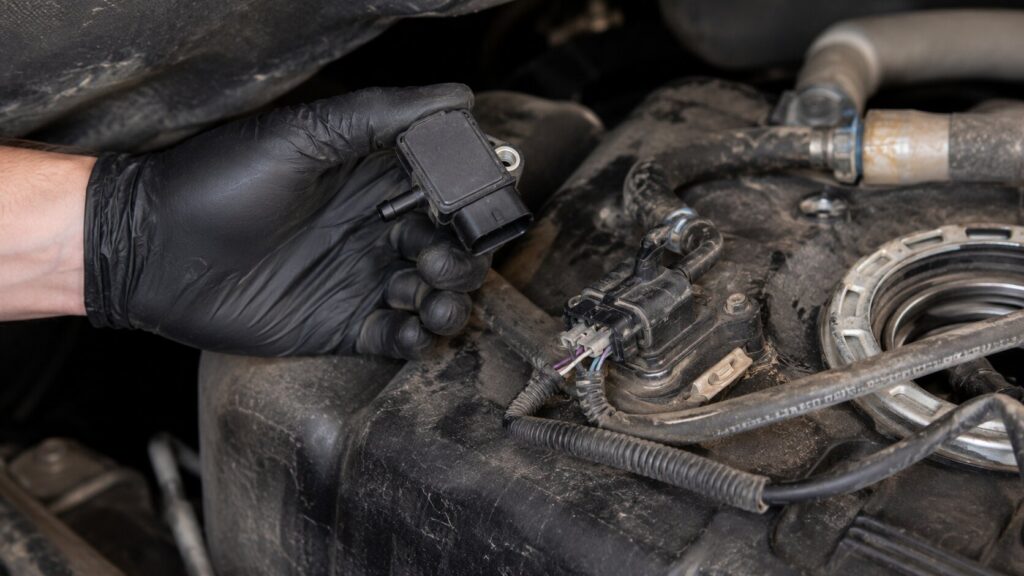
Ford EVAP pressure sensor failure on vehicles over 80k miles is typically caused by internal diaphragm corrosion from Minnesota thermal cycling. Symptoms include a P0452/P0453 code and intermittent check engine lights. A definitive diagnosis requires monitoring voltage output during an active purge cycle via a bidirectional scan tool.
Mechanics of Sensor Drift and Vapor System Degradation
Ford’s tank-mounted pressure transducer is highly sensitive to the Spring Park environment. Frequent cold starts and rapid thermal expansion stress the internal diaphragm, but the real killer is moisture ingress.
Minnesota winters are brutal, and the road salt and heavy slush buildup from daily commutes along Shoreline Drive often accelerate connector and harness corrosion, leading to erratic voltage signals. When this happens, the Powertrain Control Module (PCM) sees an incorrect vapor pressure, triggering a P0452 or P0453 code.
As the diaphragm fatigues, it loses its ability to track subtle pressure changes. During the swing between sub-zero nights and warmer garage conditions, condensation forms inside the housing. This water bridges electrical contacts or freezes, forcing the sensor to output physically impossible signals.
The diagnostic baseline: Under normal conditions, the PCM provides a 5V reference, and the sensor returns a 0.5V to 4.5V signal. Once the internal piezoresistive element is compromised by corrosion, the resistance shifts, the signal flatlines or jumps, and the PCM flags a circuit fault.
Precision Signal Analysis for Isolating Vapor System Faults
I identify these sensor faults by observing the voltage output during an active command test. A healthy sensor will track the tank pressure changes linearly as the purge valve opens. The signal flatlines or jumps around during the vacuum test. That tells me the sensor electronics have failed.
My process follows a strict sequence to isolate the failure point:
- Reference Signal Verification: I first check the five-volt reference signal at the sensor connector to ensure the PCM is supplying power.
- Vapor System Leak Check: Using a professional-grade smoke machine, I verify there are no physical breaches in the charcoal canister or vapor lines. Many technicians misdiagnose these as a simple bad gas cap, ignoring the sensor calibration itself.
- Oscilloscope Waveform Analysis: I monitor the raw signal output using a PICO Oscilloscope. A clean signal should be perfectly smooth during a purge cycle.
- Final Fault Identification: I look for noise or jagged edges on the waveform, which signify internal sensor shorting or poor electrical contact.
Last week, a Ford F-150 rolled into the shop throwing an intermittent P0452. The owner had already replaced the gas cap twice. I hooked up the PICO scope and saw the signal line jaggedly jumping between 0.8V and 3.2V while stationary. The root cause? Moisture had bypassed the weathered sensor seal during our last sub-zero Spring Park freeze, shorting the internal piezoresistive substrate.
Mitigating Secondary System Damage and Engine Wear
Ignoring an Evaporative Emission Control (EVAP) system fault leads to more than just an annoying light on the dashboard. The PCM pushes the fuel trim rich, which forces carbon onto the intake valves and kills your gas mileage. Over time, this causes the catalytic converter to overheat because it is constantly processing excess unburned hydrocarbons.
You should avoid waiting for the light to turn off on its own. Carbon buildup on the valves creates hot spots that lead to misfires, further damaging the ignition system. Furthermore, the persistent running rich condition will eventually poison the catalytic converter’s substrate. Swapping a sensor is cheap insurance. It beats the hell out of paying for a new catalytic converter or a valve job.
I use factory service bulletins to double-check my findings. I’m not going to suggest a repair unless the data confirms a faulty sensor. I focus on getting the vehicle back to factory specs rather than just clearing the code. If your Ford is throwing EVAP codes, reach out to Certified Auto Repair, or visit us at 4700 Shoreline Drive, Spring Park, MN 55384.
Frequently Asked Questions
Does a loose gas cap cause this specific sensor failure?
Yes, a loose or damaged gas cap can trigger an EVAP system alert that mimics a sensor failure. However, if the warning light remains illuminated after tightening the cap and driving for several cycles, the sensor has likely developed internal electronic faults.
Can I continue driving my Ford with this light on?
Yes, you can operate the vehicle, but your fuel efficiency will drop significantly. The engine control module will shift into an open loop mode, which causes the engine to burn more fuel than necessary to compensate for the perceived system leak.
Will the check engine light go away after I replace the sensor?
Yes, the light will turn off once the PCM completes a successful drive cycle and confirms the system integrity. I make sure the repair actually holds by running a system reset and forcing the monitors to confirm everything is clear.
Are these sensor failures common in Spring Park?
Yes, the extreme temperature variations in Minnesota create ideal conditions for internal sensor corrosion. The constant expansion and contraction of the air inside the fuel tank puts significant stress on the pressure sensing diaphragm over the life of the vehicle.