Cold Lake Minnetonka winters and Shoreline Drive road salt accelerate automotive sensor harness corrosion, terminal pin contraction, and high-resistance signal drops across European, Asian, and domestic vehicles. Rather than replacing parts using basic code scanners, advanced PicoScope waveform analysis isolates microsecond voltage dropouts, intake air leaks, and 5V reference circuit failures.
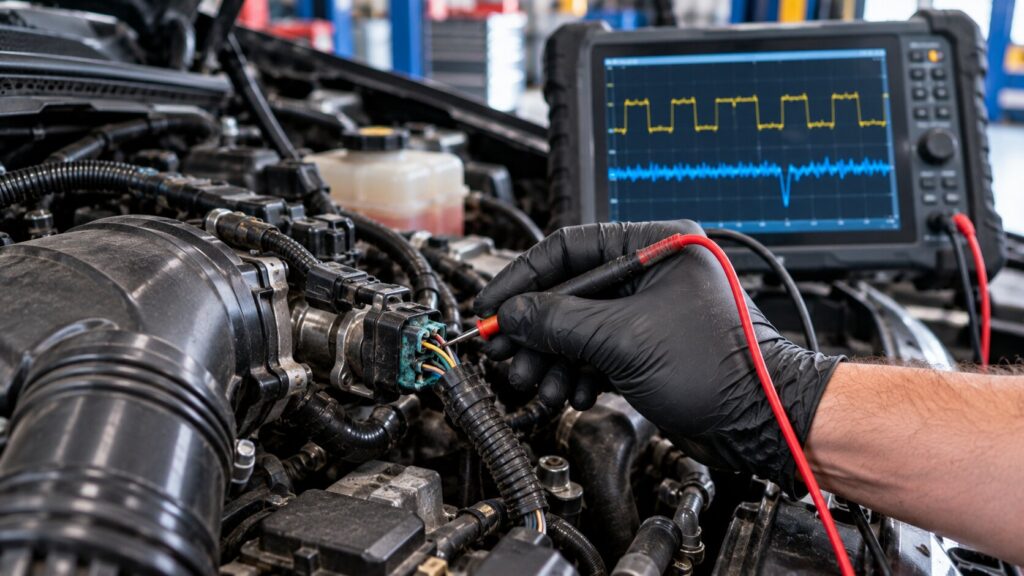
Extreme temperature shifts and road salt around Lake Minnetonka accelerate automotive sensor corrosion and signal drift. I isolate complex multi-brand sensor faults—from BMW mass air flow discrepancies to Ford crankshaft position dropouts—using PicoScope signal pattern analysis rather than guessing with basic code readers.
Why Your Check Engine Light Triggers Near Lake Minnetonka
Lake Minnetonka creates a humid microclimate that combines with heavy winter road salt on Shoreline Drive to accelerate wiring harness corrosion. When cold air hits a hot engine bay, moisture condensation collects inside unsealed sensor connectors. This creates subtle, high-resistance grounds that cause 200mV to 500mV signal drops—tricking your car’s Engine Control Unit (ECU) into setting false trouble codes.
An illuminated check engine light rarely means the sensor itself has failed. More often, the ECU detects an out-of-spec signal caused by environmental stress, intake vacuum leaks, or green copper corrosion inside terminal pins.
Modern Sensor Networks Across European, Asian, and Domestic Builds
- European Builds (BMW, Audi, Mercedes): Rely on high-speed CAN-bus networks with ultra-strict signal logic. A 0.3V deviation on a BMW Mass Air Flow (MAF) sensor forces aggressive transmission shift holds and rough idling long before a hard code sets.
- Asian Builds (Toyota, Honda, Subaru): Prioritize emissions stability using wideband Air-Fuel Ratio (AFR) sensors. Their internal heating elements face severe thermal shock during Minnesota winters, leading to open-circuit heater circuit faults (P0135/P0141).
- Domestic Builds (Ford, GM, Stellantis): Utilize speed-density algorithms cross-referencing MAP and throttle position. I regularly trace MAP sensor codes back to physical carbon loading in the intake port rather than an electronic sensor failure.
Beyond the Auto Parts Store Code Reader
Free code scans at retail auto parts stores only pull generic OBD-II fault codes like P0171 or P0300. These codes identify the system running out of spec, but they cannot show dynamic waveform degradation.
- PicoScope Waveform Analysis: Capturing voltage signals at 100 megasamples per second reveals microsecond dropouts that standard handheld scanners miss entirely.
- Live Data PID Mapping: I evaluate short-term and long-term fuel trims under load, verifying if a lean condition stems from a faulty MAF meter or a leaking intake gasket.
- Bidirectional Actuation: Manually commanding VVT solenoids, EVAP purges, and EGR valves confirms physical mechanical response times.
- Smoke Machine Testing: Introducing 1.5 PSI of ultra-fine smoke isolates unmetered air entry points disguising themselves as bad sensor readings.
How I Diagnose Intermittent Sensor Failures
Diagnosing intermittent sensor issues requires isolating physical signal integrity from ECU logic errors.
- Pull all active, pending, and history codes alongside freeze-frame data.
- Connect a multi-channel lab scope directly to the sensor signal wire, ground wire, and 5V reference wire.
- Perform a harness wiggle test while monitoring waveform trace continuity.
- Inspect physical terminal pin tension and check for capillary oil/water intrusion inside the connector body.
Diagnostic Verdict: A 2018 Ford F-150 came in with an intermittent P0300 misfire that two other shops failed to solve after replacing the MAP sensor twice. I hooked up a lab scope to the 5V reference line and caught a complete signal dropout lasting just 45 milliseconds—caused by a salt-corroded wire strand flexing against the intake manifold over the Shoreline Drive bridge route. Repairing the harness pin saved the customer from an unnecessary ECU replacement.
Secondary Mechanical Damage Prevention
Ignoring a sensor warning usually leads to far more expensive mechanical repairs over time. A failing oxygen sensor causes an overly rich fuel mixture, sending raw gas into the exhaust and overheating catalytic converter substrates past 1,600°F until they melt.
When crankshaft or camshaft position sensors lose signal continuity, the engine stalls without warning or fails to sync during sub-zero cold starts.
Stop by Certified Auto Repair at 4700 Shoreline Drive in Spring Park, MN, or call us directly to get your sensor signals scoped before road salt turns an intermittent fault into a dead catalytic converter.
Frequently Asked Questions
Can I keep driving if my check engine light is not flashing?
Yes. You can drive short distances if the light is steady and the engine runs smoothly. However, a steady light indicates an active fault that alters fuel delivery, so you should schedule a diagnostic test promptly to prevent secondary component damage.
Why did my check engine light turn off on its own?
Your check engine light turned off because the ECU cleared the active dashboard warning after detecting no recurring fault across three consecutive warm-up cycles. The initial fault code remains stored in the module memory for scope analysis.
What is the difference between a generic code reader and professional diagnostic tools?
Generic code readers only pull basic trouble code numbers. Professional diagnostic platforms provide live signal sampling at high frequencies, bidirectional component actuation, and deep PID analysis to isolate physical wiring failures from bad parts.
How does cold winter weather affect automotive sensors?
Sub-zero temperatures cause metal terminal pins to contract, lose contact tension, and crack outer wire insulation. Moisture trapped inside unsealed electrical connectors freezes, causing short circuits to ground and false fault codes during cold starts.