Nissan crankshaft position sensor failures typically manifest as intermittent stalling or no-start conditions triggered by extreme cold. Rather than simple sensor degradation, these issues often result from thermal cycling, signal drift, and wiring harness resistance. Professional lab-scope diagnostics are essential to verify true signal integrity and prevent unnecessary part replacement.
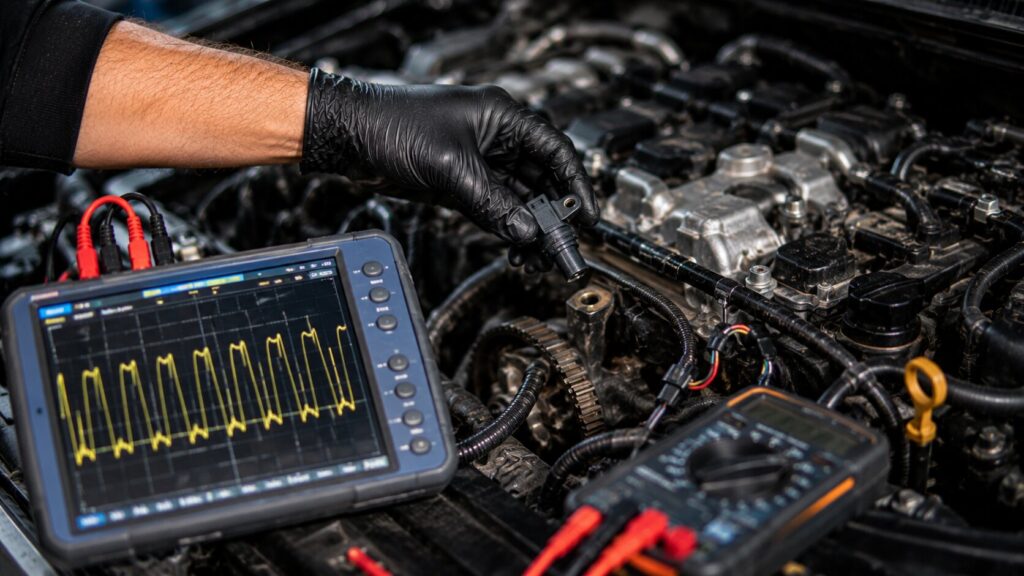
Nissan crankshaft position sensor problems often trigger intermittent engine stalls and no start conditions for Altima and Sentra models navigating the extreme temperature fluctuations of Minnesota winters. On Shoreline Drive, I see these failures during cold starts when harness resistance spikes, garbling the signal from the reluctor wheel..
| Primary Symptom | Target Component | Specialized Tooling | Local Environmental Stressor | High Risk Profile |
| Intermittent Stalling | Crankshaft Position Sensor | Lab Scope | Subzero Thermal Cycling | High Mileage Altima Units |
Why Nissan Crankshaft Sensors Fail During Cold Weather
The crankshaft position sensor operates on the Hall effect principle. It detects the precise rotational position of the crankshaft by reading the gaps in a metallic reluctor wheel attached to the crankshaft assembly. During standard engine cycles, the sensor produces a stable square wave aligned with crankshaft rotation.
Heat soaking combined with extreme cold creates a specific failure mode in these components. The internal plastic casing of the sensor often develops microscopic hairline fractures due to repeated thermal expansion and contraction. Once moisture from road salt or condensation enters these fractures, the internal semiconductor chip experiences signal drift. When the signal distorts, the engine control module loses its reference point for fuel injection timing and ignition spark. The result is an erratic timing sequence that causes the engine to die suddenly or refuse to crank.
How to Identify Crankshaft Sensor Waveform Issues
Digital diagnostics require looking beyond the basic error code. Many technicians see a P0335 and immediately swap the part, but this approach fails when the root cause is a degraded harness or an oxidized ground connection. I use a lab scope to capture the actual waveform generated by the sensor.
A healthy sensor produces a crisp, uniform square wave. Rounded waveform transitions or erratic voltage drops signify that the sensor signal has become unstable. This visual evidence separates a genuine mechanical failure from simple electrical interference or loose mounting hardware.
Step-by-Step Diagnostic Process for Sensor Faults
I identify these sensor faults by moving past simple OBDII code reading. While a P0335 code often points directly to the sensor, I verify the integrity of the entire circuit before recommending a replacement. Relying solely on a code scanner often leads to replacing perfectly functional parts while ignoring damaged wiring or grounded circuits.
My diagnostic process follows this logical path:
- Connect a digital storage oscilloscope to the signal wire of the sensor.
- Observe the square wave pattern during engine cranking.
- Compare the voltage drop against factory specifications.
- Inspect the sensor harness connector for signs of green corrosion or pin terminal spread.
- Verify the air gap between the sensor tip and the reluctor wheel teeth.
Preventing Secondary Damage from Intermittent Stalling
Repeated attempts to turn over an engine that cannot find its timing reference leads to premature starter solenoid failure and battery plate sulfation. These cascading electrical failures turn a simple sensor replacement into a multi-component repair bill.
Furthermore, the proximity of the crankshaft sensor to the transmission bell housing means it is frequently exposed to road debris and fluid leaks. If a rear main seal or a transmission cooler line begins to seep, the resulting fluid accumulation can foul the sensor housing, accelerating the rate of internal degradation. Checking for nearby debris or fluid leaks ensures the replacement sensor remains protected from fouling.
Local Environmental Factors Impacting Nissan Engines
Extreme thermal cycling in our region acts as a catalyst for sensor failure. Rapid thermal cycling between ambient freezing temperatures and engine idle heat induces internal circuit stress. Plastic housing materials that become brittle in the cold are prone to stress fractures when they expand rapidly during the warm up cycle.
Locally, I see a sharp increase in these issues during the mid winter months. Drivers who park outside are at a higher risk because the moisture trapped in the sensor housing can freeze, expand, and force the delicate internal components apart. This is why a simple scan is never enough. The hardware must be physically evaluated for structural integrity in this specific climate.
Choosing Reliable Replacement Parts for Nissan Repairs
I focus on permanent fixes rather than temporary patches. Genuine sensors are always preferred over aftermarket alternatives because the resistance values must match the factory threshold exactly. Any deviation from these factory specifications triggers a check engine light within a few hundred miles.
Inferior shielding on aftermarket sensors allows electromagnetic interference from the alternator or ignition coils to corrupt the signal. This interference creates ghost signals that mimic a failing sensor, leading to diagnostic confusion. Using original equipment ensures that the shielding and the internal semiconductor components are calibrated to the specific electrical architecture of your engine.
Professional Diagnostic Services in Spring Park
In extreme winter weather, subzero temps can warp delicate sensor signals, causing issues that a simple code reader just can’t see. Catching these hardware failures requires advanced diagnostic testing, allowing us to accurately pinpoint the root cause without the long wait times. Getting your vehicle inspected by a professional who prioritizes structural integrity over quick fixes prevents a minor sensor glitch from turning into a total roadside failure. Bring your vehicle to Certified Auto Repair at 4700 Shoreline Drive, Spring Park, MN 55384, for a detailed inspection of your ignition and sensor systems.
Frequently Asked Questions
Does a bad crankshaft sensor always trigger a check engine light?
No, a sensor can fail intermittently without setting a permanent diagnostic trouble code. The engine may stall and restart without storing a diagnostic trouble code for standard scanners to detect.
Can I drive the car if the sensor is failing?
No, you should avoid driving if the engine is stalling unexpectedly. Sudden loss of power while navigating traffic creates a significant safety hazard and places extreme stress on the electrical system of the vehicle.
Will replacing the sensor fix all starting problems?
No, harness or timing chain issues render a new sensor ineffective, so I always validate the signal path through a circuit integrity test prior to installation.
Is it necessary to use original equipment parts for this repair?
Yes, aftermarket sensors often fail to meet the strict pulse width requirements of the engine control module. Using high quality components ensures the timing signal remains consistent regardless of the engine temperature or local driving conditions.