Freeze-thaw cycles and severe potholes on Minnesota roads push wheel alignment out of factory specs, accelerating tread wear and straining suspension components. Annual digital precision alignment checks restore proper camber, caster, and toe angles. Protecting chassis geometry prevents costly tire replacement, improves fuel efficiency, and ensures stable handling year-round.
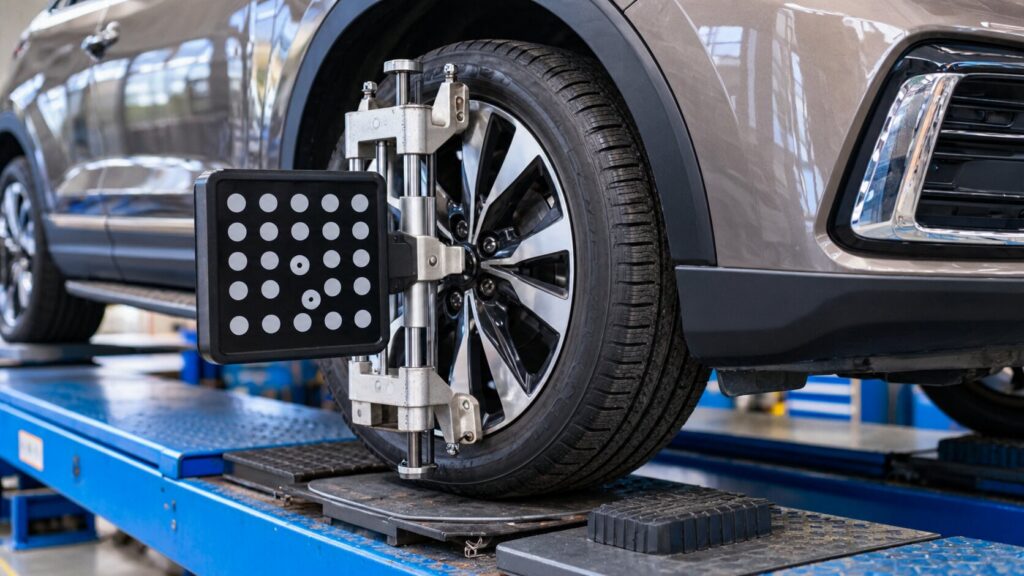
Freeze-thaw cycles on Lake Minnetonka routes push the steering setup out of alignment fast. Daily drives over bumpy pavement on Highway 7 or Shoreline Drive bend delicate tie rods and push front tires sideways long before you notice worn rubber. Left unchecked, a minor pull to the right quickly ruins your tires and damages key steering parts. We measure your wheels down to fractions of a degree so your vehicle drives straight through harsh Hennepin County winters.
How Ice and Potholes Shift Steering Geometry
Your vehicle relies on precise angles to keep tire tread flat against the road surface. Caster, camber, and toe settings control how your tires roll through turns and handle big road bumps. When you hit a hidden pothole near Spring Park during early spring thaws, thousands of pounds of force push directly into your steering parts. Soft metal control arms bend under this hit, pushing adjustment points out of place.
A small alignment problem of just 0.15 degrees makes your tires drag sideways across frozen or slushy pavement. Instead of rolling smooth and straight, the inner or outer edges scrape the road surface continuously. This scraping creates extra heat that wears down rubber quickly, even in freezing winter air. Over just a few hundred miles of commuting, this constant rubbing strips away tread depth and causes annoying steering vibrations.
What We Saw in the Shop: Last week, a driver brought in a car they use every day on Highway 7. They only felt a slight pull to one side, but our equipment showed the front tires were turned outward by just a fraction of an inch. That tiny misalignment scrubbed away a big chunk of the inner tire rubber in less than a month of driving.
Early Signs of Suspension Alignment Wear
Catching alignment issues early saves you from having to buy a brand-new set of tires prematurely. If your steering wheel emblem points off to the side while you are driving on a flat road, your front tire alignment is already out of spec. Additionally, if your vehicle constantly drifts toward the shoulder on Highway 7, a continuous pull means your left and right wheels have highly uneven camber or caster angles.
You can also physically check your tires. Running your hand across the tire tread might reveal rough, jagged edges—known as feathering or saw-toothing. This is caused directly by tires scrubbing sideways against the road. Finally, if you hear squealing tires at low turning speeds, your misaligned front wheels are forcing your tires to drag against each other during simple parking turns around Lake Minnetonka.
Our Precision Alignment Inspection Protocol
- Inspect steering linkages and ball joints: We lift the vehicle and check tie rod ends, control arm bushings, and ball joints for excess looseness. Worn parts prevent alignment tools from getting an accurate reading.
- Mount digital imaging targets: Precision clamps attach optical targets directly to all four wheels without touching or scratching aluminum rims.
- Measure wheel angles against factory specs: High-resolution cameras project live spatial coordinates to compare your wheel angles against factory settings.
- Torque adjustment points to precise spec: We turn the tie rods and lower arm adjustment bolts, tightening everything securely to factory limits (55 to 75 ft-lbs).
- Conduct a road test on local pavement: We test drive the vehicle over actual road crowns on Shoreline Drive to make sure the steering wheel stays perfectly straight.
Shop Note: The heavy salt brine used on Hennepin County roads often rusts and completely freezes 14 mm tie rod threads. Forcing stuck adjuster sleeves without the right penetrating chemicals can snap your steering shafts. We take the time to soak and free these components safely.
Protect Your Tires with Professional Spring Park Service
Misaligned wheels force your tires to drag sideways across the street, wearing out tread fast and making your engine burn more fuel. Checking your wheel alignment after winter prevents extra damage to lower control arm bushings and steering parts.
Schedule your inspection with the Certified Auto Repair. Visit us at 4700 Shoreline Drive, Spring Park, MN 55384, or call us directly at (952) 471-0471 to book your appointment and restore your vehicle’s handling today.
Frequently Asked Questions
How often should daily Minnesota commuters get an alignment check?
Once a year or every 12,000 miles is the baseline recommendation for local drivers. Commuting daily over frost-heaved routes on Highway 7 or taking heavy pothole strikes during spring thaws requires an immediate geometry check.
Can bad wheel alignment cause vibrations in the steering wheel?
Yes. Uneven tire wear caused by incorrect toe settings creates flat spots that transmit vibrations directly into the steering wheel. However, high-speed shaking usually stems from out-of-balance wheel weights or bent rim flanges.
Will misaligned wheels affect fuel economy on daily commutes?
Yes. When wheels do not roll parallel to one another, tires drag sideways against the road surface, increasing total rolling resistance and forcing the engine to burn additional fuel.
Do I need an alignment when installing new tires?
Yes. Mounting new tires over uncorrected steering geometry causes premature, uneven tread wear within the first 3,000 miles. Performing an alignment during installation protects your new tires from day one.