Inspecting suspension components before a wheel alignment prevents setting angles on bent control arms, loose tie rods, or worn bushings. Damaged parts prevent adjustments from holding, leading to rapid tire wear and off-center steering. Replacing compromised components first ensures accurate alignment, restores precise vehicle handling, and protects your tires.
Aligning wheels on top of bent suspension components wastes time and ruins fresh tires. When your vehicle strikes a pothole along Shoreline Drive in Spring Park during the winter freeze-thaw cycle, the impact forces can bend control arms or deform rubber bushings. Setting toe or camber angles while these underlying components remain compromised leaves the steering off-center and causes rapid, uneven tire wear.
How Damaged Suspension Parts Block Proper Alignment
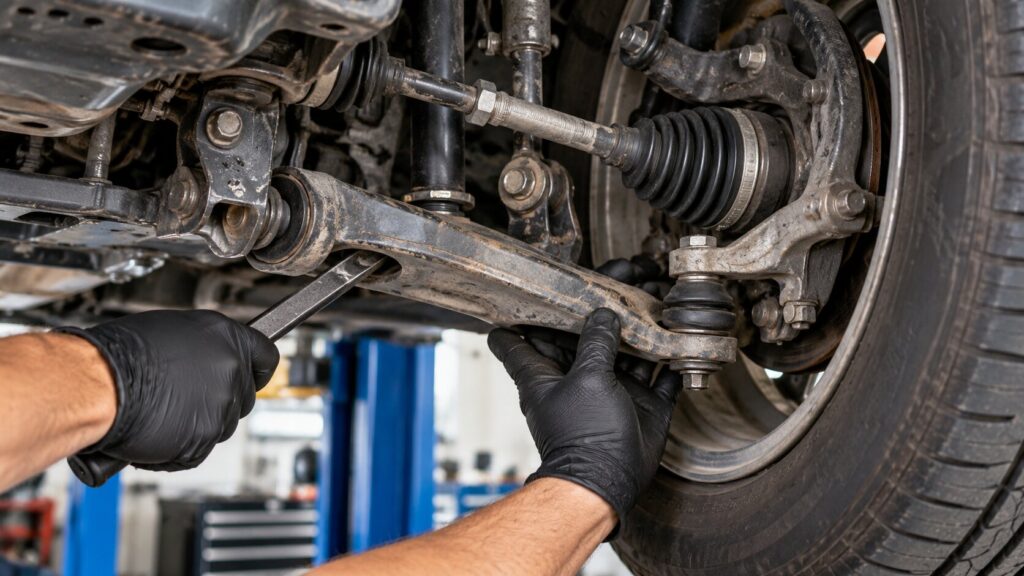
Every wheel alignment we perform depends on solid, unyielding mounting points. Suspension components like tie rods, control arms, and ball joints hold the wheel at exact angles relative to the frame. If a single control arm twists by just a fraction of an inch, the suspension geometry shifts out of specification. Attempting to force the alignment back into spec by adjusting tie rods only masks the underlying mechanical damage.
Rubber bushings and ball joints absorb continuous road vibrations. Here in Spring Park, water intrusion and road salt exposure cause the internal metal sleeves to corrode while the surrounding rubber tears and degrades. When we attach alignment sensors to a wheel with worn bushings, the weight shift of the vehicle causes the alignment readings to change constantly on our screen. The machine cannot establish a reliable baseline measurement until all loose or deformed parts are replaced.
Key Suspension Components Checked During Inspection
We focus on specific wear points and structural linkages during our initial underbody check. Catching a tiny bend in a control arm or a loose joint before mounting alignment sensors keeps you from having to repeat the repair.
- Tie Rod Ends and Adjusting Sleeves: We check inner and outer tie rod joints for looseness and rusted adjustment threads that freeze steering adjustments.
- Control Arms and Bushings: Our inspection looks for hairline cracks in the metal, subtle bends, and torn or shifted rubber bushings.
- Ball Joints: Lower and upper ball joints undergo leverage tests to check for dangerous side-to-side or up-and-down movement inside the joint socket.
- Sway Bar Links and Mounts: We verify that stabilizer links are intact so body roll does not throw off sensor calibration.
- Struts and Steering Knuckles: Visual checks confirm that strut housings remain straight and spindle mounting holes have not stretched out of shape.
Warning Signs Your Suspension Needs Inspection First
A steering wheel turned 15 degrees off-center on flat pavement signals direct mechanical deformation in the front steering linkages. Severe vibration or pulling to one side typically points toward physical component damage rather than simple tire miscalibration.
Shop Note: During Spring Park freeze-thaw cycles along Shoreline Drive, we frequently see lower control arm inner bushings tear loose. Even if the alignment screen shows green numbers on the rack, applying light pressure with a pry bar exposes over an eighth of an inch of hidden slop; those alignment settings throw themselves off the moment you hit the brakes.
When a suspension joint loosens, tires show aggressive inner or outer edge wear within just a few hundred miles. A bent strut housing can also tilt the wheel inward, dragging the tire rubber across the asphalt. Catching these mechanical failures early prevents costly secondary damage to wheel bearings and steering gearboxes.
Unexpected clunking noises over minor road bumps indicate that a joint socket has worn far past safe limits. Operating a vehicle with loose suspension parts risks complete component separation, which can cause you to lose steering control. Professional testing confirms whether the issue comes from a worn rubber bushing or a bent metal arm.
Diagnostic Methods for Spotting Subtle Component Bends
Spotting a twisted control arm or a hairline crack requires careful physical testing beyond a quick visual look. We rely on systematic mechanical tests to isolate damaged parts before setting alignment angles.
- Clearance and Play Checks
We elevate the vehicle on a lift. Hands-on testing at the three-and-nine o’clock positions on the tire checks for loose tie rod ends, while shaking at twelve-and-six isolates bad ball joints or wheel bearings.
- Pry Bar Tolerance Testing
We place pry bars against the control arm mounting points. If prying shows more than 2 to 3 millimeters of extra side movement in the rubber bushing, the part is worn out and must be replaced.
- Precision Measurement
When visual checks show no obvious cracks, we compare left-side and right-side component dimensions using precision measuring tools. This highlights subtle subframe shifts caused by curb impacts.
Restore Precise Handling and Protect Your Tires
Leaving a bent tie rod or torn control arm bushing in place causes rapid tire damage within 300 to 500 miles and makes emergency stopping unpredictable. Replacing compromised tie rods, control arms, and bushings restores original factory geometry so your vehicle tracks straight and smooth.
Our team thoroughly evaluates your steering and suspension systems to fix root causes before performing precision wheel alignments. Visit our website at Certified Auto Repair or stop by our location at 4700 Shoreline Drive, Spring Park, MN 55384 to keep your vehicle handling safely.
Frequently Asked Questions
Can you align a car with a bent control arm?
No, an alignment cannot compensate for a bent control arm. Adjusting steering linkages on a damaged arm leaves the suspension geometry out of spec and causes severe tire wear.
What happens if you align a car with worn ball joints?
Alignment angles will shift as soon as the vehicle moves because loose ball joints allow the wheel to wobble. The alignment settings will not hold, leading to erratic steering and ruined tires.
How do technicians know if a tie rod is bent?
We inspect tie rods for visible curvature, damaged adjustment threads, and excessive looseness when moving the wheel assembly by hand. Measuring steering linkage symmetry confirms whether a rod has deformed under impact.
How long does a pre-alignment suspension inspection take?
A comprehensive pre-alignment inspection typically takes between 15 to 30 minutes. We elevate the vehicle to physically test joint tolerances, measure symmetry, and inspect all mounting hardware for structural integrity.