Modern vehicles require a steering angle reset after alignment to sync physical wheel position with onboard safety computers. Without recalibrating the steering angle sensor, systems like stability control receive inaccurate directional data, causing unwanted braking, traction warnings, or disabled driver-assist features. Proper digital calibration ensures full safety system accuracy.
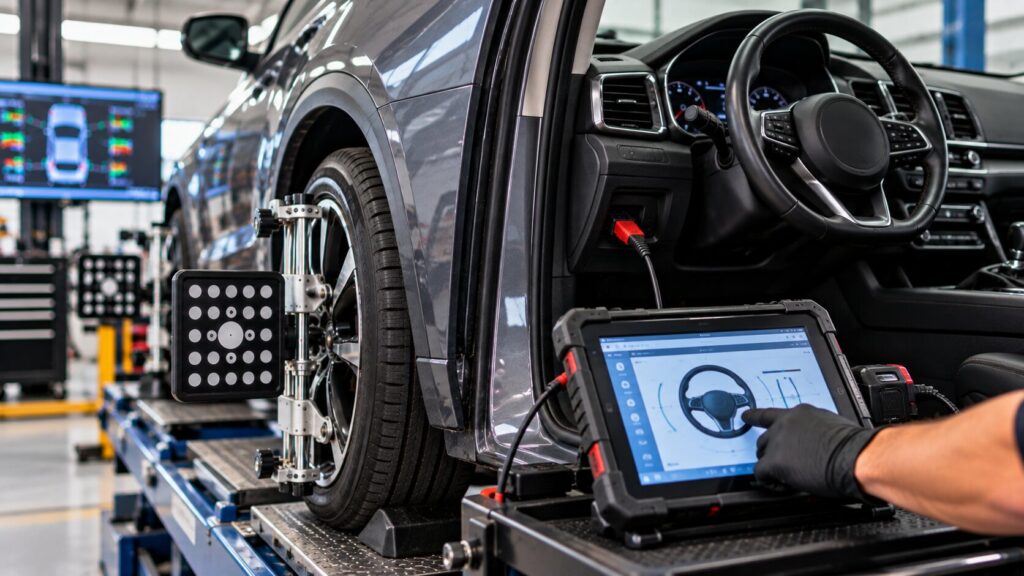
When our tires hit deep potholes along Shoreline Drive during the spring thaw, the impact knocks steering tie rods out of alignment and throws off the digital sensor tracking steering wheel position. We can easily straighten the tires and level the steering wheel back to factory specs on an alignment rack. Skipping the electronic steering angle sensor reset leaves your vehicle’s safety computers processing contradictory steering data.
Physical Mechanical Corrections Create Digital Misalignment
The steering angle sensor sits directly inside the steering column assembly to monitor the exact direction and sharpness of every turn. It sends continuous data signals to the Electronic Stability Control and Anti-Lock Braking modules to help keep cars moving safely along their intended path. When suspension parts shift after hitting rough winter roads, you often have to hold the steering wheel slightly off-center just to drive straight down the road.
Performing a standard mechanical alignment straightens the physical tires and centers the steering wheel again. However, the digital sensor inside the steering column still remembers its old off-center baseline. Even though your hands are holding the steering wheel completely straight, the uncalibrated sensor reports that the wheel is constantly turned. This conflict tricks onboard safety computers into thinking the car is skidding when it is actually driving in a straight line.
How Sensor Data Controls Stability Systems
Your vehicle continuously compares the steering wheel position with real-time feedback from the speed sensors on each wheel. When all these readings match, the stability control system stays quiet and lets you drive normally.
If the car travels straight while the steering angle sensor reports a continuous turn, the central computer detects an immediate problem. It assumes the tires are sliding on black ice or hydroplaning across wet pavement.
| Safety Intervention | What the Computer Thinks is Happening | How You Feel It |
| Targeted Braking | The car is skidding outward on a turn. | Sudden, automatic brake application on a single wheel. |
| Power Reduction | The wheels are losing traction on ice. | Engine power cuts out momentarily when accelerating. |
| System Deactivation | The sensor data is too corrupted to trust. | Dash warning lights illuminate (ESC, ABS, Lane Assist). |
How We Realign Digital Steering Sensors
Resetting the steering angle system requires specialized electronic diagnostic tools rather than traditional hand wrenches. Once physical alignment reaches target specifications on our alignment rack, we plug an advanced diagnostic scan tool directly into the vehicle’s computer port.
Our technicians clear stored error codes, hold the steering wheel at dead center, and run a digital zero-point calibration program. Depending on the vehicle make, this calibration finishes electronically in the shop or during a short, guided test drive.
Skipped Sensor Resets Threaten Secondary Safety Features
Skipping sensor calibration after adjusting front-end alignment creates subtle safety hazards that extend far beyond simple traction warnings. Modern features like lane-keeping assist, adaptive headlights, and automatic emergency braking depend entirely on accurate steering direction.
Delaying digital calibration forces safety computers to operate on inaccurate spatial data. Unnecessary automated brake corrections cause extra wear on braking components. Addressing both physical wheel angles and digital sensor resetting during service prevents unexpected safety interventions and keeps modern vehicle electronics working smoothly.
Schedule Your Precision Alignment Service
Suspension repairs and alignment adjustments require both physical precision and complete electronic calibration. We use advanced diagnostic tools to verify that physical wheel positions match digital steering sensors perfectly. Visit our shop located at 4700 Shoreline Drive, Spring Park, MN 55384 or contact us directly at Certified Auto Repair to set up a service appointment.
Frequently Asked Questions
Does every car need a steering angle reset after an alignment?
No, older vehicles without electronic stability control or digital steering sensors do not require calibration. Modern vehicles equipped with Electronic Stability Control, electric power steering, or driver-assist features usually require electronic sensor verification whenever alignment angles are changed.
What happens if you do not reset the steering angle sensor?
Inaccurate position data is sent to the safety computers while you drive. This error triggers false traction control warning lights, causes unwanted automatic braking, or disables driver-assist features like lane-keeping assistance.
Can a steering angle sensor reset itself automatically?
No, the vast majority of modern vehicles require a technician to perform a manual zero-point calibration using a diagnostic scan tool to clear stored offsets safely. Only a small fraction of specific models can self-calibrate after extended straight-line driving.
How long does a steering angle calibration take during service?
Ten to fifteen minutes is all it typically adds to a standard wheel alignment service. Connecting the diagnostic tool and running the reset routine is a quick process that integrates seamlessly into the overall alignment check.