Repeated alignment failure indicates worn steering and suspension components rather than incorrect alignment settings. Softened control arm bushings, loose ball joints, and degraded tie rod ends allow wheel geometry to shift under driving loads. Inspecting and replacing worn parts restores handling stability, prevents premature tire wear, and keeps alignments precise.
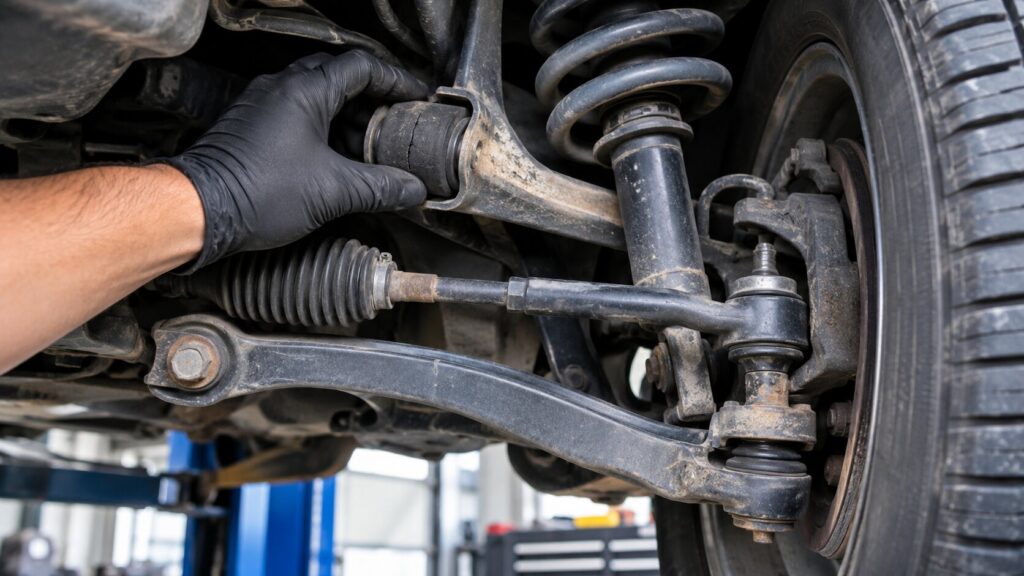
Driving over the harsh frost heaves along Shoreline Drive continually forces weak bushings and joints past their structural limits, causing your vehicle to pull to one side despite recent alignment adjustments. Over time, even minor degradation in these rubber and socket components allows road impacts to dynamically alter your tire geometry while driving. Identifying and replacing these worn suspension parts is the only way to stop this recurring drift and protect your tires from premature wear.
How Worn Suspension Components Compromise Alignment Geometry
Proper wheel alignment relies on rigid mechanical links to maintain consistent tire contact with the road. When control arm bushings, ball joints, or tie rod ends wear down, they introduce excess play into the steering system.
This free movement allows the wheels to shift position while underway, completely undoing any precise alignment service. We frequently find that a minor 1/16-inch tear in a rubber bushing allows a wheel to push backward during hard stops, altering toe and camber angles by more than 0.25 degrees.
The Role of Control Arm Bushings in Maintaining Stability
Control arm bushings act as the primary pivot point between your vehicle frame and the wheel assembly. Over time, road salt from Lake Minnetonka winter treatments, moisture, and local freeze-thaw cycles degrade the internal rubber casing.
As these bushings soften, the control arm shifts under the vehicle’s weight. Adjusting alignment angles without replacing degraded bushings provides only a temporary fix before the vehicle drifts out of specification again.
How Loose Ball Joints Shift Wheel Camber
Ball joints function as the main pivot connecting control arms to the steering knuckles. When internal grease breaks down, the ball and socket develop microscopic clearances that allow the wheel hub to tilt inward or outward.
This vertical looseness directly alters camber angles while driving, leading to erratic handling and uneven tread wear. When we test ball joint tolerances, we relieve suspension tension on the hoist to measure true physical play accurately with a dial indicator.
How Damaged Tie Rod Ends Disrupt Steering Alignment
Tie rods transmit direct force from the steering gear to the front wheels, locking in your vehicle’s toe settings. Inner and outer tie rod joints experience high stress every time you turn the steering wheel or strike a bump on Minnesota backroads.
When internal socket joints wear down, front tires tend to toe out under cornering loads, forcing you to make constant steering corrections on straight roads. Loose tie rods also introduce noticeable steering wheel vibration and delayed response.
Identifying Worn Su spension Components
| Component Name | Primary Symptom | Visual Inspection Cue | Typical Failure Cause |
| Control Arm Bushings | Steering drift during braking | Cracked, torn, or offset rubber | Salt corrosion, age, severe impacts |
| Ball Joints | Clunking noise over bumps | Ruptured dust boot, grease leaking | Lubrication loss, high mileage |
| Tie Rod Ends | Loose steering wheel feel | Excessive side-to-side wheel play | Road shocks, worn socket joint |
| Strut Mounts | Popping noise when turning | Dry rotted rubber, elevated center nut | Moisture intrusion, heavy loads |
Key Indicators That Your Suspension Requires Attention
Drivers often notice subtle feedback behind the wheel long before severe handling issues emerge on local commutes:
- A steering wheel that sits off-center even when traveling on a completely flat, straight road segment.
- A wandering feel at highway speeds that requires continuous steering corrections to stay in your lane.
- Delayed response or a soft, imprecise feeling when initiating a turn.
- Unusual vehicle body sway when changing lanes or navigating roundabouts.
Protecting Your Vehicle Through Complete Inspections
Ignoring repeated alignment failures leads to accelerated tire replacement costs and places extra strain on connected steering rack assemblies. Continuous movement in worn suspension components can eventually lead to joint separation and loss of vehicle control.
We perform comprehensive inspections to identify minor bushing tears and joint play before they cause total suspension failure on the road. Addressing underlying structural wear ensures that your next wheel alignment maintains proper stability over the long haul.
Schedule Your Precision Suspension Service in Spring Park
If your alignment keeps going out, my team is ready to inspect your suspension and restore your vehicle’s handling. We thoroughly evaluate control arms, ball joints, and steering linkages to fix the root cause of persistent alignment drift.
Visit us at 4700 Shoreline Drive, Spring Park, MN 55384, or contact our shop directly through Certified Auto Repair to schedule your diagnostic service today.
Frequently Asked Questions
Why does my vehicle pull to one side right after a fresh alignment?
Worn suspension parts like control arm bushings or ball joints are likely shifting under driving loads. Alignment machines measure static positions on the rack, but worn parts flex dynamically when accelerating or braking on the road.
Can bad shock absorbers or struts cause alignment problems?
Yes. Worn shocks and struts allow excessive body roll and vertical movement, which rapidly alters toe and camber geometry while driving. Weak struts also cause uneven tire cupping that mimics severe alignment drift.
How often should my suspension components be inspected?
At least once a year or during every routine wheel alignment service. Early detection of damaged rubber boots and slight joint play prevents severe mechanical failure down the road.
What happens if I keep driving with worn suspension components?
Driving on degraded suspension parts accelerates uneven tire wear and places unnecessary strain on neighboring components like steering racks and CV axles. Extreme wear can lead to joint separation, resulting in a total loss of steering control.