High-mileage vehicles navigating Lake Minnetonka road conditions often lose wheel alignment due to worn control arm bushings, sagging struts, and joint play. Routine precision adjustments paired with component wear checks eliminate rapid tire scrubbing, restore straight tracking on slushy roads, and prevent costly steering system damage.
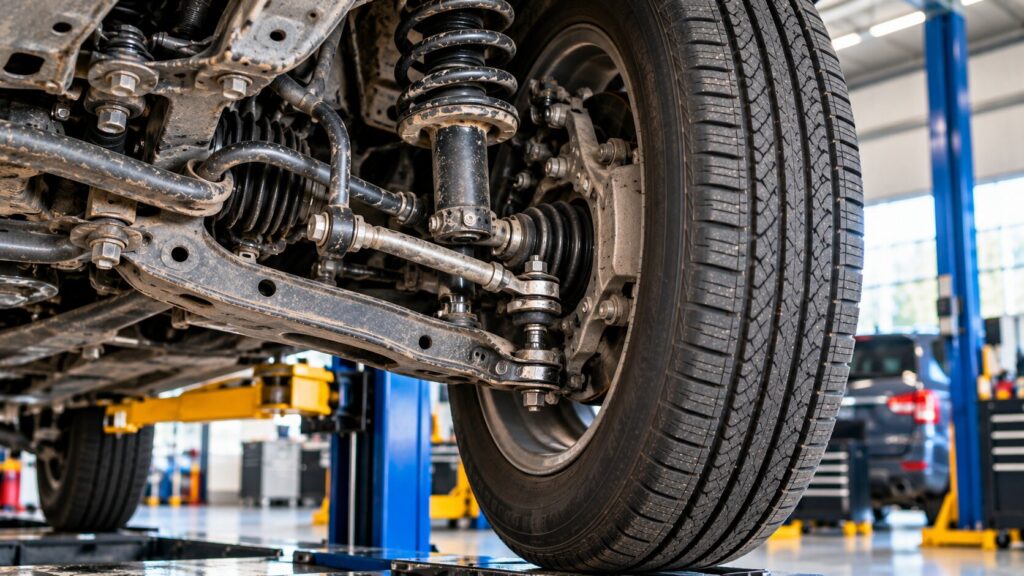
Driving around Lake Minnetonka on County Road 15 subjects high-mileage suspensions to constant lateral stresses and freeze-thaw cycles that push wheel geometry past factory thresholds. As vehicles age past 100,000 miles, worn rubber control arm bushings and tired struts prevent alignment settings from holding, leading to rapid, uneven tire wear and erratic handling. Regular precision adjustments matched with component wear checks restore tracking, improve fuel economy, and preserve your tire life.
How Road Impacts and Aging Parts Displace Your Alignment
Vehicle suspensions rely on precise geometric angles to keep tires flat against the road surface. Over time, navigating frost heaves and potholes along Spring Park roads compresses rubber bushings, fatigues coil springs, and introduces micro-play in ball joints and tie rod ends.
We frequently see how even minor wear shifts the subtle camber, caster, and toe settings calibrated by the factory. When these angles wander past factory tolerances, the tire tread scrubs against the pavement rather than rolling smoothly, causing premature wear and reduced traction on wet or icy roads.
Spotting the Signs of Alignment Shift
We frequently see how even minor wear shifts the subtle camber, caster, and toe settings calibrated by the factory. When these angles wander past acceptable tolerances, the tire tread aggressively scrubs against the pavement rather than rolling smoothly, causing premature wear and drastically reduced traction on wet or icy roads.
On higher-mileage vehicles, distinct warning signals appear long before a total steering component failure occurs. Catching these early saves your expensive tires from irreversible damage:
- Off-center steering wheel: The vehicle tracks straight down the road, but the steering wheel sits noticeably rotated to one side.
- Vehicle pulling or drifting: The car constantly pulls toward the shoulder or centerline on flat stretches of asphalt.
- Uneven tread wear: Tread edges show feathered patterns, severe inner-shoulder wear, or cupping across the tire surface.
- Vibration at speed: Unbalanced suspension angles cause subtle feedback through the floorboard or steering column.
Why Fresh Adjustments Fail Without Bushing and Linkage Repairs
Attempting to align a high-mileage vehicle without evaluating underlying mechanical slop produces short-lived results. Adjusting alignment tie rods sets toe angles accurately on the rack, but degraded rubber control arm bushings allow the wheel to shift dynamically under braking and acceleration.
Likewise, sagging struts lower chassis ride height, permanently altering camber angles beyond what standard adjustment cams can correct. We always address worn hardware alongside alignment work to ensure your tires remain parallel under real-world driving conditions.
Specialized Testing Keeps Old Suspensions Tracking Straight
Evaluating high-mileage alignment requires checking the mechanical health of every joint alongside laser target measurements. We inspect ball joints, hub bearings, and sway bar links for minor play that compromises static measurement.
Dynamic suspension testing reveals how components react under load, confirming whether tie rod threads retain adjustment tension or require replacement. Measuring actual ride height pinpoints spring fatigue, helping us determine whether custom shims or fresh struts are required to hold specification.
Real-World Shop Note: We routinely see vehicles come in with toe-out conditions exceeding 1/8 inch after hitting County Road 15 frost heaves. Standard adjustment cams cannot lock settings in place when lower control arm bushings exhibit over 3mm of dynamic deflection under load. Replacing worn bushings is mandatory before locking down final rack settings.
Tailoring Wheel Geometry for Upper Lake Minnetonka Roads
Local driving demands alignment settings calibrated for regional winter weather and uneven road surfaces. Standard factory specs assume pristine road surfaces, but our local Mound drivers frequently contend with rutted ice, gravel patches, and sharp pavement transitions.
Slightly tweaking toe-in settings within safe factory ranges provides better straight-line stability on slushy roads. Checking thrust angles ensures the rear wheels track directly behind the front wheels, preventing dangerous crab-walking behavior on slippery bridge decks along Highway 12.
Restoring Precision Handling and Protecting Your Tires
Our team evaluates suspension joints, replaces tired bushings, and sets exact four-wheel alignments designed for local driving conditions. If your vehicle pulls to one side or shows uneven tire wear, visit us at Certified Auto Repair, located at 4700 Shoreline Drive, Spring Park, MN 55384, to get your alignment precisely recalibrated today.
Frequently Asked Questions
How often should high-mileage vehicles get an alignment check?
Every 12,000 miles or once a year is the recommended interval for high-mileage alignment checks. Annual checks catch subtle bushing deflection and joint wear before they destroy expensive tires. An immediate inspection is also necessary after impacting major potholes or curbs.
Can bad struts ruin a fresh wheel alignment?
Yes, worn or sagging struts directly alter your vehicle’s camber and toe angles by changing ride height. When struts lose structural support, the suspension collapses inward, causing inner tire wear that alignment adjustments alone cannot fix. Replacing failed struts before performing an alignment ensures long-term setting stability.
What is the difference between front-end and four-wheel alignment?
A front-end alignment only adjusts the angle of the front steering wheels, leaving the rear axle untouched. A four-wheel alignment measures and recalibrates all four wheels to ensure they track completely parallel to the vehicle centerline. Most modern high-mileage cars, crossovers, and SUVs require four-wheel alignments for proper handling.
Will an alignment fix a steering wheel vibration?
No, an alignment primarily corrects vehicle tracking and tire wear patterns rather than rotating balance issues. Steering wheel vibration usually stems from unbalanced tires, bent wheels, or warped brake rotors. However, severe misalignments cause tire cupping, which creates secondary highway vibrations.