Cold weather and road salt frequently cause electrical corrosion inside a vehicle’s mass airflow sensor harness, disrupting low-voltage signals to the powertrain control module. This triggers default rich fuel trims, dashboard warning lights, and engine surging. Advanced diagnostics using oscilloscopes and multimeters pinpoint these hidden resistance drops, preventing costly and unnecessary harness replacements.
When your check engine light pops on during a freezing morning commute, it feels frustrating. Modern vehicles are packed with sensitive electronic sensors that constantly check their own health and engine performance. But when winter moisture and road salt team up under the hood, those electronic signals can get scrambled.
Instead of guessing what is wrong or ignoring a warning light, understanding how these systems work can save you time, stress, and expensive repair bills.
Why Your Car Stumbles When the Weather Drops
If you drive around Spring Park during a deep winter freeze, you know how brutal the road salt and wild temperature swings can be. That heavy salt spray creeps under the hood, finding its way into tight electrical plugs—especially the ones attached to your mass airflow sensor, which measures the air entering your engine.Think of it like a corroded battery terminal or a bad cell phone connection: a powdery, blue-green buildup forms inside the plug, blocking the clean flow of electricity.
When the car’s computer stops getting clear updates from its sensors, it panics and switches into a heavy backup fuel mode. That is why your engine might surge, hesitate, or feel sluggish at a stop sign long before a standard mechanic’s code reader picks up a permanent fault. When a car rolls into my shop after a freezing Lake Minnetonka moisture cycle, I frequently see this hidden corrosion breaking down low-voltage communication signals.
How Modern Car Sensors Work (Without the Engineering Degree)
Under normal conditions, your car’s computer relies on precise electrical signals to figure out how much fuel and air the engine needs. Inside sensors like the mass airflow meter, a tiny heated wire maintains a steady temperature. As air flows past it, the computer tracks how much current is needed to keep that wire warm.
However, local weather plays a massive role in breaking this down:
- Condensation and Cold: When warm engine air meets freezing metal, moisture forms right inside tight electrical connections .
- Road Salt Damage: Salt mixed with trapped moisture accelerates corrosion, ruining clean metal contacts.
- Signal Distortions: Instead of a smooth, steady signal, the damaged connection sends erratic voltage drops to the computer. The car misinterprets these drops as sudden engine changes, constantly adjusting fuel levels and destabilizing your idle.
On a direct-injection platform experiencing random lean codes after a Lake Minnetonka slush storm, my scope showed a 350mV ground offset on the MAF return wire caused by green copper carbonate fuzz inside pin 4, entirely bypassing standard OBD-II fault logic.
How to Find and Fix Hidden Electrical Glitches
When a car rolls into my bay with a stubborn warning light, plugging in a basic code reader is often just the first step. To find the real root cause, I use advanced tools to look past simple stored codes:
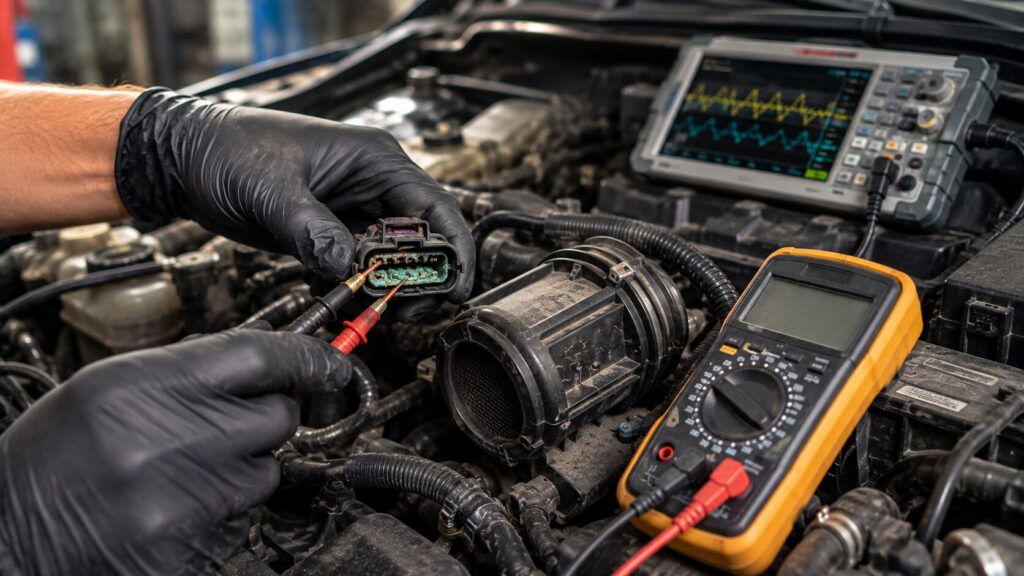
- Watch Live Waveforms: I hook up specialized diagnostic oscilloscopes to watch live voltage patterns, catching electrical drops that standard scanners miss entirely.
- Replicate Real Road Behavior: I test how sensors respond while checking if outputs drop out during acceleration.
- Inspect for Moisture Damage: I look closely under high magnification to spot green oxidation hiding inside electrical plugs.
- Measure Circuit Resistance: Using high-resolution multimeters, I hunt down tiny resistance spikes across wire crimps.
- Restore Clean Connections: I clean or replace damaged pins to wipe out electrical resistance and get the computer talking clearly to your sensors again.
Stop Guessing at Dashboard Lights
Ignoring a persistent warning light caused by bad sensor data can eventually lead to bigger problems, like unburned fuel washing down cylinder walls or destroying your catalytic converter. Unfortunately, some dealership service centers push for expensive, complete wiring harness replacements without addressing the actual environmental cause.
If your dashboard is lit up and your car is acting up, bring your vehicle to Certified Auto Repair located at 4700 Shoreline Drive, Spring Park, MN 55384, and let our expert technicians get to the bottom of it.
Frequently Asked Questions
Does cold weather cause check engine lights to turn on?
Yes. Temperature drops increase electrical resistance across corroded sensor connector pins, pushing marginal circuits out of normal limits and triggering dashboard warning lights.
Can I drive safely with an active sensor warning light?
Yes, but only for short trips. The car’s computer switches to a temporary backup mode to keep you moving, but driving long distances with bad sensor data wastes fuel and can damage emissions parts.
Do modern car sensors fail prematurely from moisture?
Yes. Moisture mixed with road deicing chemicals causes corrosion on terminal pins, breaking the low-voltage communication signals between the sensors and the central computer.
Do technicians use special tools to test intermittent sensor issues?
Yes. I use digital storage oscilloscopes to record live voltage signals over time, catching electrical drops and noise that standard code readers miss completely.