I regularly diagnose check engine lights after battery swaps because the Powertrain Control Module loses its Keep-Alive Memory. This sudden disconnect erases your adaptive driving data, causing erratic idle and lost fuel baselines. To successfully restore factory parameters, I perform an electronic throttle relearn and a specific drive cycle.
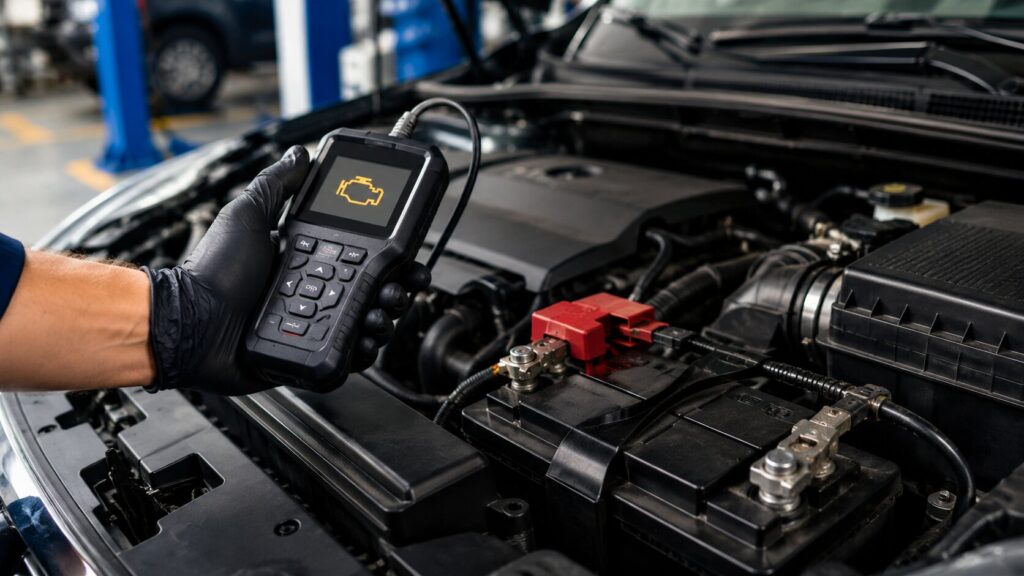
Most modern vehicles operate as complex networks of interconnected digital modules rather than simple mechanical machines. When a battery is disconnected during a DIY swap, power is instantly severed to the Keep-Alive Memory (KAM) that holds your specific adaptive driving data. Because the PCM suddenly lacks its long-term learned baselines for fuel trim and idle control upon startup, it inevitably triggers a fault code to warn you of the calibration mismatch.
Understanding Keep-Alive Memory and Idle Trim
Car computers do not rely solely on factory settings; they constantly learn and adjust how your engine runs based on your daily driving habits. This learned data is saved in a temporary memory that needs a constant, steady trickle of electricity to stay stored.
When you disconnect the battery, that memory wipes out instantly, forcing the computer to reset to a blank slate. If your throttle has built up carbon over the years, the computer incorrectly positions the throttle plate for clean airflow, leading to a rough idle or stalling. The computer spots this sudden mismatch, logs a fault, and turns on your check engine light.
Why Minnesota Weather Increases Electrical Fatigue
Local weather puts immense strain on vehicle electrical systems. Rapid shifts from humid summers to sub-zero winters wear down batteries quickly, while short, stop-and-go winter commutes prevent the alternator from fully recharging them.
Why Cold Weather Triggers Ghost Codes
- Heavy Cranking Load: Sub-zero temperatures thicken engine oil, forcing the starter to pull massive electrical current.
- Voltage Sags: An aging battery can briefly drop below 10 volts during this heavy cranking.
- Module Brownouts: This momentary power dip causes digital computer modules (CAN-bus) to suffer mini-blackouts, generating communication errors and fake ghost codes.
Installing a new battery supplies the necessary power to fix the starting issue, but it cannot automatically erase the old warning logs left behind in the computer system.
How to Reset Vehicle Learning Parameters
A tow to the dealership isn’t always necessary to clear post-replacement warning lights. While systems often self-correct, this three-stage professional workflow usually expedites the process:
1. Hard Reset Verification
First, inspect the new battery terminals. They must be tight and free of oxidation. A loose connection acts like a resistor, causing voltage drops that mimic a failing battery. Clean cable clamps with a wire brush until the metal shines, then torque them to manufacturer specifications.
2. Electronic Throttle Body Relearn
Modern vehicles require specific protocols to calibrate the throttle plate’s closed and open positions. While some systems auto-calibrate during idle, a bidirectional scan tool is often required to force the command. Without this, engines frequently surge between 500 and 1,200 RPM at stoplights.
3. The Comprehensive Drive Cycle
Take the vehicle on a 15-minute test drive combining city stop-and-go with steady highway cruising. This allows oxygen sensors to reach operating temperature and the PCM to recalculate fuel trims. Once sensor readings align with expected maps, the computer clears the light and sets diagnostic monitors to “Ready.”
When to Seek Professional Diagnostic Assistance
If you’re seeing a P0507 (Idle Control System RPM Higher Than Expected) immediately after a battery swap, don’t throw parts at it. It’s almost always a Keep-Alive Memory reset. If the code persists after a drive cycle, I’m looking for a vacuum leak or a carbon-fouled throttle body that the PCM can no longer compensate for.
A persistent check engine light may indicate the new battery is masking deeper issues, such as a failing alternator or parasitic drain. If headlights dim at idle or the light returns quickly, the charging system might be introducing ripple—alternating current noise—into the electrical system.
I use an oscilloscope to analyze the voltage waveform directly. Excessive AC ripple confuses digital sensors, leading to rapid module failure. If ripple is detected, computer resetting won’t fix the issue; the alternator must be replaced to protect the vehicle’s sensitive electronics.
Expert Troubleshooting at Certified Auto Repair
Unresolved dashboard warnings often mask deeper communication faults or charging failures that can escalate into no-start conditions. We prioritize expedited electronic resets and precise diagnostic workflows to minimize your vehicle’s downtime.
Clearing a code isn’t the same as fixing the fault. If your check engine light is mocking you after a battery change, bring your vehicle to Certified Auto Repair at 4700 Shoreline Drive, Spring Park, MN 55384. I’ll hook it up to our shop-level scanner, verify the idle trim data, and ensure your alternator isn’t pushing AC ripple into your modules.
Frequently Asked Questions
Does replacing a car battery always trigger a check engine light?
No, but it is common on vehicles with electronic throttle bodies. When battery power is lost, the PCM loses adaptive memory, leading to temporary sensor calibration errors.
Will driving the car normally eventually clear the light?
Yes, in many cases, the vehicle completes a self-calibration process after several drive cycles. If the light persists after three days of commuting, the computer has likely detected a genuine mechanical or electrical fault.
Can a weak battery installation cause multiple sensor errors?
Yes, loose terminals or voltage drops during startup cause control modules to lose communication. This results in ghost codes across the transmission, ABS, and engine management systems.
Do I need specialized equipment to reset throttle actuators?
Yes. While some vehicles perform a ‘key-on, engine-off’ self-relearn, most modern CAN-bus systems require a bidirectional scan tool to trigger the electronic throttle actuator control (TAC) reset.