Freezing temperatures, road salt, and moisture trigger check engine lights by cracking aging sensors and corroding wiring in high-mileage vehicles. Sub-zero cold increases electrical resistance, drops battery voltage, and fractures internal components. A professional diagnostic test isolates voltage drops and sensor heater failures before unburned fuel damages your catalytic converter.
What We See in the Bay
A perfect example of winter-induced sensor failure recently rolled into our shop. Instead of guessing, we pulled the data to see exactly what the engine computer was experiencing:
- Vehicle: 2014 Chevy Silverado 1500 (5.3L V8) with 148,200 miles.
- Trouble Codes: P0171 / P0174 (Engine Running Too Lean on Banks 1 & 2).
- The Data: The ECU was dumping 28% extra fuel into the cylinders because an oxygen sensor signal was stuck low at 0.12 Volts.
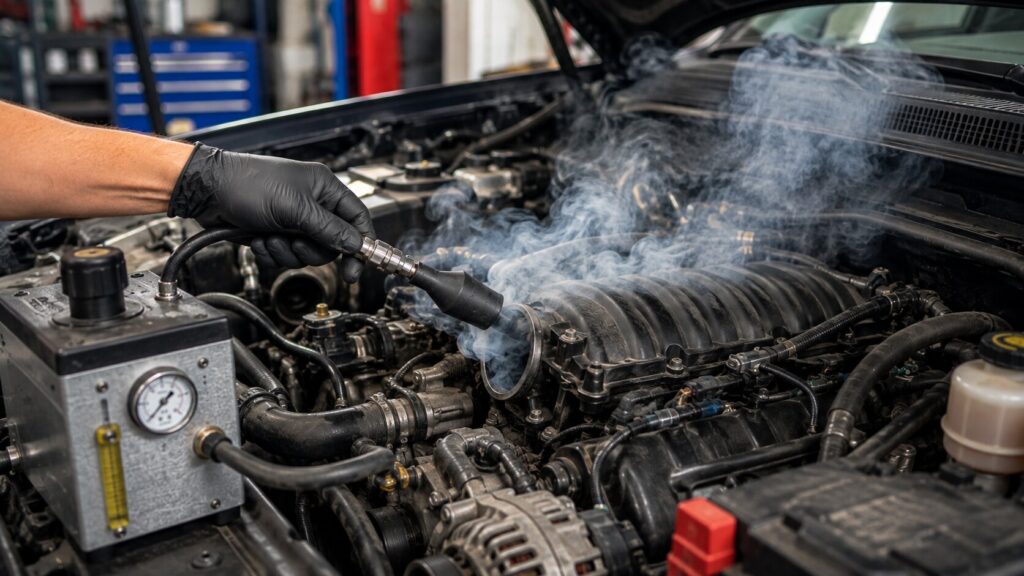
While a parts store might tell you to buy new O2 sensors, our smoke test revealed that freezing weather had cracked the rubber intake manifold gaskets. Cold air was sneaking past the shrunken seals, tricking the functional sensors into thinking the engine was starved for gas. We replaced the hardened manifold gaskets, and fuel levels instantly returned to normal. If freeze-frame data shows fuel trims pinned at +28% at idle, do not replace the O2 sensor without cold-soaking the intake with a smoke machine first.
Why Minnesota Winters Destroy Older Sensors
After 140,000 miles of thermal cycling in brutal Minnesota winters, internal O2 sensor seals turn into brittle plastic. During slushy commutes along Shoreline Drive, liquid road salt splashes directly onto hot exhaust parts, rapidly rusting metal housings and electrical ground straps.
When you park your car overnight in freezing weather, capillary action pulls melted snow and saltwater through microscopic cracks in those degraded seals. The trapped moisture freezes sub-zero overnight, and the expanding ice physically snaps the delicate ceramic circuit board inside the sensor housing. Without a solid electrical ground, the sensor sends a false “low voltage” signal, causing the computer to flood the combustion chamber with excess gas that washes away protective oil and fouls your spark plugs.
How to Isolate the Real Problem in the Shop
Don’t throw parts at a code; pull freeze-frame data to see what the ECU saw the millisecond the MIL tripped.
- Checking Live Computer Signals: I plug in a scanner to monitor live sensor response time at operating temperature. A healthy upstream oxygen sensor rapidly toggles between 0.1 Volts and 0.9 Volts at 1–2 Hz. If cycle latency exceeds 800ms or stays pinned below 0.3 Volts, the ECU sets a slow response fault (P0133) before complete failure. I test these lagging units for harness damage or sensor contamination.
- Testing for Air Leaks with Diagnostic Smoke: Before replacing components for lean codes (P0171/P0101), I pump dense diagnostic smoke into the intake tract at 3 PSI. Sub-zero temps shrink hardened intake gaskets, letting unmetered air leak in and tricking functional sensors into triggering fault codes.
- Measuring Circuit Resistance with a Multimeter: Modern sensors rely on internal heating elements to reach their 600°F operating temperature on cold starts. I use a digital multimeter across the heater circuit wires to check resistance. Readings above 15 Ohms (or an open circuit) indicate a burnt element, causing rough idles and poor cold-start efficiency.
Pro Tip: Never spray aerosol solvents directly onto an installed Mass Air Flow (MAF) sensor. The extreme thermal shock of cold spray hitting a warm wire can easily snap the microscopic platinum element inside.
Signs Your Sensors or Wiring Are Failing
Winter weather exposes pre-existing electrical issues almost immediately. If you notice any of these drivability changes on a cold morning, your engine management system is struggling to adapt.
| Diagnostic Symptom | Potential Root Cause |
| Rough Cold-Start Idle | Open sensor heater circuit failing to reach operating temperature. |
| Sudden Drop in MPG | Degraded sensor biasing low, forcing continuous rich fuel enrichment. |
| Hesitation Under Load | Corroded harness pins delaying signal delivery from the airflow sensor. |
| Intermittent MIL in Wet Weather | Cracked wire insulation letting slush and moisture short the circuit. |
Three Cascading Failures We See Every Winter
Ignoring a sensor issue when the temperature drops often leads to a domino effect of expensive repairs. Here are the three most common secondary failures we see:
- Saturated Lower Harnesses: Oil leaking from valve cover gaskets degrades the protective loom on lower O2 sensor wiring. Once cold slush hits oil-softened wire insulation, it creates an instant short to ground.
- Low-Voltage ECU Logic Resets: During a sub-zero start in Spring Park, an aging battery dropping below 9.6 Volts during cranking clears the ECU’s adaptive fuel parameters and trips false sensor codes (P0131/P0102).
- Melted Catalysts from +25% Fuel Trims: Driving on a “stuck low” O2 sensor forces the ECU into continuous rich enrichment. Raw fuel dumping into the exhaust drives converter substrate temperatures past 1,800°F, melting the internal honeycomb.
Stop Guessing With O2 Sensors in Spring Park
If your high-mileage vehicle is throwing P0171 lean codes or running rough after a cold night near Lake Minnetonka, throwing parts at it won’t fix shrunken manifold gaskets or corroded grounds.
Bring your vehicle to Certified Auto Repair at 4700 Shoreline Drive, Spring Park, MN 55384. We will run a 3 PSI cold-intake smoke test and pull live freeze-frame fuel trim data to pinpoint the exact failure point before you spend money on unnecessary parts.
Frequently Asked Questions
Can I drive my car with a solid Check Engine Light on?
Yes. You can drive short distances if the engine runs smoothly and the light is solid, but an unmetered air leak running +28% fuel trim will dump raw gas down the exhaust, destroying the catalytic converter within 200 miles.
Why do sensor issues spike right at the start of winter?
Sub-zero cold shrinks hardened rubber intake seals, drops cranking battery voltage below 9.6V, and traps liquid road salt in cracked harness insulation. These environmental factors instantly expose pre-existing hairline fractures in aging oxygen and MAF sensor circuits.
How do I know if my Check Engine Light is a bad sensor or a major mechanical failure?
A steady Check Engine Light with normal engine operation usually indicates a sensor or air leak fault, whereas a flashing light indicates an active engine misfire that allows unburned fuel into the exhaust system.
Will an active sensor code cause my car to fail an emissions test?
Yes. An active sensor code or incomplete readiness monitor will result in an automatic OBD-II emissions test failure in Minnesota.
Should oxygen sensors be replaced in pairs?
Yes. Opposing bank sensors experience identical heat cycles and mileage; replacing only one creates a response lag between engine banks.