Sliding into a snow-covered curb can bend lower control arms, warp steering knuckles, and throw off wheel alignment without damaging tire rubber. Left uncorrected, misaligned wheels cause rapid tread wear, steering pull, and reduced winter traction. A precision geometric inspection identifies hidden suspension damage to restore vehicle safety and handling.
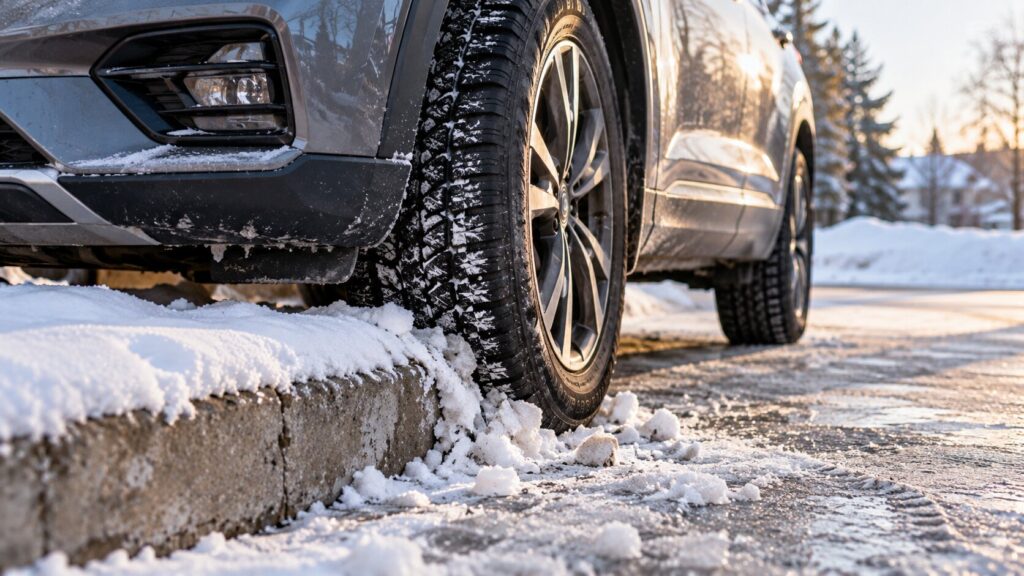
Hitting a hidden curb buried under fresh snow along Shoreline Drive in Spring Park can instantly bend an underbody component or throw off your steering angle without leaving a single mark on your tire. When navigating icy Lake Minnetonka winter roads, we frequently see local drivers deal with crooked steering and rapid tire wear after what seemed like a minor sliding bump.
Why Snow-Covered Curbs Cause Unseen Damage
When your car slides sideways into a curb in freezing weather, the impact force skips the soft rubber of the tire and goes straight into the metal parts underneath. Suspension assemblies are built to soak up up-and-down bumps from rough roads, not hard side-impacts against concrete. We often see a slide at just 5 miles per hour bend steering parts out of shape.
That sudden lateral hit forces the lower control arm to flex well beyond its structural limit. At the same time, cast iron steering knuckles can permanently warp, and tie rod threads can stretch or bend. Because rubber tires flex and bounce right back into shape, the outside of your wheel often looks brand new even while the metal frame holding it in place is severely bent.
Shop Floor Example: Last week, a driver came into our shop after sliding into a Shoreline Drive curb at under 10 mph. The tire looked completely fine, but our alignment rack showed the right front wheel was pushed out by nearly half an inch—all from a tiny, hidden bend in the lower control arm.
Common Signs Your Alignment Is Off
- Crooked Steering Wheel: Your steering wheel stays tilted to one side even when you are driving straight down the road.
- Car Pulling to One Side: Your vehicle constantly drifts toward the edge of the road when you loosen your grip on the wheel.
- Steering Wheel Shimmer or Shake: You feel a steady vibration or wobble in your hands that gets worse as you speed up.
- Uneven or Fast Tire Wear: The inner or outer edges of your front tires look scrubbed, smoothed out, or worn down unevenly.
- Squealing Tires on Sharp Turns: Your tires squeal on dry pavement when you make slow turns in a parking lot.
How Cold Weather and Impacts Hurt Metal Parts
Freezing Minnesota temperatures make steel and aluminum suspension parts stiffer and more brittle. When metal hits a hard object in sub-zero weather, it is much more likely to bend or crack instead of absorbing the shock.
| Part Damaged | What Happens to the Part | How It Affects Your Drive |
| Lower Control Arm | The metal arm or rubber joint bends | Shifts the wheel backward and tilts it sideways |
| Tie Rod | The steering rod bends or threads strip | Pushes the front of the tire outward |
| Steering Knuckle | The thick metal wheel mount warps | Causes the steering to pull and bind when turning |
| Wheel Bearing Hub | Internal steel rings get gouged | Creates a loud humming sound that grows worse over time |
How We Find and Measure the Damage
We check your vehicle by mounting optical targets to your wheels on our digital alignment rack to verify factory tolerances:
- Toe Angle Check: We measure whether the front edges of your tires point inward or outward. A curb hit almost always forces the wheel outward into a toe-out condition, which drags the tire sideways down the road.
- Camber and Caster Check: Our system measures vertical wheel tilt and steering axis position. Significant variations here point to a bent strut, control arm, or frame mount.
- Underbody Inspection: We lift your vehicle and use pry bars to physically check ball joints and steering links for cracks, loose joints, or hidden play.
Protect Your Tires and Get Your Alignment Checked
Do not wait for a ruined tire to tell you your suspension is bent. My team at Certified Auto Repair uses precision diagnostic equipment to find hidden winter damage and straighten out your steering properly.
Visit our professional team at 4700 Shoreline Drive, Spring Park, MN 55384, or call us directly to get your vehicle checked and schedule your wheel alignment today.
Frequently Asked Questions
Can hitting a curb damage my car without marking the tire?
Yes. Tires flex and spring back into shape after an impact, leaving no marks on the rubber. However, the force travels past the tire into metal parts like tie rods and control arms, bending them out of shape.
How soon should I get an alignment check after hitting a curb?
Immediately, or within 50 miles. Driving on misaligned wheels drags your tires across the road, causing severe tire wear and putting extra strain on your wheel bearings.
Will a standard wheel alignment fix curb damage?
No. An alignment only adjusts healthy parts. If a control arm or tie rod is physically bent, we must replace that part first before we can properly align your wheels.
Can a bent control arm make my car pull to the side?
Yes. A bent control arm changes the angle and position of the wheel, which forces the car to pull toward one side of the road. Replacing the bent arm and setting the alignment restores smooth, straight driving.