When your vehicle receives a software update or module reflash, the Engine Control Module (ECM) often tightens the acceptable voltage ranges for aging sensors. This digital-to-physical mismatch is a leading cause of post-update check engine lights. Our technicians use factory-level tools to clear adaptation memory, execute sensor relearns, or match revised hardware to new software parameters.
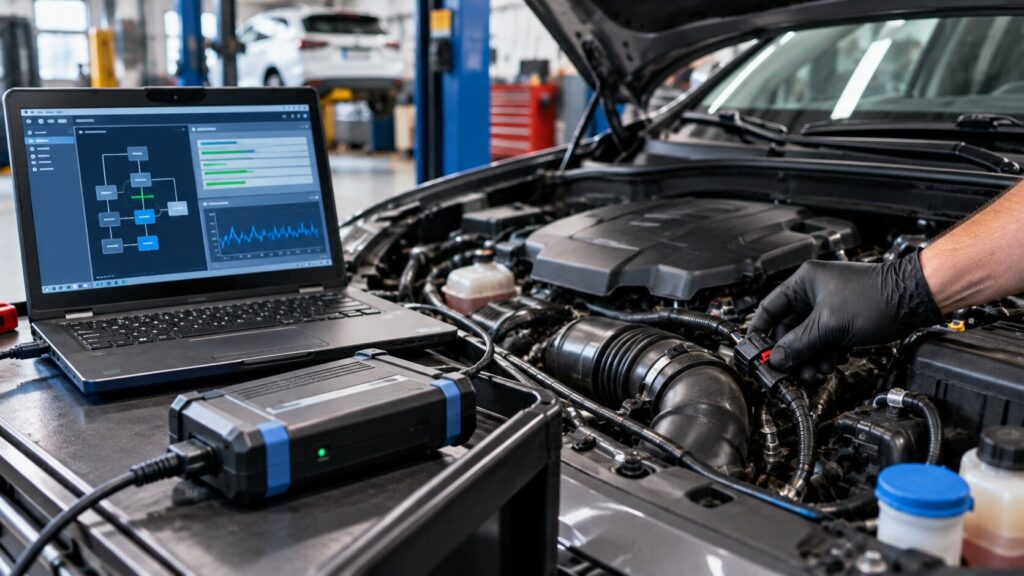
When a car leaves the dealership after a routine module reflash or receives a fresh over-the-air update, seeing a new check engine light on the dashboard can feel completely unexpected. Drivers often assume a physical part broke right during the update process.
In reality, the hardware itself often hasn’t changed at all—the software rules evaluating it did. Modern vehicles rely on precise control algorithms to interpret incoming sensor signals, and a factory calibration update can shift those interpretation windows overnight. Understanding how digital threshold updates collide with physical wear helps pinpoint whether your vehicle needs a quick computer adaptation reset or an updated component part number.
Factory Software Updates Shift Sensor Operating Tolerances
When I reflash a PCM using an OEM J2534 pass-thru device, the manufacturer changes the mathematical algorithms evaluating incoming signal voltage. An O2 sensor circuit that once allowed a ±15% long-term fuel trim variance might instantly flag a P0171 bank-lean code if the new software caps acceptable deviation at ±8%.
The shift isn’t a hardware failure; it’s a software threshold movement. During winter thaws along Shoreline Drive, road salt corrosion on ground straps adds 0.3 Ohms of resistance to sensor reference circuits. Under old factory code, the module ignored that voltage drop. After an over-the-air update, that minor resistance shift pushes live sensor output outside the newly restricted parameter map.
- Targeted Voltage Shift: Updated code drops allowable sensor signal variance from 0.5V down to a strict 0.15V window.
- Narrowed Response Timing: Heated oxygen sensors must hit full closed-loop operation within 12 seconds of cold start—down from the previous 25-second buffer.
- Aggressive Monitor Execution: Onboard emissions readiness monitors now run within 3 miles of driving, rather than waiting for extended highway drive cycles.
The ECM Decides If a Sensor is Working
A sensor does not decide if it is working—the ECM does. When monitoring live PID streams on a PicoScope, I see clean 0–5V analog square waves coming off a Mass Air Flow sensor, yet the updated PCM sets a pending P0101 fault code. The physical wire is intact, but the updated air-density translation table interprets that specific voltage as an implausible intake value.
Humidity coming off Lake Minnetonka regularly alters cold-start intake air density values. Older ECU firmware compensated for this moisture load with a wide fuel-enrichment table. Updated emissions logic removes that cushion to reduce tailpipe emissions, leaving local drivers in Spring Park with unexpected driveability stumbles right after a service flash.
Why a Check Engine Light Appears Immediately After an Update
When a vehicle leaves the shop post-update, its internal adaptation memory is wiped clean. As you drive down Shoreline Drive toward Route 15, the ECM executes active self-tests on zeroed-out memory maps. If an aging sensor exhibits even slight signal drift from internal wear, it fails the initial drive-cycle validation before the module can write new long-term adaptive values.
Diagnostic Verdict: I pulled a P0171 code on a 2021 GM 5.3L after a dealer PCM reflash. The update tightened long-term fuel trim limits from ±20% down to ±12%. The MAF sensor was reading 4.1 g/s at idle—well within old factory specs—but the new calibration flagged it immediately due to a 0.4 g/s drop caused by light PCV vapor buildup on the sensing wire. Cleaning the element dropped idle flow back into the 4.5 g/s target band and cleared the DTC.
Diagnostic Steps for Investigating Software-Related Sensor Faults
Guessing at parts based on a generic code reader causes wasted money. I follow a strict diagnostic procedure whenever a check engine light sets within 100 miles of a module update:
Check Calibration IDs & TSB Bulletins
Plug into the OBD-II port using factory-level scan tools (e.g., GM GDS2, Ford FDRS, or Autel MaxiSYS) to query the active Calibration ID (CAL ID) and Calibration Verification Number (CVN). Cross-reference these numbers against manufacturer Technical Service Bulletins to check if the update requires a revised physical component part number.
Scope Signal Lines under Load
Connect a multi-channel lab scope to the sensor signal wire, reference circuit, and ground line. Measure raw voltage spikes, signal noise, and ground drops under hard acceleration to verify circuit integrity independently of what the ECM reports on the scan tool.
Perform Forced Module Adaptation Resets
Execute dedicated bi-directional relearn protocols (such as Throttle Body Idle Relearn or Crankshaft Position Variation Learn) through the scan tool to force the module to establish a baseline under the new calibration logic.
Resolving Digital-to-Physical Mismatches
Resolving post-flash fault codes requires synchronizing the software logic with hardware capabilities. If an updated ECU expects faster response times than an aging sensor can deliver, installing an updated OEM part number—often designed with revised internal resistance or improved sensing elements—is the only permanent fix. Skipping mandatory relearn procedures guarantees the check engine light will return after three complete warm-up cycles.
Resolving Complex Automotive Diagnostic Challenges
Digital software updates and physical sensor degradation cross paths on every modern vehicle. If your check engine light is illuminated shortly after a dealership flash or over-the-air update, bring it to the bay at Certified Auto Repair located at 4700 Shoreline Dr, Spring Park, MN 55384. We scope raw signals, verify CAL IDs, and execute complete factory adaptation protocols to keep your vehicle running smoothly on Lake Minnetonka roads.
Frequently Asked Questions
Can a vehicle software update fix a check engine light?
Yes. Vehicle manufacturers frequently release ECM software updates to correct overly sensitive diagnostic logic that triggers false-positive check engine lights. Reflashing the module alters software thresholds, allowing normal sensor voltage fluctuations without setting a trouble code.
Do I need to replace my sensor if a software update caused the code?
Not always. Sensor replacement is not strictly required if the code stems solely from an incomplete relearn procedure or cleared adaptation memory. However, if physical sensor degradation or internal drift exceeds the updated software’s tighter operating tolerances, replacing the component becomes necessary.
How do I know if my car needs a module calibration update?
A factory-level diagnostic scan tool must pull your module’s active Calibration ID (CAL ID) and compare it against OEM TSB databases. If the manufacturer lists an updated flash revision addressing your specific fault code, a software calibration is required before replacing hardware.
Will resetting the battery clear software-related sensor codes?
No. Disconnecting the battery clears temporary fault memory from the module, but it does not roll back or erase installed software updates. Once the engine completes its self-test drive cycle, the updated calibration will detect the out-of-spec sensor and turn the check engine light back on.