A shifted subframe alters suspension geometry beyond standard adjustment limits, causing persistent steering pull and severe tire wear. Hard road impacts displace the frame along its mounting holes. Technicians must use specialized laser measuring equipment to loosen hardware, center the frame back to factory specs, and restore true vehicle tracking.
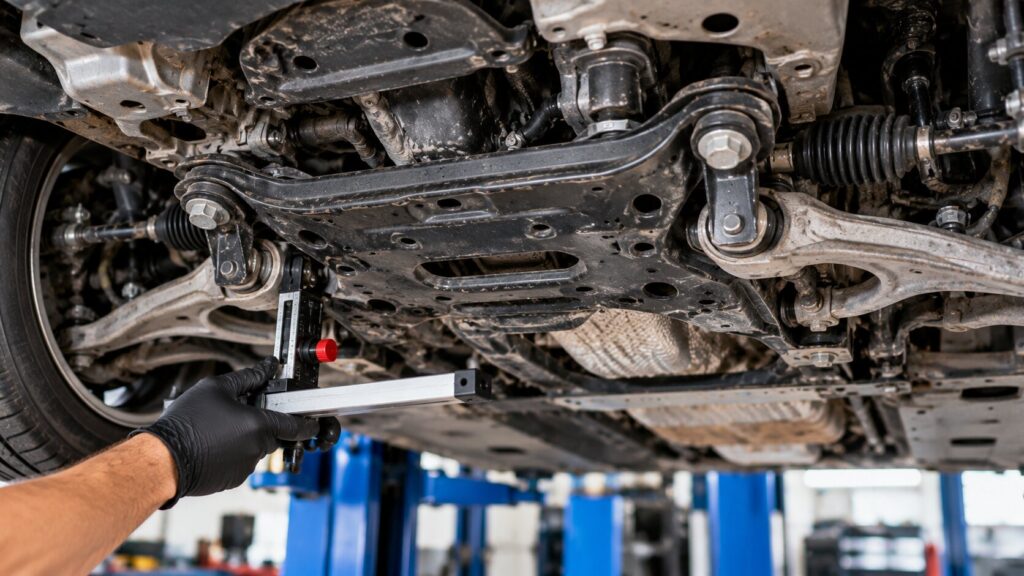
Shifted subframe mounting points on vehicles navigating severe freeze-thaw cycles along Shoreline Drive cause persistent steering pull that standard tie-rod and camber adjustments cannot correct. When severe impacts from hidden frost heaves or recessed utility covers force the secondary structural frame out of factory alignment, the entire lower suspension geometry shifts relative to the body structure.
Winter Road Impacts That Force Structural Subframe Shift
When a vehicle suffers a hard impact from rough winter roads around Spring Park, the heavy subframe holding your lower suspension components can shift out of position. This subtle structural movement alters your wheel angles beyond the range of standard adjustment cams. Restoring proper vehicle tracking requires diagnostic measuring equipment to center the subframe back to factory location before performing a final alignment setup.
Mechanical Physics Behind Subframe-Induced Alignment Distortion
Your vehicle relies on a heavy-duty lower structural frame to support the engine, transmission, and lower control arms. This entire assembly bolts directly to the unibody structure using specialized rubber or solid isolators positioned over locating dowels. Under normal driving conditions, these heavy-duty mounting points hold the lower suspension pivot points perfectly square with the rear axle centerline, ensuring your vehicle tracks perfectly straight.
A sudden impact against a sharp curb or frozen pothole creates a massive spike of lateral force. This energy travels through the lower control arm directly into the subframe mounting hardware. If the force exceeds the bolt clamping friction, the subframe slides along its oversized mounting holes, taking every lower control arm with it. A shift of just a few millimeters alters both caster and camber angles simultaneously; sliding the left side of the subframe forward increases left-front caster while reducing right-front caster, creating an immediate, aggressive pull toward the side with less caster angle.
Physical Symptoms Indicating Unibody and Subframe Misalignment
The most obvious symptom of a shifted subframe is a steering wheel that remains turned at an angle while you are driving straight down a flat highway. You will likely notice the vehicle drifts aggressively toward the shoulder the moment you release your hands from the wheel, and turning sharply in one direction will feel noticeably tighter or stiffer than turning in the opposite direction. Furthermore, brand new tires will show rapid, uneven tread wiping across the inner shoulder blocks within just a few thousand miles.
Shop Inspection Note: If your alignment printout shows camber or caster angles outside allowable limits on a vehicle with no bent control arms, we recommend checking the alignment hole marks on the subframe. Shifted subframes almost always leave clean paint lines or exposed bare metal right around the washer footprint.
Diagnostic Workflow for Centering Shifted Frames
Resolving complex geometry issues requires systematically measuring structural reference points against factory specifications rather than blindly adjusting tie rods hoping for a green screen. Here is how my team safely restores your frame geometry.
- Cross-Chassis Laser Measurements:
Placing the vehicle on a level alignment platform, we attach optical targets to primary unibody reference holes. Comparing cross-diagonal distance measurements from the front subframe bolts to opposite rear axle locator points confirms if the frame has shifted. .
- Isolator and Locator Pin Inspection
After raising the vehicle, we inspect the primary mounting locations. This reveals sheared locator pins, deformed rubber isolator sleeves, or asymmetric gaps around the main hold-down bolts that prove movement occurred.
- Steering Gear Centerline Offset
Measuring the distance from the steering rack housing to the inner tie-rod pivots shows if structural shift has pushed the entire steering gear off-center, which causes erratic electronic stability control interventions.
- Hydraulic Centering Pressure
After supporting the engine weight with an overhead bridge, we loosen all main subframe retaining bolts. Hydraulic alignment bars then shift the structure until factory alignment pin tools slide smoothly through both frame layers.
- Torque to Yield and Final Alignment
Installing new factory stretch bolts ensures proper clamping force when secured to manufacturer torque-plus-angle specifications. To complete the process, we run a multi-wheel alignment sequence to bring toe and camber angles back to ideal mid-spec positions.
Preventing Expensive Secondary Wear
Driving a vehicle with a misaligned lower frame places constant lateral stress on wheel bearings, steering rack seals, and lower ball joints. Continuing to force wheels to roll sideways scrubs tires flat in short order and wastes fuel through added rolling resistance. Addressing structural shift early prevents expensive secondary wear across your entire front suspension system.
At Certified Auto Repair, my experienced team provides precise, honest diagnostic evaluations to resolve complex steering and frame geometry issues. We combine advanced measuring tools with proven technical methods to ensure your vehicle travels straight and handles safely on every road. Visit our shop located at 4700 Shoreline Drive, Spring Park, MN 55384, where we are ready to assist you with complete alignment solutions.
Frequently Asked Questions
Can a standard wheel alignment fix a shifted subframe?
No, standard alignments only adjust tie rods, upper strut mounts, or factory control arm cams. If the primary frame holding those components is out of position, we must physically loosen and shift the subframe back to center before standard adjustments will work.
What causes a vehicle subframe to shift out of position?
Hard impacts against deep potholes, sharp curb strikes, or driving over heavy frost heaves can overcome bolt clamping force. The sudden lateral force pushes the subframe sideways or backward along its oversized mounting bolt holes.
How do I know if my steering pull is caused by a subframe issue?
If your vehicle continues to pull sideways after multiple alignments, or if your steering wheel remains crooked, a shifted frame is likely responsible. Unequal cross-caster measurements on your alignment report strongly point to a shifted lower subframe.
Is it safe to drive with an unaligned subframe?
Driving with a shifted subframe compromises your vehicle handling and causes rapid, uneven tire wear. Emergency braking and evasive steering maneuvers can become unpredictable because your suspension geometry remains out of spec.