A failing intake air temperature (IAT) sensor on a direct-injection Mercedes-Benz platform instantly corrupts air density calculations, distorting fuel trims and ignition timing. Recognizing the physics of NTC thermistor fatigue, monitoring real-time voltage drops, and executing precise multimeter back-probes prevents catastrophic catalytic converter meltdown and excessive cylinder-wall fuel wash.
When sub-zero cold snaps hit Lake Minnetonka, moisture-laden air and rapid engine-bay thermal cycling ruthlessly bake the intake tract of a modern Mercedes-Benz. When the intake air temperature sensor fails on direct-injection platforms like the M274 or M276, the Engine Control Unit (ECU) receives corrupted thermal data that instantly ruins fuel trims and ignition timing. I see this issue constantly at the shop when local commuters limp their luxury vehicles in, complaining of dead-throttle hesitation and sudden fuel economy drops.
How the Intake Air Temperature Sensor Works
The IAT sensor operates as a rapid-response thermistor mounted directly downstream of the air filter housing or inside the charge air cooler pipe.
- NTC Design: It utilizes a Negative Temperature Coefficient (NTC) thermistor element, meaning its internal electrical resistance drops exponentially as incoming air temperature rises.
- ECU Density Calculation: The ECU supplies a regulated 5-volt reference signal to the sensor circuit. By measuring the return voltage drop across the sensor, the computer calculates absolute air density.
- Combustion Metering: Cold air is dense and oxygen-rich, requiring a richer pulse duration; warm air requires precise trimming to maintain stoichiometric balance. The ECU cross-references this with the Mass Air Flow (MAF) sensor to meter milligrams of fuel with absolute precision.
Common Warning Signs of Sensor Degradation
When an IAT sensor drifts out of calibration, the ECU loses its baseline for air density mapping.
- Cold-Start Lurching: You will feel a rough, surging idle on startup as the computer struggles to reconcile conflicting thermal data between the engine coolant temperature (ECT) sensor and a frozen IAT signal.
- Throttle Sluggishness: You may experience severe hesitation during sudden acceleration because the computer miscalculates air mass, dumping excess fuel into the combustion chambers.
- Secondary Exhaust Symptoms: Watch for black smoke spikes, rapidly fouled iridium spark plugs, and an eventual Check Engine Light logging codes such as P0112 (Intake Air Temperature Circuit Low Input) or P0113 (High Input).
The Physics of Thermal Fatigue and Failure
The under-hood microclimate of a modern turbocharged luxury vehicle is brutally hostile.
- Heat Soak: Every time the vehicle undergoes a hot soak, residual heat from the turbocharger and cylinder head bakes the delicate plastic sensor housing.
- Epoxy Micro-Fracturing: The constant cycle of rapid thermal expansion and contraction causes microscopic stress fractures across the internal epoxy resin and the microscopic wiring bonds of the thermistor bead.
- Signal Voltage Spikes: Once micro-cracks form, internal resistance fluctuates wildly under vibration, sending erratic voltage spikes straight to the ECU and forcing the powertrain into a protective safety limp map.
Advanced Diagnostic Approaches for Luxury Vehicles
Pulling a generic diagnostic trouble code with an entry-level OBD-II reader is rarely enough to isolate an erratic IAT circuit. When a Mercedes rolls into the shop with suspected air-charge sensor issues, this is the exact diagnostic workflow:
- Bi-Directional Live Data Scan: I hook up an advanced diagnostic scanner to monitor live IAT voltage against ambient air temperature, looking for flatlined or sluggish data curves during engine warm-up.
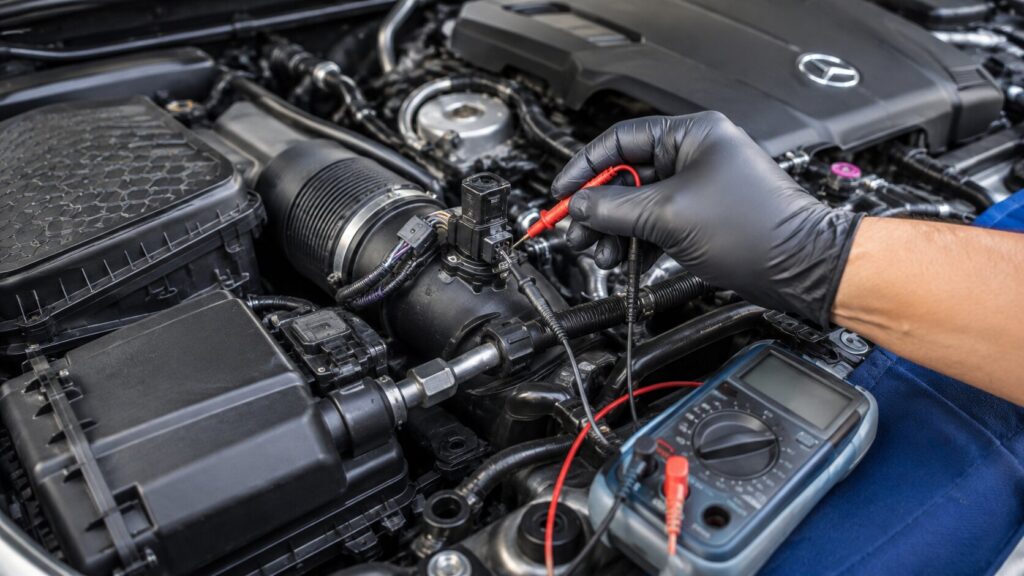
- Multimeter Back-Probing: I use a digital multimeter to back-probe the signal return wire directly at the sensor harness connector to check the live 5V reference return.
- Thermal Verification: I verify that the circuit shows a smooth, progressive voltage drop as the sensor absorbs heat, rather than erratic jumps or fixed resistance values.
My Diagnostic Verdict: If your live-data scan tool shows a fixed 4.9V or 0.2V flatline that refuses to shift during a Lake Minnetonka morning freeze, skip the resistance math—the thermistor bead is micro-fractured from thermal shock and needs an immediate, direct replacement.
Inspecting Wiring Harness Integrity and Connectors
Sometimes the sensor itself is completely intact, but the electrical path feeding the ECU has failed. The wiring harness spanning the intake tract is constantly exposed to engine vibration, oil vapor weeping, and rodent intrusion.
- Corrosion & Pins: Inspect the connector pins for green, crusty copper corrosion caused by localized moisture intrusion.
- Oil Contamination: If a failing valve cover gasket allows engine oil to pool inside the harness connector, it insulates the terminals and creates high electrical resistance, mimicking a dead sensor. Clean terminals or repair frayed wires before replacing hardware unnecessarily.
Long-Term Impacts of Ignoring Bad Air Density Data
Driving indefinitely with an inaccurate air temperature sensor creates severe, expensive secondary system failures:
- Catalytic Converter Meltdown: Running on an unnaturally rich fuel mixture floods the exhaust stream with unburned hydrocarbons, which ignite inside the catalytic converter honeycombs and melt precious metal substrates.
- Cylinder Wall Fuel Washing: Excess liquid fuel washes away vital boundary-layer engine oil from the cylinder walls, accelerating piston ring wear and diluting crankcase oil.
Professional Replacement Versus Temporary Fixes
Installing an Original Equipment Manufacturer (OEM) replacement sensor is mandatory. Budget aftermarket sensors frequently utilize inaccurate internal resistor curves that disrupt fuel mapping. The physical swap requires releasing the harness locking tab, twisting the old sensor out of its rubber grommet or threaded port, and seating a fresh unit with an uncompromised O-ring seal to eliminate unmetered vacuum leaks.
To secure prompt diagnostic work and expert repair without corporate dealership delays, bring your vehicle to Certified Auto Repair located at 4700 Shoreline Drive, Spring Park, MN 55384.
Frequently Asked Questions
Can a failing intake air temperature sensor trigger a check engine light?
Yes. The engine control unit logs a diagnostic trouble code when the sensor signal voltage falls outside expected manufacturer parameters for multiple consecutive drive cycles.
Will cleaning a dirty sensor fix internal electronic failure?
No. While surface oil residue can be wiped away with specialized electronic contact cleaner, internal material fatigue and broken thermistor bonds require total component replacement.
Does ambient weather change how the car drives with a broken sensor?
Yes. Severe cold snaps make drivability symptoms significantly worse because the computer must rely entirely on default substitute maps when outside temperatures fluctuate rapidly.
Is it safe to drive long distances with a faulty sensor?
No. Prolonged driving forces incorrect air-fuel ratios that can permanently melt your catalytic converters, wash down cylinder walls, and severely degrade your fuel economy.