Maintaining the 3.0L Hurricane or 2.0L I4 turbo engines in a Jeep Wagoneer requires precise boost pressure monitoring, which we verify using our ASE-certified diagnostic process. Driving the MN-7 corridor involves frequent acceleration cycles that stress wastegate actuators. Specialized scan tools are used to track boost PIDs, ensuring the twin-scroll system delivers peak torque without triggering overboost codes.
How High-Load Commuting Affects Wagoneer Acceleration and Heat Soak
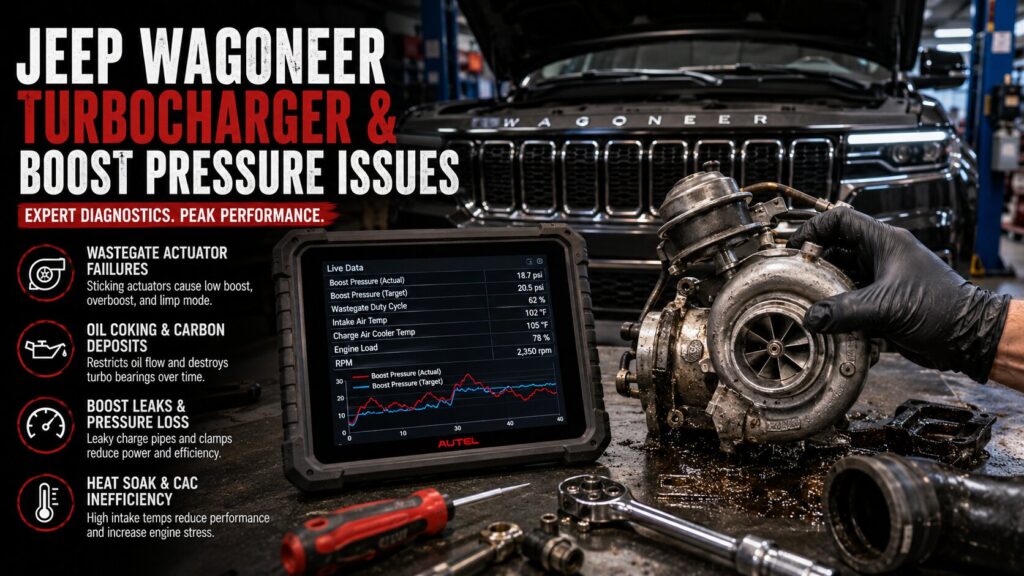
When a Wagoneer comes in struggling to merge, the first thing we look at is the correlation between engine load and boost delivery. High-load commuting in the Twin Cities creates a high-load/low-flow cooling paradox that prevents the intercooler from shedding heat between stoplight launches.
Identifying the Difference Between Turbo Lag and Wastegate Actuator Failure
We distinguish between normal spool-up time and mechanical lag caused by a sticking actuator arm. On the highway, a second of delay during a merge is more than a nuisance; it is a diagnostic red flag. The electronic wastegate actuator on the Hurricane engine handles an immense duty cycle.
Every time you lift off the throttle and then accelerate again, that actuator must move the wastegate flapper valve to regulate turbine speed. Over time, the pivot arm develops play or physical resistance. If the actual boost pressure deviates more than 2 PSI from what the Powertrain Control Module (PCM) requests, the vehicle enters a limp mode to prevent engine damage.
How Carbon Deposits and Oil Coking Destroy Turbocharger Bearings
We know that the stop-start nature of suburban Minnesota driving prevents proper turbo cool-down. This leads to carbon deposits that restrict oil flow to the journal bearings. At 150,000 RPM, the Hurricane’s turbo bearings rely on oil as a cooling medium; even a momentary drop in flow will score the shaft. When a driver shuts off a hot engine after spirited, high-boost driving, the oil trapped in the bearing housing can bake, or coke. This solidified carbon acts like sandpaper, scouring the shaft and eventually leading to catastrophic bearing failure.
Advanced Diagnostic Protocols for Hurricane Engine Turbos
Standard code readers often miss the early stages of turbocharger degradation. I utilize a deeper diagnostic protocol that looks at the physical health of the air induction and internal rotating assembly, including:
- Locating Hidden Boost Leaks (High-Pressure Smoke Testing): I use high-pressure smoke machines to find leaks, such as hairline fractures in charge pipes, that only manifest under load. Detecting these leaks prevents the turbocharger from overspeeding and potentially bursting the compressor wheel.
- Inspecting Aluminum Compressor Wheels (Borescope): Using a borescope, I check for fretting, blunting, and pitting of the leading edges caused by airborne debris and salt mist from de-icing agents. This erosion ruins the aerodynamic balance, leading to the destruction of the precision bearings.
Thermal Management Strategies for the 3.0L Hurricane Engine
The 3.0L Hurricane engine demands precise lubrication and cooling due to its high-output design and narrow thermal tolerances. Effectively managing heat is crucial because the turbochargers operate above 1,000°F and rely heavily on the engine oil for both lubrication and cooling. If oil temperatures rise excessively or cooling flow is interrupted, the system is immediately vulnerable to coking and bearing failure.
Our maintenance approach focuses on preventing these high-heat conditions.
Why Shorter Oil Change Intervals Protect Twin-Scroll Turbochargers
Shorter drain intervals are essential for maintaining oil shear stability and protecting the twin-turbo system. Maintaining a tight 5,000-mile service interval is the only effective defense against the oil shear and acidic buildup common in the demanding Twin Cities’ humidity.
Monitoring Charge Air Cooler Performance in Stop-and-Go Traffic
Static heat-soak is a major concern. The Hurricane engine utilizes a liquid-to-air Charge Air Cooler (CAC). When you are sitting in traffic, there is no ram air hitting the heat exchanger.
The coolant temperature within the CAC system rises, and the air entering your engine becomes less dense. I monitor CAC efficiency to ensure the electric water pump responsible for this cooling circuit is performing correctly. If the intake air temperatures remain too high, the PCM will pull ignition timing and limit boost to prevent Low-Speed Pre-Ignition (LSPI), which can destroy pistons in seconds.
If your Wagoneer is showing intermittent boost problems, ignoring the issue is not an option—it’s a countdown to catastrophic engine failure due to LSPI or bearing damage. Our primary mission is to provide the specialized, data-driven diagnostic work (like duty cycle logging and borescope inspection) required to keep these complex Hurricane engines running safely. If you suspect wastegate fatigue or oil coking, don’t wait for limp mode.
Schedule a precision turbo system check with the experts at Certified Auto Repair. We are located at 4700 Shoreline Drive Spring Park, MN 55384.
Frequently Asked Questions
Why is my Jeep Wagoneer losing power on the highway?
Loss of power in a Jeep Wagoneer is primarily caused by a boost leak or a failing wastegate actuator. This issue triggers the PCM to pull timing and limit output to safeguard the engine. We use PIDs and duty cycle logging to differentiate between physical leaks and software-commanded power limits.
Does cold Minnesota weather affect Jeep turbochargers?
Yes, cold Minnesota weather severely affects Jeep turbocharger components. Extreme temperature swings cause plastic and rubber intake components to expand and contract. This cycle often creates small cracks in the charge air cooler or vacuum lines. Additionally, cold oil does not lubricate turbo bearings effectively, making a brief engine warm-up essential for long-term turbocharger health.
What is the whistling sound coming from my Jeep engine?
A whistling sound from your Jeep engine is a serious indicator of an air leak or damaged turbocharger. A high-pitched whistle usually indicates a boost leak or a damaged compressor wheel; a metallic grind means the turbocharger bearings are likely failing and need immediate attention. I recommend an inspection to prevent metal shards from entering the engine intake and causing catastrophic failure.
How often should I change the oil in a turbocharged Jeep?
A 5,000-mile oil change interval is recommended for any turbocharged Jeep driven in Minnesota. High heat generated by the turbos breaks down oil quickly. Using high-quality synthetic oil ensures the turbocharger bearings remain lubricated during demanding stop-and-go traffic.
What causes turbo lag in the Jeep Hurricane engine?
Turbo lag in the Jeep Hurricane engine is primarily caused by mechanical wear in the electronic wastegate actuator arm. While these engines are designed for quick response, a failing electronic wastegate or carbon buildup in the oil lines can delay boost delivery. My diagnostic process checks the wastegate duty cycle to ensure the turbo responds instantly.
Can a dirty air filter damage my turbocharger?
Yes, a dirty or poorly fitted air filter can damage your Wagoneer’s turbocharger. A dirty or poorly fitted air filter allows fine particulates to strike the compressor wheel at supersonic speeds. This causes pitting and erosion of the blades, leading to an unbalanced turbocharger. Regular filter replacements are a low-cost way to prevent an expensive turbocharger replacement in your Wagoneer.