Road salt exposure on County Road 19 triggers Jeep ABS malfunctions through Wheel Speed Sensor (WSS) decay and tone ring rust jacking. Brine intrusion also causes 5V reference circuit faults, activating the Traction Control system. Oscilloscope drop-out testing distinguishes between sensor hardware failure and salt-induced wiring corrosion, ensuring accurate repairs.
How Road Salt Triggers Jeep Service 4WD and ABS Dashboard Lights
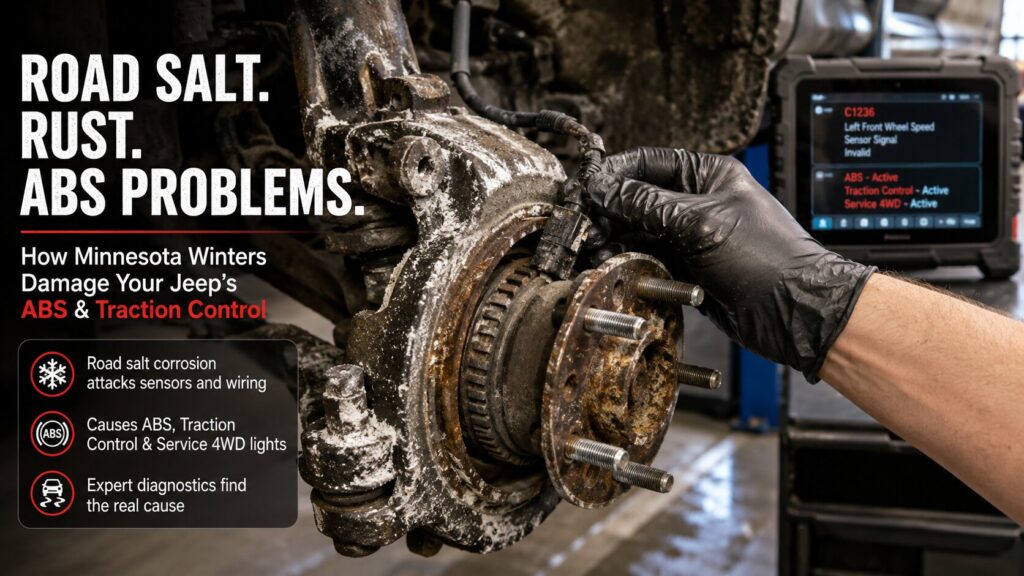
The Service 4WD and ABS lights are usually triggered by road salt brine (calcium chloride) intruding into the 5-volt electrical circuit, causing a short, or by rust jacking physically expanding the tone ring until it hits the Wheel Speed Sensor (WSS). The solution requires professional diagnostic testing, often using an oscilloscope, to distinguish between a sensor failure and salt-induced corrosion of the wiring harness.
Driving a Jeep through the slush on MN-7 isn’t just a winter chore; it’s a high-pressure chemical treatment for your vehicle’s nervous system. I see the results of highway speeds effectively pressure-washing brine into the steering knuckle, where it swiftly targets the sensitive hardware controlling your ABS and Traction Control.
Identifying 5-Volt Reference Circuit Drops Caused by Brine
I’m seeing a surge of Jeep ABS logic failures that present as electrical system faults but trace back to salt-bridged connectors. The culprit is the 5V reference circuit. Road salt—specifically the calcium chloride—is highly conductive. When moisture enters a weather-pack connector or a nicked wire, it creates a micro-bridge between the power and ground.
In my experience, this doesn’t always blow a fuse. Instead, it pulls the voltage down. I’ll see a steady 5V drop to 3.8V on my meter. The light might vanish once the sun comes out and the harness dries, only to return the next time you hit a puddle.
The Mechanics of Rust Jacking and Sensor Tone Ring Damage
On many Jeep models, the ABS system relies on outboard tone rings. These are toothed metal rings that spin with your wheels. I’ve seen how Salt Belt brine drives “rust jacking,” where internal oxidation physically exfoliates the metal until the part structurally fails. The rust grows under the ring, between the metal and the CV axle or hub.
This oxidation is powerful enough to physically expand the ring’s diameter. As the ring grows, it begins to strike the tip of the WSS. I’ve seen sensor tips ground down like they were held against a bench grinder.
My diagnostic verdict is that a C1236 code on a Jeep is rarely a sensor failure; it’s almost always a tone ring expansion striking the WSS tip. When that happens, you lose the signal entirely at low speeds, which is why your ABS might kick in unnecessarily just as you’re rolling to a stop at a light.
How Residual Spring Moisture Activates Winter Salt Corrosion
Your Jeep’s Traction Control light often stays on in April because residual road salt is hygroscopic, meaning it pulls moisture from the humid spring air. This creates an active electrolytic bridge in your wiring or sensors, triggering faults even when the roads appear to be dry and salt-free.
Hidden Jeep Undercarriage Areas That Standard Washes Miss
Most people think a quick trip through the undercarriage wash solves the salt problem. It doesn’t. While the wash hits the big stuff, it rarely reaches the hidden pockets where brine accumulates—like behind the fender liners or inside the ABS module connector seals.
The ABS pump motor pins (specifically Pins 1 and 25 on many Jeep Hydraulic Control Units) are notorious for this. I often find “Pump Motor Circuit Malfunction” codes that lead people to believe they need a thousand-dollar module. When I peel back the connector, I find a green crust on the pins. The brine has been sitting there, trapped against the seal, slowly eating the copper.
The Link Between Cold Weather Potholes and Wiring Harness Failures
Salt doesn’t just corrode; it leaches the plasticizers out of wire insulation, making it brittle. Combine that with the post-winter potholes, and you have a recipe for disaster. Every time you hit a jolt, those brittle wires flex. Eventually, the internal copper strands snap but the insulation stays intact, creating a ghost break that only fails when the chassis hits a Shorewood pothole.
Technical Approach to High-Voltage Jeep Electrical Diagnostics
When a Jeep comes in with traction issues, I don’t just read the codes and start throwing parts at it. That’s a fast way to waste money.
Why Oscilloscope Testing Outperforms Generic Code Scanners
I prefer to use an oscilloscope. By back-probing the sensor at the module, I can watch the square-wave pattern in real-time. If there is a chip in a tone ring or a salt-corroded wire that only fails when the suspension moves, the scope will show a drop-out that a scanner simply misses. This forensic approach ensures I’m fixing the root cause, not just the symptom.
Proactive Steps to Protect Your Jeep Wiring from Salt Damage
During a 30,000-mile service, I recommend a proactive “Salt-Shield” approach. I inspect the ABS harnesses and apply high-grade dielectric grease to the weather-pack connectors. This creates a hydrophobic barrier that brine can’t penetrate.
Additionally, if I see the beginning stages of rust jacking on a tone ring, I can often clean and coat it with a corrosion inhibitor before it expands enough to kill the sensor. A little grease and a keen eye in April save you from a service 4WD light in July.
If your Jeep is showing signs of morning sickness with its traction control or if those dashboard lights are flickering after a drive on MN-7, reach out to us. At Certified Auto Repair, we use high-resolution oscilloscope diagnostics to precisely identify the source of electrical interference or corrosion caused by road salt. Visit us at 4700 Shoreline Drive Spring Park, MN 55384.
Frequently Asked Questions
Can road salt cause ABS sensor failure?
Yes, road salt can cause ABS sensor failure through a process called rust jacking. Salt gets trapped behind the tone ring, causing it to oxidize and expand. This expansion causes the ring to physically strike and destroy the WSS tip, resulting in a total signal loss.
What does a C1236 Jeep code mean?
The C1236 Jeep code indicates a low signal or missing wheel speed fault, usually at the rear left wheel. In Minnesota, I frequently trace these faults to salt brine pulling down the 5V reference circuit or a tone ring that has expanded and destroyed the sensor.
How do you fix a corroded ABS tone ring?
Fixing a corroded ABS tone ring requires removing the axle or hub. This allows you to clean away the rust jacking oxidation underneath. If the ring is cracked or overly expanded, it must be replaced. I also recommend applying a corrosion inhibitor to the mating surface to prevent the rust from returning.
Is it safe to drive with the ABS light on in Minnesota?
No, it is not safe to drive a Jeep with the ABS light on in Minnesota because an active light indicates your traction and stability control systems are completely offline. While basic hydraulics remain, in Minnesota’s April slush, this leads to immediate wheel lock-up during braking. I’ve found that without these electronic overrides, the vehicle is highly susceptible to hydroplaning and uncontrolled slides.