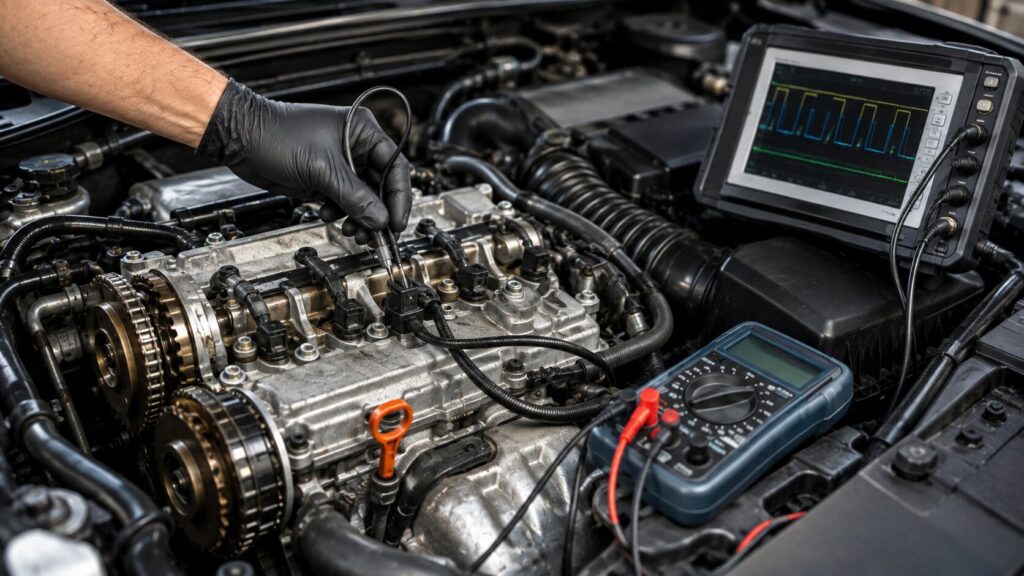
Failing variable timing sensors in Honda vehicles cause acceleration hesitation and rough idling, particularly during extreme sub-zero weather conditions. Isolating the root cause requires backprobing circuit returns with an oscilloscope, verifying cylinder head oil gallery pressure, and measuring internal coil resistance.
A bad timing sensor makes Honda Accords stumble and idle rough on cold winter mornings around Lake Minnetonka. Moisture breaches the housing seal during rapid temperature drops, freezing internal coil windings and scrambling camshaft phase feedback to the powertrain control module.
If your scan tool points straight to a VTC correlation code after a sub-zero Lake Minnetonka freeze, skip the parts cannon. Backprobe the signal return wire first; if voltage response lags the command signal by more than 5ms, the internal coil windings are water-compromised.
How Variable Valve Timing Sensor Failures Happen
Your Honda’s computer controls oil pressure to physically shift your camshaft timing on the fly. Extreme regional thermal cycling—like our wild Minnesota weather swings—causes rapid material expansion and contraction across the dissimilar metals in the sensor housing.
This thermal shock cracks the protective resin coating, allowing oil contamination to wick directly into the electrical connector pins. At the exact moment of failure, internal circuit resistance spikes erratically. This wild resistance jams the oil control valve halfway, leaving your camshaft stuck in the wrong position right when you step on the gas..
Diagnostic Steps for Variable Timing Sensor Testing
Generic OBD-II scanners only point to a generic camshaft position correlation code without isolating whether the fault lies in stretched timing chains, low oil pressure, or a failing sensor circuit. To find the real problem, I use a strict diagnostic workflow:
- Oscilloscope Testing: I connect a digital storage oscilloscope to monitor signal waveform switching speeds against the crankshaft reference pulses.
- Live Back-Probing: I back-probe the signal return wire to track the exact voltage output under active command tests.
- Lag Verification: I measure the waveform to verify if the voltage response lags behind the computer’s command signal by more than 5 milliseconds.
My Shop Note: I never replace a variable timing sensor without performing an oil pressure drop test at the cylinder head gallery first. Severe sludge accumulation from delayed oil changes perfectly mimics the exact same symptoms as a dead electrical sensor.
Separating Sensor Faults From Mechanical Timing Issues
When a customer comes into my bay complaining of a sluggish throttle response, my first job is to separate a simple electrical sensor fault from a mechanical timing disaster. Many people swap out the timing sensor right away because a scanner points to it, only to find the problem is still there. That happens because a stretched timing chain or worn chain guides throw off the physical correlation between the crankshaft and camshaft, tricking the computer into blaming the sensor.
I use a digital multimeter to check the internal resistance of the copper windings inside the sensor coil. If that resistance falls outside the factory specification of 5 to twenty ohms, or shows infinite resistance, the electrical component inside has failed permanently. If the electrical resistance checks out fine, I turn my attention to oil flow dynamics. If varnish or carbon sludge blocks the fine mesh screen on the body of the sensor, clean oil cannot pass through to actuate the spool valve, rendering a perfectly good electronic component completely useless.
Recognizing Symptoms of Advanced Timing Degradation
As a State-licensed Emissions Technician, I see the long-term damage caused by ignoring these problems. Poor valve timing stops your engine from burning fuel efficiently. The computer defaults to a safe “limp-home” mode, dumping extra fuel into the combustion chambers to prevent a complete stall. This unburned fuel washes protective oil down the cylinder walls and rapidly destroys your catalytic converter.
When you step on the gas to merge onto a busy highway, the car might stumble, hesitate, or produce a harsh mechanical rattle right at startup. That infamous “startup rattle” is the physical sound of the variable timing gear violently slapping against its internal stop pin because oil pressure took too long to build up inside the actuator. Catching these symptoms early stops metal debris from circulating through your oil passages and ruining your cylinder head bearings.
Professional Repair Services for Honda Timing Issues
Ignoring early hesitation symptoms risks permanent valve train wear and stranded roadside failures during the next cold snap. Avoid inflated dealership diagnostic delays by targeting the VTC circuit failure directly with specialized shop-level scope testing.
If you are struggling to isolate a hesitation or rough idle issue on your Honda, a professional diagnostic check can safely identify the root cause without wasting money on unneeded parts. If you ever need a hand scoping your sensors or checking your cylinder head oil pressure, my team at Certified Auto Repair is always available as a local resource. You can find us at 4700 Shoreline Drive, Spring Park, MN 55384.
Frequently Asked Questions
Does a variable timing sensor failure always trigger a check engine light?
Yes. The powertrain control module sets a diagnostic trouble code immediately when camshaft position correlation falls outside factory programmed thresholds.
Can driving with a faulty timing sensor damage the engine internals?
Yes. While modern Honda safety protocols try to prevent catastrophic valve interference, chronic oil dilution from the unburned fuel (due to rough running) will wash away cylinder wall lubrication and destroy your emissions equipment over time.
Is it possible to clean a contaminated variable timing sensor instead of replacing it?
No. Once engine oil or moisture infiltrates past the internal resin barrier, it permanently damages the fine copper wire windings. Complete unit replacement is the only safe fix. .
Will clearing the diagnostic trouble codes permanently fix the erratic idle?
No. Resetting the computer with a scan tool only provides a temporary mask. The underlying electrical short or mechanical sticking remains inside the sensor assembly, and the engine will drop back into limp mode almost immediately.