Advanced Jeep diagnostics require moving beyond basic trouble codes to identify the true root cause of vehicle failures. Environmental factors like Lake Minnetonka moisture and Minnesota road salt accelerate wiring harness corrosion and high resistance. Utilizing WiTech 2.0 live data streams, high-speed data logging, and oscilloscope waveform analysis isolates intermittent electrical faults before parts are unnecessarily replaced.
Technical Diagnoses and Environmental Factors
Modern Jeep diagnostics utilizing the WiTech 2.0 platform move far beyond simple code retrieval. By analyzing real-time Parameter Identifiers (PIDs) and sensor voltage waveforms, technicians isolate intermittent electrical faults and mechanical degradation. This data-driven approach shifts repair strategies from speculative component replacement to precise, evidence-based system correction.
Standing in the service bay, I often watch dashboards lit up with warning lights. Despite a recent throttle body replacement recommended by a parts retailer, a vehicle’s warning light can reappear after only ten miles of driving. A diagnostic trouble code is often misinterpreted as the final verdict, rather than a starting point for technical investigation. By looking past the dashboard display, the underlying cause of the failure can finally be uncovered.
Live Data Streams and Real-Time Interpretation
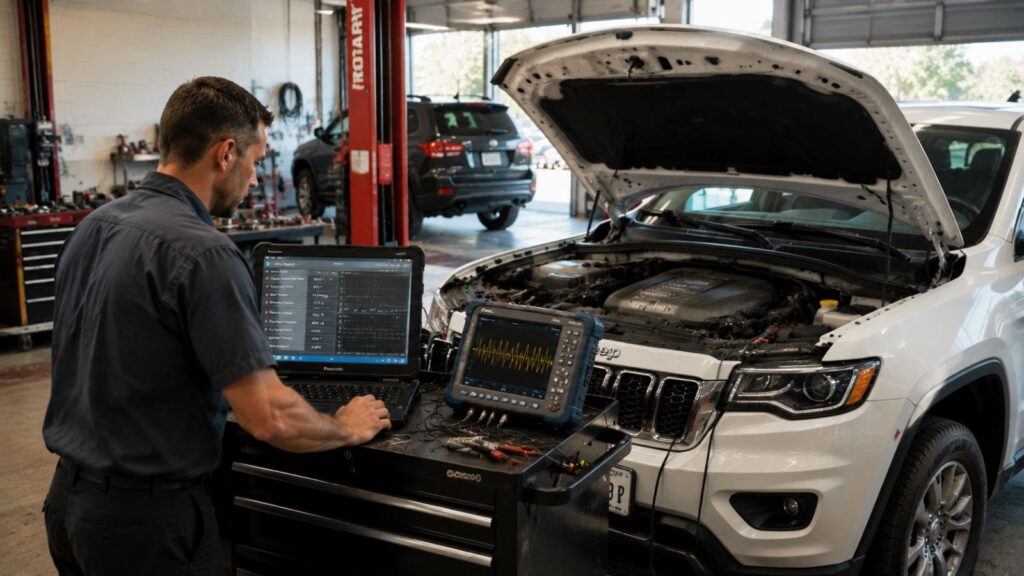
When I hook up the WiTech 2.0 system, it allows me to bypass quick fixes and analyze the engine’s heartbeat through live data streams and PIDs. While traditional tools only record past failures, real-time monitoring reveals exactly how components perform under actual driving conditions. Interpreting this data pinpoints the exact root cause, preventing the unnecessary parts swapping that drives up repair bills.
Environmental Impact of Minnesota Road Salt Corrosion
The environment here in Spring Park is brutal on electrical systems and vehicle longevity. I see the effects of these harsh conditions on wiring integrity every single day. Surrounded by water, local roads are treated heavily with salt and brine during the colder months.
That chemical mist finds its way into every crevice of a wiring harness, settling into the weather-pack connectors and beginning a slow, silent destruction of the metal contacts. These patterns show up across every Jeep model traveling these wet local roads.
High-Resistance Wiring Faults Near Lake Minnetonka
Dozens of Jeeps come into the shop with sensors that test fine on the bench but fail on the road. The problem is almost always high resistance caused by hidden oxidation inside the harness. Standard multimeters often indicate a clean signal because they lack the sensitivity to detect momentary resistance spikes in a steady voltage stream. However, when the vehicle is bouncing along the rough roads near Lake Minnetonka, those corroded pins vibrate.
Even a millisecond drop in voltage is enough to trick the diagnostic system into throwing a false trouble code. I intentionally move away from basic service manuals here because they often assume perfect factory conditions. While factory manuals prioritize sensor replacement for generic codes, real-world experience reveals that loose connector terminals caused by road vibration are the frequent source of failure.
Data Logging Solutions for Intermittent Stalling
Intermittent stalls are the hardest problems to solve because they rarely happen when the vehicle is sitting in the shop. They happen when idling at a stoplight or climbing a hill in the middle of a commute.
To catch these, I install a high-speed data logger that captures the entire event. The vehicle can be driven on a normal route to capture the failure exactly as it occurs, recording every signal from the crank sensor to the fuel pump relay. This is critical around the Lake Minnetonka boat ramps, where short-distance commutes prevent engines from achieving proper thermal regulation.
This constant cooling and heating cycle traps moisture in electrical connectors, leading to the exact intermittent failures we log on the road.
Predictive Diagnostics for Fuel System Integrity
Reviewing these logs helps me catch hidden voltage drops and missing pulses, definitively exposing the component’s true condition. This type of real-time data analysis lets us pinpoint vulnerabilities long before a vehicle strands its driver on the highway.
Through advanced data capture, I look for specific hidden patterns:
- Erratic Pulses: Misfiring cylinders produce faint, erratic pulses that fall below the threshold for a computer-generated hard failure.
- Gritty Resistance: Debris and corrosion detected during ground wire inspections serve as a primary indicator of degraded connections.
- Amperage Spikes: Real-time data analysis pinpoints excessive fuel pump amperage before the component fails entirely.
Oscilloscope Waveform Analysis and Signal Verification
The oscilloscope remains my standard for modern automotive repair. If a scan tool is a simple magnifying glass, an oscilloscope is a high-powered microscope. It shows the exact shape of an electrical signal over time, revealing the rise time of a voltage pulse and the quality of a ground connection with absolute clarity. This allows for the verification of complex circuits that would otherwise remain a mystery.
A jittering, uneven line on the oscilloscope screen confirms a dying sensor before it fully quits. The definitive proof comes when overlaying the throttle position sensor voltage against the fuel trim data, looking for the millisecond latency that occurs when the signal drops off. That visual gap on the graphing tool is the evidence that the component is failing, despite what the basic diagnostic report claims.
When basic code readers fail to fix an intermittent stall or recurring dashboard warning, the solution lies in waveform analysis. This level of high-speed data logging to resolve complex electrical faults is the standard diagnostic protocol at Certified Auto Repair, 4700 Shoreline Drive, Spring Park, MN 55384.
Frequently Asked Questions
Does a check engine light reveal everything wrong with a Jeep?
No. A check engine light only provides a starting point code. Advanced data graphing is utilized to analyze real-time sensor behavior. This analysis isolates the root cause, frequently uncovering deep electrical or mechanical faults that basic code readers routinely overlook.
Is data driven diagnosis better than traditional testing?
Yes. Traditional methods rely on guessing and part swapping until the problem vanishes. Data driven diagnostics use live sensor feedback and oscilloscope waveforms to pinpoint the exact failure. This saves you money by preventing unnecessary part replacements and ensures the repair is accurate on the first try.
Can Minnesota weather impact Jeep electrical sensors?
Yes. Extreme humidity and road salt accumulation create hidden corrosion within wiring harnesses. This moisture degrades signal quality and induces false sensor readings. Diagnostic testing determines if the issue stems from the component or the circuit.
Do short trips around Lake Minnetonka affect my engine?
Yes. Frequent short trips prevent your engine from reaching the necessary temperature to burn off condensation. This trapped moisture promotes sludge buildup and corrodes electrical terminals. Early diagnostic intervention identifies performance degradation, mitigating long-term engine wear and preventing total system failure.