Short-trip driving cycles around Mound prevent Jeep AGM batteries from reaching the 12.6V saturation point required for chemical stability. The variable Minnesota climate, especially in May, often causes the Intelligent Battery Sensor to miscalculate during brief commutes, leading to chronic undercharging, rapid sulfation, and auxiliary battery failure that compromises the eTorque system.
Why Jeep Stop/Start Systems Fail During Short Trips
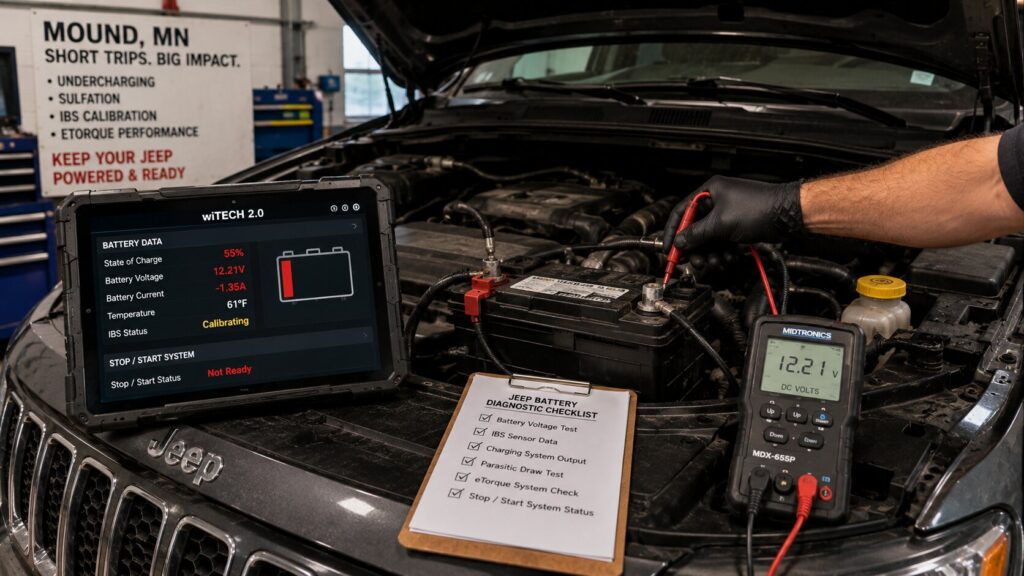
A 2024 Grand Cherokee arrived after a 1.8-mile drive from the Mound Transit Center. The battery voltage had already dropped to 12.2V, which is low enough to begin permanent sulfation inside AGM batteries.
Most Jeeps require several miles of steady driving before the alternator can fully recover startup power loss. When the battery never reaches a healthy State of Charge, the Body Control Module disables the Stop/Start system to protect battery performance.
How Short Commutes Damage Jeep AGM Batteries
Our testing with a Midtronics analyzer showed increased internal battery resistance caused by repeated low-charge cycles. When AGM batteries remain below 12.4V for long periods, acid stratification begins reducing charging efficiency.
Common warning signs of battery sulfation include:
- slow engine cranking
- stop/start warnings
- weak battery recovery after driving
- low resting voltage
- repeated charging alerts
What Causes Hidden Battery Drain in Spring Park Jeeps
Inspection of the battery terminals revealed corrosion buildup around the G906A ground point. Spring humidity combined with lingering road salt residue can create a conductive film that slowly drains the battery overnight.
The Intelligent Battery Sensor monitors cable current flow, but surface leakage across the battery case itself may bypass normal IBS monitoring and create hidden discharge problems.
TBM2 Module Problems in 2022–2026 Jeep Models
Technical Service Bulletin 08-017-24 identifies cases where the TBM2 telematics module remains active in weak cellular signal areas around Lake Minnetonka. Instead of entering sleep mode, the module continues searching for signal and draws excessive current, often exceeding 1.5 Amps.
When this condition occurs, the battery may lose enough power within a couple of days to trigger charging faults, weak starts, or complete no-start conditions.
How Corroded Battery Terminals Affect Charging Performance
Loose or oxidized battery terminals increase electrical resistance throughout the charging system. As resistance rises, charging efficiency drops and additional heat builds at the connection points.
Proper terminal cleaning and dielectric protection help reduce voltage loss and improve alternator charging performance during short-trip driving.
Why the Jeep eTorque System Struggles in Minnesota Spring Weather
The Jeep eTorque system relies on both a 48V lithium battery pack and a 12V auxiliary AGM battery. Repeated short trips and rapid spring temperature swings place additional stress on these components.
When the auxiliary battery weakens, the Jeep may still start normally while displaying “Service Stop/Start” or battery charging warnings that continue returning after startup.
How We Diagnose Jeep Charging System Problems
We perform diagnostic testing with wiTECH 2.0, focusing on charging setpoints commanded by the Powertrain Control Module. Weak or inconsistent IBS signals can force the system into conservative charging behavior that struggles to recover battery voltage.
Direct load testing at the battery posts often reveals failing cells or charging problems that onboard sensors fail to detect accurately.
Why IBS Reset Procedures Matter After Battery Replacement
Repeated short-trip driving between Mound and Spring Park had already contributed to battery sulfation and acid stratification. After charging, an IBS reset procedure was performed so the Jeep could properly relearn battery condition and charging behavior.
Without an IBS reset, the charging system may continue treating a replacement battery like the original weakened unit, causing recurring charging warnings and poor battery performance.
Get an Expert Diagnostic Audit in Spring Park
Don’t let hidden TBM2 drains or sulfation ruin a new battery. If your Jeep still displays “Service Stop/Start” or charging alerts after a simple boost, it needs the deep, module-level diagnostics (wiTECH 2.0 and IBS Reset) that generic shops miss.
Protect your eTorque system and get the definitive repair your Jeep requires. Schedule a professional diagnostic audit today: 4700 Shoreline Dr, Spring Park, MN 55384
Frequently Asked Questions
Why does my Jeep Stop/Start system stop working in the spring?
Frequent short trips prevent the battery from reaching the required State of Charge (SoC). Cold starts consume significant battery power that brief drives cannot fully recover, forcing the system to disable Stop/Start.
Can a short commute damage a Jeep battery?
Yes. Repeated trips under five miles contribute to sulfation and acid stratification because the battery remains partially discharged for extended periods.
What is the TBM2 module drain issue in newer Jeeps?
The TBM2 telematics module may remain active in weak cellular signal areas instead of entering sleep mode. This creates a parasitic battery drain that can discharge the battery overnight, often exceeding 1.5 Amps.
Does cold weather affect Jeep charging behavior?
Yes. The Intelligent Battery Sensor (IBS) adjusts charging strategy based on temperature and battery condition. Rapid spring temperature swings reduce charging efficiency and battery performance.
How do you properly test a Jeep with eTorque battery problems?
Accurate diagnosis requires full scan-tool analysis (like wiTECH 2.0) combined with direct load testing of both the main and auxiliary batteries. Manual testing is essential to identify weak cells missed by onboard sensors.