Incorrect toe alignment forces your tires to drag sideways instead of rolling parallel, scrubbing off tread through friction and heat. Catching misalignments early protects tire lifespan, preserves fuel efficiency, and prevents uneven wear like feathering. Our technicians restore factory tolerances so your vehicle tracks straight on local roads.
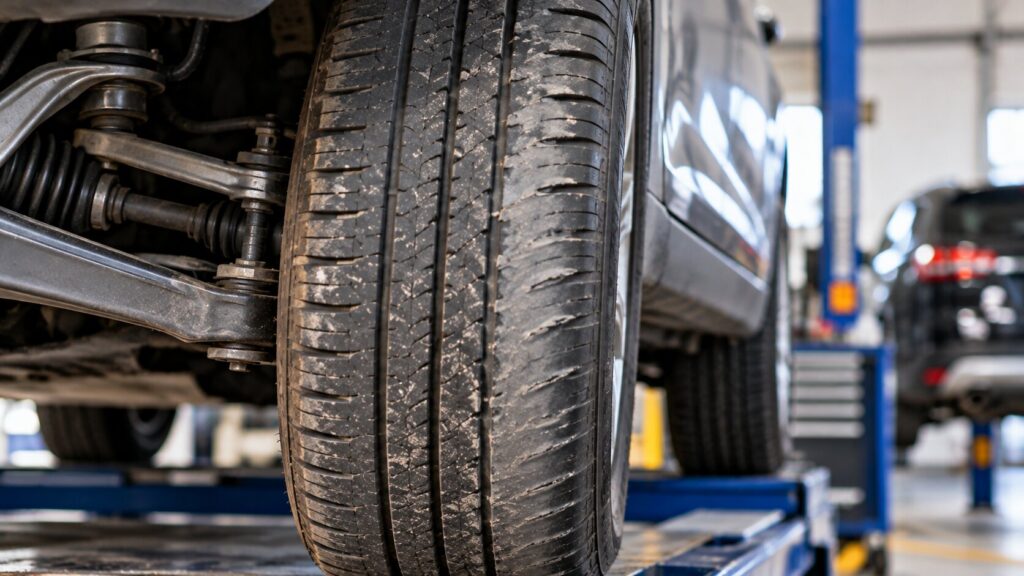
Every time you head down Shoreline Drive with improper toe alignment, your tires drag against the pavement rather than turning cleanly forward. On heavy all-wheel-drive crossovers handling Spring Park’s rutted asphalt and harsh seasonal freezes, off-center toe angles strip away years of usable tread in just a few months. A total toe offset of merely 1/16th of an inch forces a tire sideways roughly 28 feet for every single mile traveled.
What Toe Alignment Actually Means for Your Vehicle
Toe alignment measures whether the front edges of your tires point inward or outward when viewed from directly above your vehicle. If the front edges angle toward one another, your vehicle runs with toe-in. When those edges point outward, it operates with toe-out. Auto manufacturers calibrate suspension geometry to exact fractional-degree specifications so your tires roll perfectly parallel when traveling under load.
When toe settings fall out of this tight tolerance, your tires suffer from a destructive condition known as “tire scrub.” This unrelenting dragging action builds excessive friction and thermal stress deep within the tread blocks. As heat builds across the face of the tire, the rubber compounds physically soften, rapidly accelerating the rate of material loss and drastically reducing your gas mileage.
The Physical Mechanics of Tire Scrub and Friction
When toe settings fall out of tolerance, your tires suffer from a condition known as tire scrub. This unrelenting dragging action builds excessive friction and thermal stress within the tread blocks. As heat builds across the face of the tire, the rubber compounds soften, accelerating the rate of material loss.
This friction produces a distinct wear pattern called feathering across the tread surface. Running your hand across the tread block from inside to outside reveals smooth edges in one direction, but sharp, raised ridges in the opposite direction. Unaddressed toe misalignments wear down tread height rapidly, forcing premature tire replacement.
Common Signs Your Suspension Needs Alignment Attention
- Your steering wheel remains crooked while traveling straight down a level highway.
- Your vehicle drifts or strays toward the road shoulder when you loosen your grip on the wheel.
- The edges of your tire tread develop thin, saw-toothed ridges upon close inspection.
- You notice a persistent high-pitched humming or droning sound coming from the wheel wells at speed.
How Local Road Conditions Accelerate Alignment Wear
Navigating Lake Minnetonka’s seasonal transitions imposes continuous mechanical stress on steering linkages and suspension joints. Severe winter frost heaves, concealed potholes along local access routes, and routine curb contact while parking push suspension geometry out of factory specifications. Over time, degraded tie rod sockets, deteriorated rubber bushings, and loose ball joints allow the wheels to flare outward or toe inward under acceleration.
We frequently identify inner tie-rod socket play on local AWD crossovers following winter. Even a tiny fraction of an inch of looseness within a joint allows heavy cornering forces to literally push the wheels outward. This instantly wears away the inner shoulder rubber long before you ever notice a drift in the steering wheel.
Our Systematic Approach to Restoring Steering Alignment
We do not just guess at your alignment; we follow a strict protocol to measure, inspect, and correct your vehicle’s exact geometry.
- Digital Geometry Measurement: High-precision computerized targets attach to your wheels, measuring current toe, camber, and caster angles down to hundredths of a degree.
- Suspension Component Inspection: Our technicians evaluate tie rods, steering racks, and rubber bushings for physical play or damage before making adjustments.
- Precision Mechanical Adjustment: Threaded inner and outer tie rods are adjusted to align the wheels squarely with your vehicle’s center line.
- Final Road Verification: We perform a thorough test drive to confirm the steering wheel sits perfectly centered and the vehicle tracks completely straight.
Protect Your Vehicle and Tread Life
Allowing incorrect toe settings to persist can ruin hundreds of dollars in tire tread within just a few months of driving. If you spot uneven tread wear or an off-center steering wheel, bring your vehicle to our team for a comprehensive suspension inspection. We evaluate your vehicle’s current alignment angles, restore precise factory tolerances, and help you maximize tire mileage.
Visit us at Certified Auto Repair at 4700 Shoreline Drive, Spring Park, MN 55384 or schedule your appointment to protect your tires and keep your vehicle driving smoothly.
Frequently Asked Questions
How often should I get my toe alignment checked?
Have your overall alignment checked every 12,000 miles or once a year. However, driving over severe winter frost heaves or potholed access roads heavily common in Spring Park requires checking it much sooner.
Can bad toe alignment affect my gas mileage?
Yes, incorrect toe angles create extra rolling resistance because the tires constantly drag against the road surface. This forces your engine to work harder and consumes more fuel over time.
Is toe alignment the same thing as tire balancing?
No, tire balancing corrects weight imbalances inside the wheel assembly to prevent vibrations. Toe alignment adjusts the actual physical angles of the steering parts so the tires point straight ahead.
Will a toe alignment fix a vehicle that pulls to one side?
Yes, a toe adjustment can correct pulling if the wheels are tracking unevenly across the road surface. However, strong pulling can also be caused by improper camber angles, uneven tire pressure, or a damaged tire.