Minnesota winters stress family SUV suspensions through heavy passenger loads, sub-zero temperatures, and frost-heaved roads. Unaligned wheels compromise AWD traction, accelerate uneven tire wear, and reduce steering control on ice. Professional four-wheel alignment restores exact factory geometry, protecting tires and drivetrain components before winter weather sets in.
As temperatures drop around Lake Minnetonka, family SUVs face a dual threat: heavy passenger weight pushing down on chassis linkages and frozen, rutted pavement slamming upward against tires. When these opposing forces meet on daily commutes, a fraction of a degree in alignment drift quickly escalates into severe tire scrubbing and unpredictable handling across slush-covered lanes.
Why Minnesota Winters Strain SUV Suspensions
Seven-passenger SUVs carry significantly more mass than standard sedans, creating higher vertical and lateral forces on steering linkages. When fully loaded with passengers, cargo, and winter gear, suspension bushings flex more deeply into their travel range. Daily commutes along frost-heaved stretches of Shoreline Drive force struts and control arms to absorb repeated sharp impacts. Over time, these combined weights and road strikes push subtle wheel geometry settings completely out of spec.
Furthermore, sub-zero temperatures accelerate hardware degradation by physically hardening rubber suspension bushings and reducing their natural elasticity. Cold metal becomes much less forgiving when striking frozen ruts, deep potholes, or hidden curb edges under fresh snowfall. As your control arm bushings stiffen and settle unevenly, wheel angles shift away from their target positions. This structural shift completely alters how your tires meet freezing road surfaces, directly impacting traction when stopping or steering through icy curves.
How Misalignment Compromises AWD Performance
Modern all-wheel-drive systems rely on consistent rolling resistance across all four wheel positions to distribute power correctly. When misalignment forces one tire to drag or travel at a slightly different angle, speed sensors detect synthetic slippage. The vehicle computer may continuously adjust power distribution between axles, creating drivetrain strain and delayed throttle response on slippery surfaces. Maintaining aligned wheels ensures your AWD system reacts accurately to actual icy patches, rather than fighting itself.
Ineffective wheel angles also create severe directional instability during winter highway lane changes. Improper toe settings make the rear end feel loose or tail-heavy when crossing packed snow ridges between lanes. Positive or negative camber drift reduces the tire contact patch, preventing winter tread sipes from properly gripping packed snow. Restoring correct geometry allows all four tires to track true, giving drivers predictable steering feedback during sudden maneuvers.
Essential Wheel Alignment Angle Adjustments for Heavy Vehicles
- Toe Angle Settings: Toe measures whether tires point inward or outward when viewed from directly above the vehicle. Incorrect toe causes immediate tire scrubbing, wearing down expensive winter tread within a single season.
- Camber Alignment Specs: Camber measures how far the top of the tire tilts inward or outward when looking directly at the front of the vehicle. When heavy SUVs haul full loads of cargo, excess negative camber causes tires to lean inward, rapidly grinding down the inner rubber edges long before the outer tread wears out.
- Caster Alignment: Caster angle impacts high-speed directional stability and steering wheel return-to-center feel. Proper caster ensures your SUV tracks straight down rutted highway lanes without constant steering corrections.
- Thrust Angle Alignment: Thrust angle compares the rear axle direction against the centerline of the vehicle frame. Unaligned rear thrust causes the vehicle to “dog-track” sideways down slippery roads.
Warning Signs Your Family SUV Needs an Alignment Check Right Now
Uneven tread wear remains the primary visual indicator that suspension geometry needs professional attention. Inspecting the front and rear tires often reveals inner or outer edge feathering long before steering problems become obvious. If the rubber feels rough or stepped when wiping a hand across the tread block edges, alignment angles have drifted out of tolerance. Catching feathering early saves tires from premature replacement before winter fully sets in.
| Symptom Observed | Probable Alignment Cause | Long-Term Risk |
| Steering wheel crooked while straight | Incorrect toe settings front or rear | Accelerates tread scrubbing by 300% |
| Vehicle pulls to left or right | Unequal caster or camber across axle | Increases driver fatigue on long trips |
| Inner edge rubber wearing fast | Excessive negative camber under heavy load | Causes sudden tire sidewall failure |
| Squealing tires during slow turns | Severe toe angle misalignment | Decreases fuel economy and traction |
What Expect During Our Professional Four-Wheel Alignment Service
We begin every evaluation with a detailed visual inspection of steering and suspension assemblies. We check ball joints, tie rod ends, sway bar links, and rubber bushings for wear or looseness before placing the vehicle on our alignment rack. Attempting to align a vehicle with worn chassis parts leads to inaccurate readings and short-lived adjustments. Replacing loose components first guarantees that setting modifications hold true under real driving conditions.
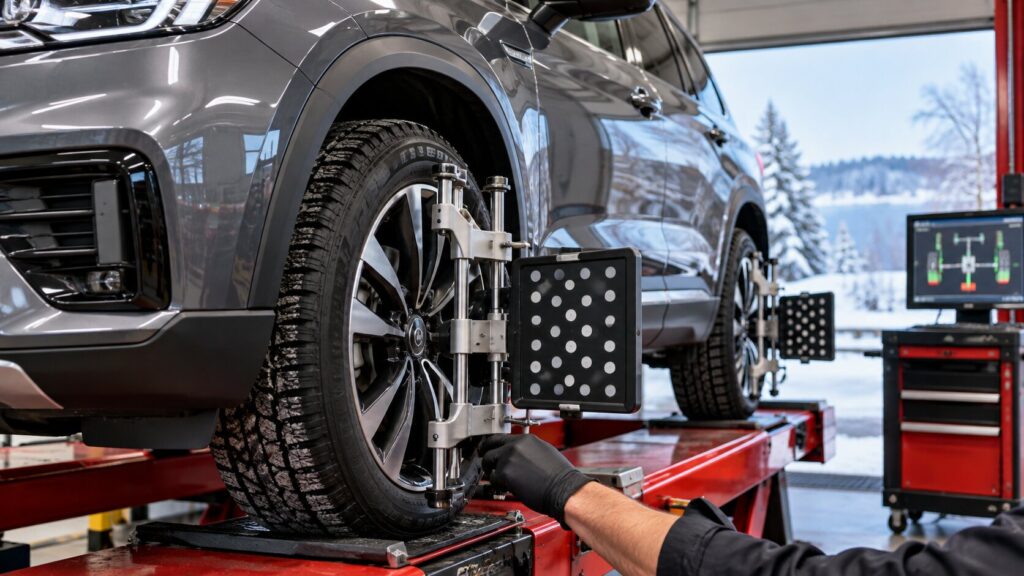
Using advanced Hawkeye digital imaging systems, we measure current wheel angles against factory specifications for your specific SUV make and model. Precision optical targets mounted on all four wheels map full three-dimensional suspension geometry within hundredths of a degree. My team carefully adjusts tie rods, eccentric cam bolts, and suspension shims to center all readings within high-precision tolerances. After completing precision adjustments on the rack, we take the SUV out on local roads to ensure the steering wheel stays perfectly level and the vehicle tracks straight without pulling.
Protecting Your Family SUV Before Lake Minnetonka Freezes
Scheduling suspension maintenance before winter storms arrive prevents compounding repair bills down the road. Running misaligned wheels destroys expensive winter tire sets in a matter of months while placing unnecessary strain on wheel bearings, steering racks, and control arms. We recommend addressing minor handling quirks early to protect your tires and ensure your vehicle handles predictably when navigating slush, black ice, and freezing rain.
Schedule your SUV wheel alignment service with my team at Certified Auto Repair located at 4700 Shoreline Drive, Spring Park, MN 55384 to keep your family safe across Hennepin County routes.
Frequently Asked Questions
How often should a family SUV get a wheel alignment in Minnesota?
Every 12,000 miles or once per year, ideally right before winter starts. Minnesota potholes, frost heaves, and seasonal salt corrosion accelerate wear on steering linkages and bushings. Checking geometry annually protects expensive winter tires from premature, uneven wear.
Can bad wheel alignment ruin all-wheel-drive systems?
Yes, uneven wheel angles create varied rolling resistance across axles. This variance causes AWD wheel speed sensors to detect false slippage, placing continuous stress on transfer cases and electronic differentials. Keeping wheels properly aligned prevents costly repairs to electronic AWD components.
How do I know if my SUV needs a two-wheel or four-wheel alignment?
Nearly all modern family SUVs require a four-wheel alignment because they feature independent rear suspensions. Adjusting only the front wheels leaves rear toe and camber angles out of spec, causing directional instability on snow. A true four-wheel alignment ensures both axles track perfectly along the same geometric centerline.
Will cold Minnesota weather change my vehicle wheel alignment?
Yes. Sub-zero temperatures harden rubber suspension bushings, drastically reducing their ability to absorb road impacts from frozen ruts. Additionally, hitting concealed curbs or deep potholes hidden beneath fresh snow easily knocks precision suspension settings completely out of tolerance.