Synchronized four-wheel alignments protect all-wheel-drive transfer cases and ensure stability on wet Lake Minnetonka roads. Uneven wheel angles force center differentials to adjust power continuously, accelerating fluid heat buildup and tire wear. Annual inspections maintain precise steering angle calibration, preventing costly multi-axle drivetrain damage across harsh Minnesota winter conditions.
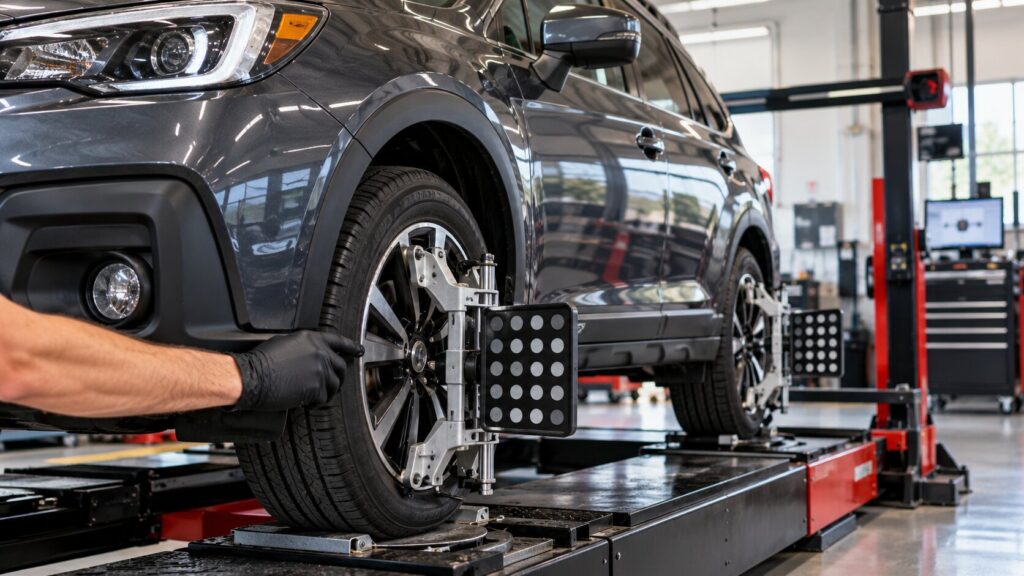
All-wheel-drive vehicles require synchronized alignment measurements across all four wheels to protect the transfer case and maintain stability on wet Lake Minnetonka roads. When suspension angles shift on an AWD setup, uneven rolling resistance forces the center differential to work continuously, leading to accelerated tire wear and drivetrain strain.
All-Wheel Drive Systems Depend on Synchronized Wheel Angles
Unlike two-wheel-drive vehicles where non-driven wheels simply roll along, an all-wheel-drive system actively sends power to every corner. We see every tire needing identical rolling dimensions and directional angles so the system functions smoothly. A slight misalignment on a single wheel creates dragging forces that trick the center differential into sensing a loss of traction.
When one tire scrubs against the road at an improper angle, it rotates at a slightly different speed than the other three. Even a tiny tread depth difference over 2/32 of an inch or a fraction of a degree off in alignment causes speed mismatches. The vehicle’s computer responds by adjusting power distribution unnecessarily, heating up differential fluid and placing extra stress on driveline components.
AWD Driveline Stress and Tire Mismatches
When one tire scrubs against the pavement at an improper toe or camber angle, it physically rotates at a slightly different speed than the other three. The tolerance on modern AWD systems is incredibly tight; even a tiny tread depth difference of 2/32 of an inch, or a fraction of a degree off in alignment, causes speed mismatches across the axles. The vehicle’s computer responds by adjusting power distribution, which superheats the differential fluid and places immense mechanical stress on the driveline components.
Winter freeze-thaw cycles along Shoreline Drive create deep ruts and sharp potholes that force control arms and tie rods out of factory specification. On a basic front-wheel-drive car, rear wheel misalignment might only cause minor tire dragging. However, on an AWD platform, a rear toe or camber shift directly alters how the vehicle’s thrust forces push it forward, immediately destabilizing the entire chassis during winter driving on Highway 15.
Understanding the Hidden Drivetrain Risks of Uncorrected Steering Angles
When the rear axle strays from parallel with the vehicle’s centerline, the vehicle suffers from a condition known as thrust angle misalignment. This forces the rear wheels to push the car sideways. To keep the vehicle traveling straight in your lane, you are forced to hold the steering wheel slightly off-center. This constant steering compensation severely degrades the vehicle’s electronic stability control during slippery driving conditions.
When suspension angles drift beyond manufacturer tolerances, mechanical wear accelerates exponentially across multiple vehicle systems:
- Thrust Angle Variance: Causes the rear wheels to push sideways, forcing the driver to hold the steering wheel off-center on straight roads.
- Camber Deviation: Concentrates the vehicle’s weight on the inner or outer edge of the tread, leading to premature tire replacement.
- Toe Angle Errors: Creates continuous scrubbing against the pavement, generating excess friction that reduces fuel efficiency and burdens the transfer case.
Our Systematic Four-Wheel Alignment and Inspection Process
We begin every AWD service by inspecting control arm bushings, ball joints, and tie rod ends for hidden play. Worn steering components prevent suspension settings from holding true, so we address mechanical wear before taking readings. Next, we verify that all four tires match in tread depth, brand, and air pressure to establish a neutral baseline.
We mount high-definition targets to all four wheels and place the vehicle on a leveled Hunter Hawkeye alignment rack. Our digital sensors capture live angles for front and rear camber, caster, and toe simultaneously. We adjust the rear suspension settings first to establish a straight thrust line, then align the front wheels to match that centerline precisely.
Why Digital Steering Angle Sensor Recalibration Is Necessary
Modern AWD vehicles use advanced stability control software to manage traction during tight turns and sudden swerves. These electronic systems rely on a Steering Angle Sensor (SAS) mounted inside the steering column to track your exact driver intent. If the physical steering wheel is straight, but the computer thinks it is turned 3 degrees to the left, the traction control system will malfunction on wet pavement.
After resetting the physical mechanical alignment angles underneath the vehicle, we ensure the physical position of the steering wheel matches the digital center point stored in the vehicle computer. We recalibrate the sensor electronically using an OBD-II diagnostic scanner so the traction control systems interpret your inputs accurately and refrain from applying unexpected, dangerous wheel braking on icy turns.
Protecting Your Drivetrain On Minnesota Roads
Addressing minor steering pull or uneven tread wear early prevents severe transfer case and differential damage down the line. My team and I use specialized alignment equipment calibrated specifically for multi-axle all-wheel-drive systems to ensure your vehicle is safe for Minnesota winters. Bring your vehicle to Certified Auto Repair at 4700 Shoreline Drive, Spring Park, MN 55384, or visit our website to schedule your alignment inspection today.
Frequently Asked Questions
Can you align just the front wheels on an AWD car?
No, we always perform a full four-wheel alignment on all-wheel-drive vehicles to keep the front and rear axles synchronized. Adjusting only the front leaves rear thrust angle errors intact, which continues to strain the transfer case.
How often should an AWD vehicle get aligned?
I recommend checking alignment angles once a year or every 12,000 miles. We also highly suggest inspecting settings immediately after hitting a deep pothole or replacing any suspension parts.
What are the signs of AWD misalignment?
Common indicators we look for include a crooked steering wheel while driving straight, uneven tread wear across the tire face, or a gentle pulling sensation toward the shoulder. You might also notice a decrease in fuel mileage.
Why do all four tires need equal tread depth on AWD models?
Variations in tread depth change the overall circumference of each tire, causing them to rotate at different speeds. We know this speed difference makes the AWD system work continuously, generating excess heat in the driveline.