High mileage car sensor failure symptoms primarily present as poor gas mileage, rough idling, engine hesitation during acceleration, and an active check engine light. As your car passes 100,000 miles, heated oxygen sensors slow down, and mass air flow sensors get dirty from oil vapor. These aging parts send wrong electrical signals to your car’s main computer, making the engine burn far more gas than it actually needs.
How Freezing Weather and Road Brine Cause Aging Sensors to Fail
Driving a high-mileage vehicle through Spring Park along Highway 12 exposes sensitive engine parts to intense thermal shock and chemical corrosion. Modern sensors inside your engine rely on tiny electrical voltages to measure air and fuel. Severe temperature drops cause internal sensor components to rapidly expand and contract, creating microscopic cracks over time.
At the same time, liquid road salt sprayed during winter storms sneaks past aging rubber seals on wire connectors. When salty moisture touches exposed wiring under your car, it creates corrosion and electrical resistance. Even a small amount of rust on a sensor wire disrupts the voltage signal back to your car’s computer, forcing it to miscalculate how much fuel to feed the engine.
Why Aging Sensors Drift and Fail as Mileage Climbs
Your engine’s computer expects exact electrical signals to run smoothly. As miles stack up, three main sensor failures happen most often in my shop:
- Mass Air Flow (MAF) Sensor Coating: Oil vapors from the crankcase slowly coat the delicate platinum sensing wire inside your air intake. A clean sensor accurately measures incoming cold air. A dirty sensor gets insulated, under-reporting how much air is entering the engine. Your computer responds by starving the engine of fuel, causing hesitation and lean-running engine codes.
- Oxygen (O2) Sensor Slowdown: A healthy oxygen sensor in your exhaust constantly flips its voltage reading high and low every single second to fine-tune fuel delivery. Age and exhaust buildup slow this signal down. When the sensor becomes sluggish, your computer can’t adjust fuel quickly enough, leading to wasted gas and rough engine performance.
- Coolant Temperature Sensor Drift: The sensor that reads your engine temperature uses internal resistance to send readings. As it wears out, its internal calibration drifts. On sub-zero mornings, a worn sensor might tell the computer the engine is much colder than it really is. The computer responds by dumping massive amounts of extra fuel into the cylinders, which quickly fouls your spark plugs.
How to Spot a Failing Sensor
When I test a car with engine performance issues, I look for clear physical and electronic warning signs:
- Drastic Drop in Gas Mileage: If your fuel trims—the adjustments the computer makes to control gas—are adding over 15% to 20% extra fuel, a sluggish oxygen sensor is usually tricking the system into running rich.
- Hesitation Under Load: If you step on the gas to pass someone and the car stumbles or lags, the air flow sensor is failing to calculate the sudden rush of incoming air.
- Unusual Temperature Readings: If your dashboard temperature gauge stays cold or jumps around erratically, the coolant temperature sensor is failing, which prevents the engine from reaching efficient operating temperatures.
- Rough, Shaky Idle at Red Lights: Sluggish sensor signals leave the engine computer constantly guessing, causing your engine RPM to bounce up and down while idling.
How to Find the True Cause Behind Your Check Engine Light
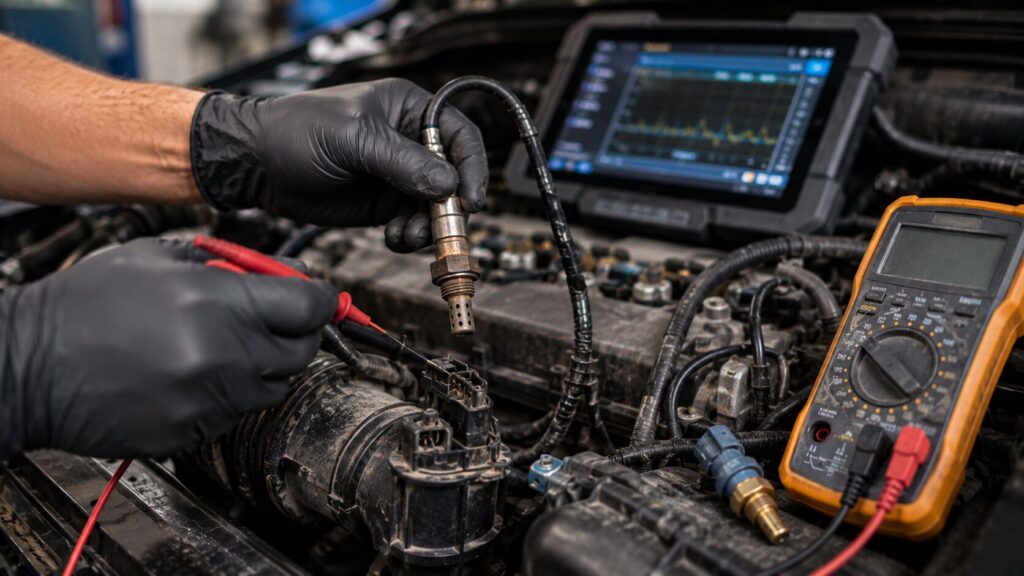
When a high-mileage car comes into my bay, I never just scan the code and swap out parts. A When a high-mileage car comes into our bays, we never just scan the code and blindly swap out parts. A diagnostic code pointing to a lean exhaust reading often stems from a simple vacuum leak or rusted wiring rather than a bad sensor. In one memorable case, a 124,000-mile commuter came into our shop with a lean engine code after a sudden cold snap along Route 12. The owner had already replaced the air flow sensor twice at home, but the engine still stumbled during its morning idle.
Instead of replacing more parts, we hooked up our diagnostic scope to monitor live data streams. The computer was adding over 23% extra fuel at idle, but when we held the engine at 2,500 RPM, the fuel numbers instantly returned to normal—proving the MAF sensor was actually fine. We eventually tested the O2 sensor’s electrical wiring and discovered its internal heating element was completely dead. In freezing weather, the sensor stayed cold and stuck at a low voltage, tricking the computer. Replacing a simple relay and installing an OEM sensor fixed the issue in under fifteen minutes.
What Happens If You Ignore Sensor Failure
Driving long distances with failing sensors causes expensive secondary damage to your car:
- Catalytic Converter Failure: A sluggish sensor that constantly dumps extra fuel sends unburnt gas straight into your hot exhaust. That raw gas ignites inside your catalytic converter, melting its delicate internal structure and leading to repairs that cost thousands.
- Engine Wear and Diluted Oil: Excess raw fuel sprayed into the cylinders washes away the protective layer of oil on your cylinder walls. This causes premature piston ring wear and allows gas to leak down into your engine oil, thinning it out and causing internal friction.
Schedule a Preventative Diagnostic in Spring Park
To prevent sudden breakdowns during winter storms along Shoreline Drive, professional diagnostic testing with live data tools guarantees an accurate fix the first time. Stop guessing at what is causing your check engine light.
Reach out to the expert technicians at Certified Auto Repair to schedule a comprehensive evaluation. You can visit our shop at 4700 Shoreline Drive, Spring Park, MN 55384 today, and let us pinpoint the exact cause of your electrical or sensor concern before the weather turns.
Frequently Asked Questions
Can a bad car sensor cause your engine to misfire?
Yes, a failing air flow or oxygen sensor can cause an engine misfire. When a bad sensor sends incorrect air or fuel readings to the engine computer, the air-fuel mixture becomes too thin or too heavy to ignite properly, causing the spark plugs to misfire.
Does a check engine light turn off on its own after replacing a sensor?
No, a check engine light usually stays on immediately after replacing a sensor. While some car computers may turn the light off after several days of normal driving, the most reliable approach is clearing the stored trouble code and resetting learned fuel values using a diagnostic scan tool.
Will a failed oxygen sensor cause a car to waste gas?
Yes, a degraded oxygen sensor typically fails by reading a low voltage, which signals a fake “lean” condition. This tricks the engine computer into injecting up to 25% extra gas into the engine to compensate, dramatically dropping your fuel efficiency.
Can you drive safely with a faulty mass air flow sensor?
No, driving long distances with a faulty mass air flow sensor is unsafe. An improper air-fuel ratio can cause your engine to hesitate or stall unexpectedly in traffic, while dumping unburnt fuel that permanently ruins your catalytic converter.