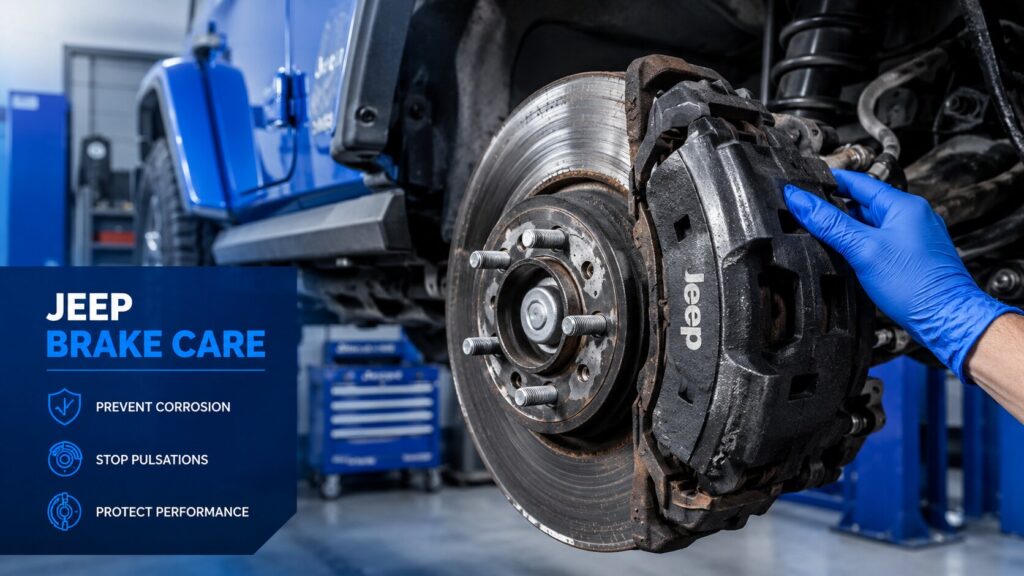
Jeep JL and WL braking systems utilize Ferritic Nitro-Carburizing (FNC) rotors designed for extended wear, yet Lake Minnetonka’s high-humidity spring microclimate frequently overwhelms their sacrificial oxidation limits. Low-speed rideshare duty cycles prevent rotors from reaching self-cleaning thermal thresholds, allowing leftover winter magnesium chloride to penetrate the cast iron, trigger piston retraction lag, and induce deep pitting.
Short-Trip Suburban Routes Keep Rotors in a Perpetual Cold-Soak State
Driving the 125 miles of Lake Minnetonka shoreline creates a sustained, high-dew-point operating environment that keeps vehicle wheel wells perpetually damp. When heavy spring dew or May rain interacts with dormant winter de-icing salts packed inside the chassis, the moisture acts as an aggressive electrochemical catalyst.
To see how this manifests in a working bay, consider a Jeep Grand Cherokee I recently pulled onto the lift after it finished a morning rideshare shift between Lord Fletcher’s and the Ridgedale Center. The road test revealed a distinct, rhythmic pedal pulsation. The physical inspection confirmed that frequent, low-speed suburban trips had kept the cast iron in a perpetual cold-soak state—preventing the rotors from ever reaching the temperatures required to bake off the lake moisture.
From Outer Dust Boot Contamination to 1.5mm Retraction Lag
In a healthy Jeep braking system, the elastic memory of the square-cut inner caliper seal pulls the hydraulic piston back roughly 0.1mm the instant the driver releases the brake pedal. When atomized brine migrates past the outer dust boot, corrosion builds up inside the cylinder bore directly behind this seal.
Digital pressure testing on rideshare vehicles routinely reveals ABS modules fighting a 1.5mm retraction delay. This mechanical lag forces the brake pad to stay pressed against the spinning rotor. Because the vacuum booster automatically overcompensates for the resulting hydraulic drag, the driver feels a deceptively normal pedal—right up until the uneven friction causes the vehicle to pull hard toward the shoulder during a downhill stop near the Arcola Bridge.
Why Does Shoreline Drive Road Salt Act Like an Electrochemical Catalyst
Traditional white rock salt generally washes out of a wheel assembly during a spring rain; liquid magnesium chloride does not. Hennepin County utilizes an atomized liquid de-icer that dries into a sticky, hygroscopic film across the brake abutment brackets.
Indicators of brine-induced hydraulic binding:
- Rhythmic steering wheel shake applied strictly during 40–20 MPH deceleration
- A localized, sharp acrid smell from one specific wheel well after a short drive
- Uneven inner-to-outer brake pad taper exceeding 2mm of variance
- A rigid, “notched” resistance felt when manually compressing the caliper piston
Liquid Magnesium Chloride Atomization Physics
Standard visual lube-bay inspections miss internal bore pitting entirely. The damage is only confirmed when the caliper is swung up and the piston is manually wound back. Brine collected along Shoreline Drive acts as an accelerator, turning minor condensation into deep interstitial pitting along the steel piston wall.
Once this cylinder wall is scarred, installing fresh brake pads is a wasted expense; the rough metal will tear the new square-cut seal within 1,000 miles. In a lakeside environment, waiting for the factory-recommended 10,000-mile inspection interval frequently transforms a routine $100 caliper slide-pin cleaning into a mandatory hydraulic caliper replacement.
Ferritic Nitro-Carburizing Chemistry and Thermal Shock
Late-model Jeep Grand Cherokees and Wranglers arrive from the factory with Ferritic Nitro-Carburizing (FNC) rotors—a baked surface treatment designed to delay rust. However, FNC chemistry relies on friction heat to maintain its bonded integrity. Constant idling at the Wayzata Depot or waiting in staging lots keeps the braking system cold.
When a rideshare driver suddenly accelerates onto Highway 7 and applies firm braking for a red light, the instant kinetic spike creates a localized thermal shock. This rapid expansion physically fractures the microscopic layer of flash rust that formed over the FNC coating while the vehicle sat idling in the humid lakeside air.
Cast Iron Brakes Must Hit 400°F to Shed Hygroscopic Road Films
Automotive braking systems must regularly achieve $400^\circ\text{F}$ to effectively shed chemical road films and vaporize deep pore moisture. The stop-and-go finesse braking required when navigating residential neighborhood drop-offs rarely generates this thermal mass.
Instead of shedding old material, the brake pads develop a hardened, glazed surface. A technician can identify this instantly by touch: the rotor face feels like polished window glass rather than turned iron. This glazing actively repels friction, increasing wet-weather stopping distances and generating the signature, abrasive “crunching” sound heard during the first stop of a damp spring morning.
From County Road 15 Silica Slurry to 0.005-Inch Lateral Runout
Spring road construction detours along County Road 15 introduce a secondary enemy: suspended silica dust and pulverized asphalt silt. When this wet slurry gets trapped between a glazed pad and a damp rotor, it acts as an industrial lapping compound.
True shop certification requires putting a dial indicator directly against the rotor face. A lateral runout reading exceeding 0.005 inches is the definitive diagnostic smoking gun—proving that asymmetric rust scale has physically jacked the rotor hat away from the engineered wheel hub surface.
Restoring true geometry requires stripping the hub face to bare metal, applying Mopar-specific silicone brake lubricant to the floating hardware, and locking the wheel assembly down to exactly 130 ft-lbs of torque using a calibrated split-beam wrench.
Jeep Grand Cherokee and Wrangler owners operating rideshare routes around the Lake Minnetonka corridor can have their hydraulic brake deltas and rotor runout verified at Certified Auto Repair, 4700 Shoreline Drive, Spring Park, MN 55384.
Frequently Asked Questions
Do my Jeep brakes squeak every morning near the lake?
Yes. This is standard flash rust. Lake Minnetonka’s high overnight humidity causes a microscopic layer of iron oxidation to form across the rotors within hours of parking. The morning squeal is simply the semi-metallic brake pad physically scraping this rust layer off during your first three or four stops.
Does rideshare driving affect brake life more than standard commuting?
Yes. Frequent low-speed residential stops and extended curbside idling prevent the rotors from reaching the $400^\circ\text{F}$ threshold required to shed moisture. This traps road salt against the metal, accelerating piston seizure and rotor pitting that high-speed highway commuters naturally avoid.
Can road salt from Shoreline Drive cause “ghost” brake issues?
Yes. Liquid magnesium chloride atomizes at speed and easily penetrates wheel speed sensor harnesses and electronic parking brake (EPB) connectors. This localized corrosion spikes circuit resistance, triggering erratic ABS dashboard warnings and soft pedal logic even when the brake pads have 80% of their life remaining.
How often should a Lake Minnetonka rideshare driver service their brakes?
Every 5,000 miles. While OEM manuals suggest 10,000-mile checkups, severe commercial duty in a lakeside microclimate requires a dedicated “hardware clean and lube” at 5,000 miles. Stripping the magnesium chloride from the abutment clips prevents the pad jamming that ruins expensive FNC rotors.