Lake Minnetonka winter cycles destroy Jeep steering geometry through repetitive high-impact loading on frozen asphalt ruts. These impacts shift eccentric cam bolts and bend adjustment sleeves, causing toe-in deviations. A 0.10° shift is the documented threshold for rapid tire cupping and steering wander, requiring precise caster recalibration.
The Physical Evidence of Spring Thaw Potholes
The Minnesota spring freeze-thaw cycle creates shelf potholes—sharp, vertical asphalt drops that deliver high-velocity impacts to Jeep leading-link axles. These sharp vertical impacts force the axle housing to rotate slightly, immediately compromising the caster angle. Without proper geometry, the front end loses its self-centering torque, allowing the natural crown of the road to hijack your steering input.
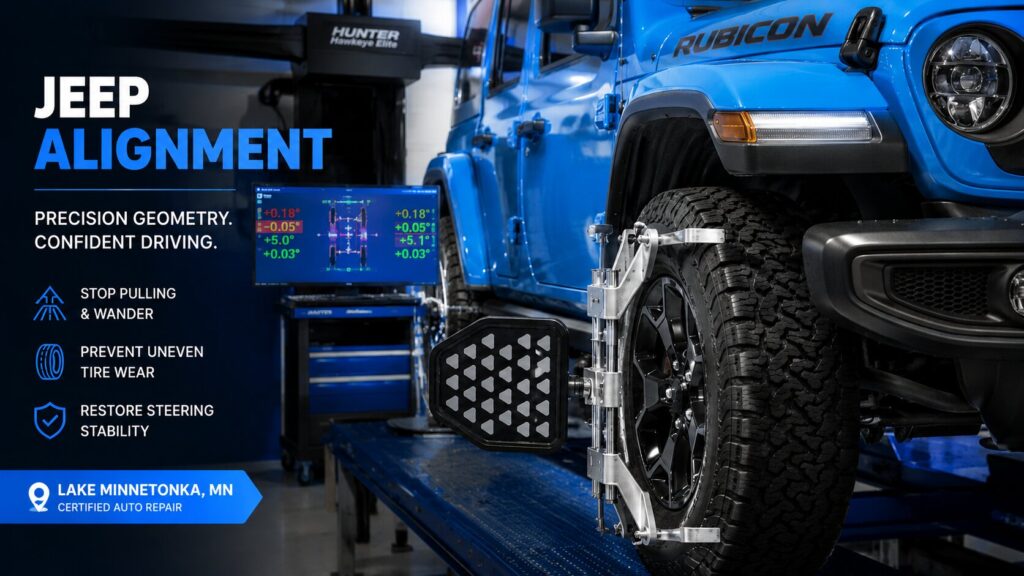
To visualize how this damage occurs on local roads, consider a recent diagnostic sweep I ran on a 2024 Jeep Wrangler Rubicon mounted on a Hunter Hawkeye Elite rack. The owner reported a constant drift toward the shoulder while driving down County Road 15. The laser sweep confirmed a front-left toe deviation of 0.18°. That single measurement is the physical, diagnostic footprint of a Lake Minnetonka winter.
Analyzing the Two Millimeter Deformation Threshold
When a heavy vehicle strikes a frozen shelf pothole near Shorewood at 45 MPH, the solid front axle translates that vertical energy into a direct lateral shock across the drag link. The factory adjustment sleeve is the inherent mechanical weak point. Shop diagnostics routinely reveal that a microscopic 2mm deformation in this sleeve is all it takes to cock the steering wheel off-center. Because the frozen roadbed cannot absorb the kinetic transfer, the steel linkage must take the entire load.
Road Salt Corrosion vs. Steering Gear Box Failure
Corrosion from winter road treatments is frequently the silent culprit behind a stiff or wandering steering wheel. Hennepin County de-icing brines easily penetrate ball joint boots and tie-rod seals, crystallizing inside the socket to create massive internal friction. This resistance prevents the steering linkage from returning smoothly to center, mimicking the exact symptoms of a failing steering gear box. In most instances, the mechanical steering gear is intact but is fighting against abrasive salt buildup from months of lakeside driving.
Indicators of brine-induced linkage binding:
- Failure of the steering wheel to return to center after a turn
- A heavy, notched feeling when applying lateral steering input
- Visible white crust (magnesium chloride residue) packed around tie-rod boots
- Audible grinding or creaking from the front axle during dry parking maneuvers
Identifying Tie Rod Contamination
When rubber boots on tie-rod ends are pulled back during spring inspections, technicians routinely discover a packed layer of crystallized de-icing salts. Hennepin County utilizes an aggressive liquid brine mix that atomizes inside the wheel wells at highway speeds. By the time the spring thaw arrives, this atomized salt has migrated past the rubber dust seals. The resulting grit completely contaminates the internal grease lubrication, creating mechanical resistance that is easily misdiagnosed as internal steering box failure.
How Suspension Geometry Reacts to Frost Heaves
The shifting, heaving asphalt of North Shore Drive during the spring thaw places immense stress on the track bar and control arm bushings. As the roadway buckles, it delivers repetitive lateral shocks that compress the rubber suspension bushings beyond their designed elastic limit.
When these bushings lose their elastic memory, the entire solid axle drifts out of alignment with the vehicle frame. This forces the Jeep into a dog-track stance where the rear wheels no longer track directly behind the front tires. This thrust-angle misalignment is exactly why Wranglers and Gladiators feel particularly skittish and unstable when crossing the metal expansion joints on the Wayzata bayside bridges.
Solid Axle Leading Link Deflection
As tires impact the sharp edges of frost heaves, the front track bar bushings absorb the primary lateral load. Under severe compression, the rubber bushing deforms permanently on its leading edge. This allows the entire front axle housing to shift slightly toward the driver side under load—a mechanical deflection that generates the vague, wandering steering sensation local drivers report during the seasonal transition.
Certifying Jeep Alignment with Laser Diagnostic Sweeps
A 0.18° toe-out deviation is completely invisible to a standard visual inspection, yet it is more than enough to trigger immediate highway steering wander. Modern alignment diagnostics prioritize the caster-to-toe relationship because cross-axle caster splits are where “Death Wobble” harmonics begin to brew. High-definition laser sweeps allow technicians to map exactly how freeze-thaw impacts have tweaked the chassis geometry outside of factory specifications.
Critical 2026 alignment targets for solid-axle Jeeps:
- Total Toe: +0.10° to +0.20° (slight toe-in to maintain straight-line tracking)
- Thrust Angle: 0.00° (absolute zero to prevent dog-tracking)
- Caster Target: +4.8° to +5.2° (heavy positive caster to dampen harmonic vibration)
- Max Caster Split: 0.20° side-to-side (to prevent cross-axle pulling)
Reading Hunter Hawkeye Waveforms
When diagnostic waveforms are pulled after a brutal winter of stop-and-go commuting on I-394, a 0.5° caster split across the front axle is often the smoking gun. This geometry drift is rarely caused by a single catastrophic impact; it is the cumulative fatigue of rough lakeside pavement.
Restoring precision geometry requires loosening the suspension binding, pulling the axle back to center, and applying exactly 125 ft-lbs of torque to the factory track bar bolts to ensure the eccentric hardware locks in place. While factory manuals frequently claim these joints are maintenance-free, the mechanical play observed after two Minnesota winters proves that annual re-torquing and caster correction are mandatory for high-speed stability.
If your Jeep refuses to track straight after hitting the spring frost heaves along North Shore Drive, have the front axle geometry and tie-rod linkage diagnosed at Certified Auto Repair, 4700 Shoreline Drive, Spring Park, MN 55384.
Frequently Asked Questions
Does my Jeep wander after the Lake Minnetonka winter?
Yes. Winter driving near Lake Minnetonka frequently knocks Jeeps out of alignment. Potholes and frost heaves apply heavy lateral force to the solid axle, shifting eccentric cam bolts and compressing rubber bushings. This alters the caster and toe settings, leading to a wandering sensation on the road.
Can a steering stabilizer fix my Jeep steering pull?
No. An aftermarket steering stabilizer cannot fix an alignment pull. A stabilizer is a horizontal shock absorber designed only to mask minor oscillations and road feedback. If your Jeep pulls toward the ditches in Shorewood, the underlying cause is a geometry deviation or bent linkage that requires a precision alignment rack.
How often should a Jeep be aligned in Minnesota?
A Jeep should receive an alignment diagnostic check every spring, specifically after the final frost thaw. The extreme sub-zero temperature shifts and de-icing brines used in the Twin Cities metro accelerate bushing wear and hardware corrosion, making annual geometry verification necessary to prevent premature tire cupping.
What is the Death Wobble threshold for a Jeep?
The threshold for harmonic oscillation—commonly known as Death Wobble—is typically a positive caster setting below 4.5° combined with lateral play in the front track bar. For Minnesota road conditions, technicians target a caster setting between 4.8° and 5.2° to ensure the steering linkage maintains enough mechanical tension to absorb harmonic vibrations.