The daily routine of school drop-offs, tight parking lots, and heavy passenger loads takes a massive toll on your family vehicle’s suspension geometry. Understanding how fluctuating cargo weight and minor curb impacts shift your camber and toe angles helps prevent rapid tire wear. Regular alignment checks at Certified Auto Repair keep your family hauling safely across Spring Park.
I spend a lot of time educating drivers on how their daily routines secretly damage their vehicles. Here in Spring Park, family SUVs and minivans endure a very specific type of abuse. The continuous cycle of short drives, loaded school carpools, and navigating tight grocery store parking lots puts immense, uneven stress on your suspension components.
Most drivers assume that wheel alignment is only necessary after hitting a massive pothole or sliding on winter ice. However, the slow, cumulative impact of daily family hauling shifts your steering geometry just as severely. Understanding how the weight of your passengers and the reality of suburban driving affect your suspension is the first step in protecting your expensive tires and keeping your vehicle handling safely on Minnesota roads.
Daily Spring Park Driving Shifts Suspension Geometry
Spring Park roads put a lot of stress on family minivans, SUVs, and crossovers around Lake Minnetonka. We see how winter freezing and thawing create deep cracks and sudden potholes that slam into your wheel hubs, twisting front springs and forcing adjustment bolts out of place over time.
Bumping curbs during school drop-offs or tight parking maneuvers also damages steering parts. Hitting concrete parking blocks at low speeds bends outer tie rods and control arms, forcing your front tires to point inward or outward. Even small shifts from rough dirt roads accumulate until your tires drag sideways down the pavement.
Heavy Passenger Loads and Cargo Strain Suspension Components
Packing your car with carpool kids, sports gear, and weekend luggage pushes down hard on your rear springs. This extra weight lowers the back of your car and causes rear tires to lean inward at the top, changing how your tread contacts the road during long family drives.
When heavy weight squashes your suspension, less rubber touches the road cleanly and unbalanced trunk loads wear down one tire faster than the other. Roof racks packed with heavy gear further increase body sway around sharp turns. We routinely inspect family vehicles carrying heavy weight to ensure clean suspension settings keep your car stable.
Simple Warning Signs of Bad Family Vehicle Wheel Alignment
Your car gives you clear signs when your wheels point the wrong way. On a flat, straight road, a misaligned car will drift toward the side as soon as you loosen your grip on the wheel. You might also see your steering wheel sitting crooked even when you drive straight.
We recommend checking your tires for quick answers about your suspension safety. If the inside or outside edge of your tire tread feels smooth or looks jagged like saw teeth, your tires are dragging sideways. Catching this early saves you from buying replacement tires too soon.
- Your steering wheel stays crooked while driving straight down flat roads.
- Your car constantly pulls or drifts toward the edge of the lane.
- Your tire tread shows smooth, bald strips along the inner or outer edges.
- Your tire tread feels rough or sharp when you slide your hand across it.
How Technicians Correct Alignment Angles
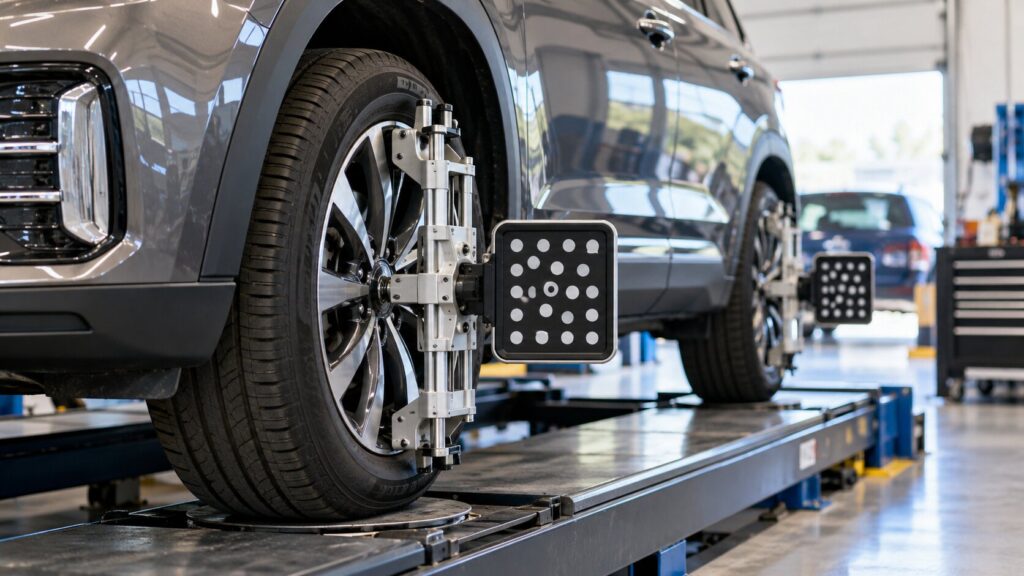
Our professional wheel alignment service uses digital camera sensors attached directly to all four wheels. We check your current wheel angles against factory limits to evaluate live offset readings. Before making mechanical adjustments, we also inspect ball joints and rubber bushings to replace any worn parts.
Underneath your vehicle, we adjust turning sleeves, subframe bolts, and eccentric cam bolts. Correcting toe adjustments stops tires from scrubbing the road and centers your steering wheel, while our camber adjustments level out tire contact so cabin weight spreads evenly across the tread surface.
Preventive Steps to Protect Alignment and Extend Tire Life
Checking tire pressure once a month is the easiest way to protect your steering parts. Soft, underinflated tires flex too much over bumps, transferring hard road shocks straight into your steering joints. Keeping your tires filled to the correct PSI helps them absorb small road bumps safely.
We advise adopting careful driving habits around town to protect your alignment settings. Slowing down before crossing railroad tracks, potholes, or high curb edges lowers shock impacts on control arms. Combining sensible driving with our routine alignment checks helps your tires last as long as possible.
- Check cold tire pressure monthly with a digital gauge to prevent steering strain.
- Slow down over rough asphalt, train tracks, and speed bumps around town.
- Schedule a four-wheel alignment check every 12,000 miles or once a year.
Keeping Your Family Safe on Minnesota Roads
Operating a vehicle with shifted suspension geometry compromises your handling predictability and causes rapid, uneven tire wear. Emergency braking and evasive steering maneuvers become highly unpredictable when your tires are not sitting flat on the pavement. Addressing minor steering pulls early prevents catastrophic secondary wear across your entire front suspension system.
Honest service means fixing the root cause and keeping you fully informed about your vehicle’s health. My team thoroughly evaluates your steering and suspension systems before performing precision wheel alignments. Visit our shop located at 4700 Shoreline Drive, Spring Park, MN 55384, to let us keep your family vehicle handling safely and smoothly.
Frequently Asked Questions
How often should a family vehicle get a wheel alignment?
A family vehicle needs a wheel alignment once every 12 months or 12,000 miles. You should also get an alignment check immediately if you hit a deep pothole or feel your car pull to one side.
Will a bad wheel alignment cause my vehicle steering wheel to vibrate?
No, a bad wheel alignment causes steering drift and uneven tire wear rather than steering wheel vibration. Steering vibrations usually mean your tires are unbalanced, your wheels are bent, or your suspension parts are worn out.
How long does a standard family vehicle alignment service take?
A standard four-wheel alignment inspection and adjustment takes between 45 and 60 minutes. The service takes longer if mechanics find rusted adjustment bolts or broken tie rods that need replacement first.
Can bad alignment ruin brand new tires quickly?
Yes, severe misalignment can ruin a brand-new set of tires in less than 3,000 miles. When wheels sit out of alignment, your tires drag sideways across the pavement instead of rolling smoothly forward.