An alternator burning smell means your stator windings are cooking from salt-induced corrosion and heavy winter electrical loads. If you catch that melted-varnish smell early, a quick multimeter check for voltage drop across the main charging cable will tell you if the stator is cooking before it leaves you dead in a snowbank.
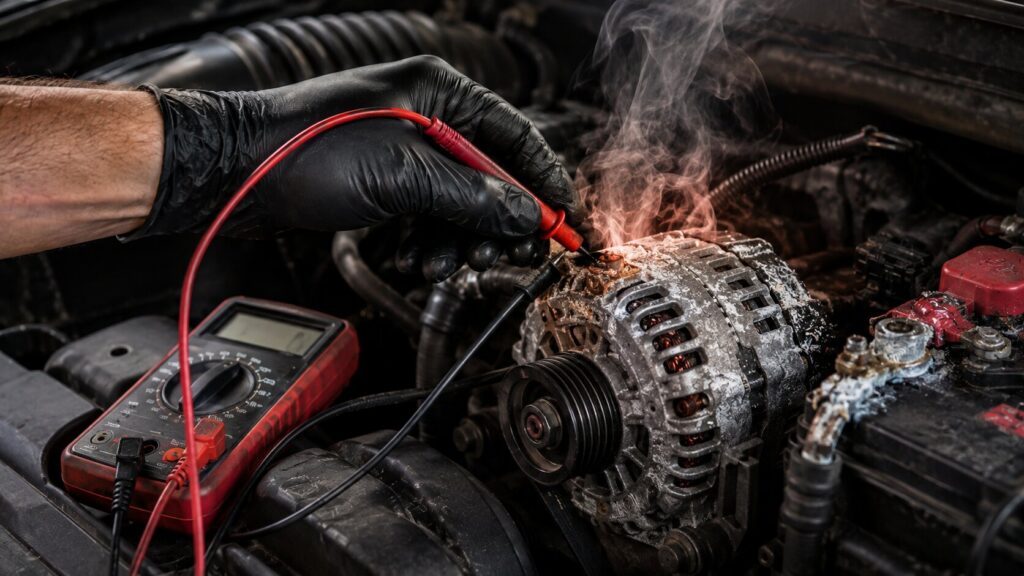
Thick road salt slurry has caked the alternator housing on the sedan idling at the snowy intersection of County Road 15 and Highway 55 in Medina, forcing the voltage regulator to overcompensate until the stator insulation melts. Without an immediate AC ripple test, that acrid electrical smell will escalate into a complete charging system shutdown before the vehicle reaches the shop.
Why Alternators Overheat and Fail
Normally, your engine turns a serpentine belt that spins an internal rotor past stationary stator coils, generating alternating current. The internal diode bridge then rectifies that into direct current to feed your 12-volt electrical bus and keep the battery charged.
The trouble starts when local road conditions interfere. Minnesota highway departments love using aggressive magnesium chloride and salt brines to melt ice. When that chemical brine splashes up through worn splash guards, it coats your alternator housing and kicks off severe galvanic corrosion between dissimilar metals.
- Resistance Spike: Corrosion forces the voltage regulator to command maximum field current to compensate for the drop.
- Thermal Overload: Stacking this on top of heavy winter electrical demands—rear defrosters, seat heaters, blower motors on high, and headlights—pushes internal operating temperatures past safe insulation thresholds.
- Insulation Breakdown: Continuous heat-soaking softens the protective varnish on the stator windings, setting the stage for internal short circuits long before the dashboard battery light ever turns on.
Warning Signs of a Failing Alternator & Burning Smells
Dashboard battery lights often trigger only after total failure. Before that happens, an overheating alternator produces specific electrical and mechanical warning signs.
Faint Electrical Odors During Long Idles
This occurs during prolonged idling, where lack of under-hood airflow allows heat-soaking to concentrate right around the stator windings, producing alternator warning smells that sneaks inside the cabin.
Unusually Dim or Fluctuating Headlights
Watch your lights: they brighten the second you press the gas pedal and dim down significantly while you’re idling at a stoplight. This voltage sag tells you the vehicle is temporarily running entirely off battery power at low RPMs.
Whining or Growling Under-Hood Noises
The alternator rotor spins on tiny precision bearings that eventually fail when moisture contamination and excessive belt tension breach their seals. This creates a high-pitched mechanical whine that climbs right along with your engine RPMs.
Intermittent Electrical Glitches
Modern control modules are hyper-sensitive to voltage fluctuations. You might notice your radio resetting randomly, power windows crawling up slowly, or your ABS and traction control lights flickering for no apparent reason.
How to Test and Diagnose a Failing Alternator
Catching an early-stage alternator failure requires moving beyond basic parts-store battery tests. When a vehicle enters the bay smelling of hot electrical solder, the complete charging circuit must be tested under heavy load:
- Voltage Drop Baseline: Place one multimeter lead directly on the alternator output stud and the other on the positive battery terminal with the engine running and accessories loaded. In Minnesota winters, road salt and moisture frequently trap under the alternator bracket, creating a hidden failure point. Always inspect the B+ terminal cover first; if blue-green crusting is present on the connection, excessive voltage drop is guaranteed. Any reading above 0.5 volts proves there is excessive resistance in the charging cable.
- AC Ripple Detection: Set the multimeter to measure AC volts. While a healthy unit converts nearly all AC to DC, an output exceeding 0.5 volts AC indicates a failing diode trio, which allows raw alternating current to leak into sensitive vehicle control modules.
- Current Output Verification: Clamp an inductive amp meter around the main charging lead to confirm whether the unit is delivering its rated amperage output without thermal runaway or voltage sag.
Stop the Short-Circuit Before It Strands You
Ignoring an electrical burning smell turns a simple diode or brush replacement into a fried battery and a dead car on the side of the road. Let us put an inductive clamp on your charging lead and check that AC ripple before the salt brine completely melts your stator insulation.
We provide specialized electrical diagnostics serving Spring Park, Mound, Minnetonka, and the surrounding Lake Minnetonka communities. Bring your vehicle to Certified Auto Repair at 4700 Shoreline Drive, Spring Park, MN 55384 to schedule your charging system diagnostic today.
Frequently Asked Questions
Does a burning smell from the engine always mean the alternator is failing?
Yes, a hot electrical or acrid ozone smell often points directly to overheating alternator windings, melting stator insulation, or a failing voltage regulator working overtime under a heavy electrical load.
Can a bad alternator drain my car battery overnight?
Yes, a shorted internal diode inside a failing alternator can allow current to flow backward from the battery while the engine is turned off, completely draining your battery overnight.
Will a failing alternator trigger the check engine light?
Yes, severe voltage drops or high AC ripple caused by a failing alternator can starve your vehicle’s control modules of clean power, frequently triggering a check engine light alongside dimming headlights.
Should I drive my car if I smell burning electrical wires in the engine bay?
No, driving with an active electrical burning smell is dangerous because it can rapidly escalate into an under-hood electrical fire or leave you stranded when the charging system shuts down completely.