Struggling with intermittent electrical glitches or warning lights on a Jeep around Lake Minnetonka? Basic diagnostic tools may not capture brief voltage changes or intermittent communication concerns that require live circuit monitoring. Advanced diagnostic software combined with real-time network analysis helps technicians identify intermittent wiring and communication faults more efficiently.
Very brief voltage fluctuations may not appear during standard testing because basic meters display averaged measurements rather than capturing rapid waveform changes. I can observe changes in the data stream as intermittent electrical disturbances occur because the diagnostic platform records brief signal changes that standard testing may not capture. It shows me the real-time toll that lake heat and humidity take on the wiring.
Leveraging this platform allows me to isolate the precise Grand Cherokee fault code without resorting to the manufacturer. Diagnostic procedures may sometimes lead toward component replacement when additional circuit testing is needed to confirm the root cause.
Decoding the Dual-Channel Rationality Failure in Summer Traffic
Jeep utilizes a dual-channel rationality check for critical engine data inputs, particularly within the electronic throttle control and crankshaft position sensor circuits. Channel A and Channel B must mirror each other within strict operating parameters. If the signal voltage between these two streams diverges by more than 0.5 volts for more than 40 milliseconds, the powertrain control module flags a critical error and forces the vehicle into limp-mode.
Summer congestion near Sunset Point forces engine bay temperatures to soar, which frequently destabilizes weak electrical circuits. Standard scan tools fail to report trouble until the circuit encounters a prolonged 40-millisecond failure window. By comparing current circuit outputs to factory wear data, the program catches microscopic electrical drift early, pinpointing a failing wire terminal before your vehicle strands you on County Road 15.
How AI Diagnostics Catch Complex Data Link Failures Faster
Traditional troubleshooting relies on waiting for a hard trouble code to trigger after a part has already failed. In contrast, I use an AI-driven diagnostic platform to analyze the vehicle’s Controller Area Network (CAN-Bus) at the bit level, processing thousands of data packets per second to catch transient glitches instantly.
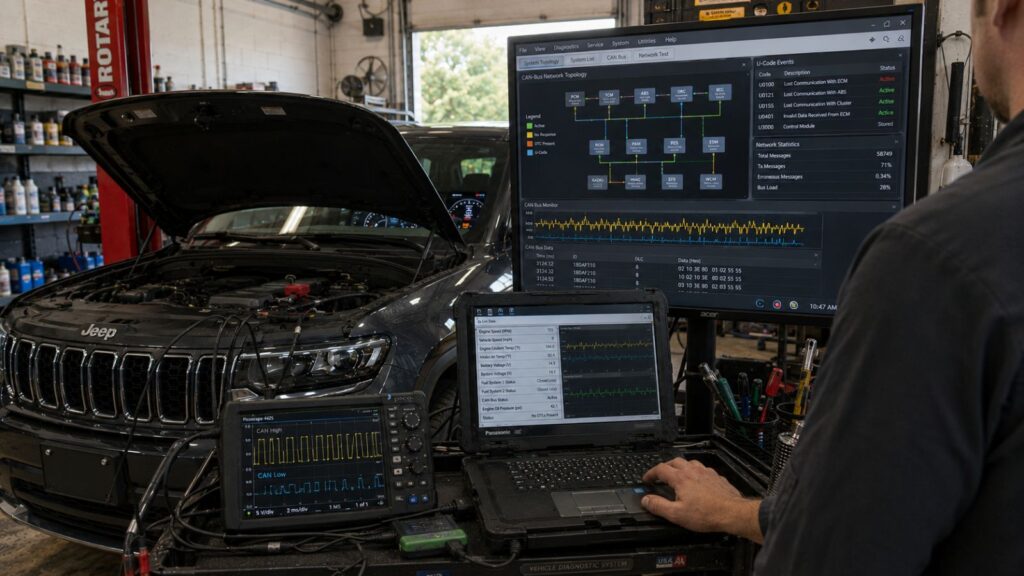
The software helps isolate complex electrical issues by analyzing specific network behavior:
- Module Communication Errors (U-Codes): Instead of blindly condemning a dropped module, the platform tracks the precise rate of decaying data packets. I can then cross-reference these drops with network traffic load to help distinguish a physically failed module from a wiring, connector, or communication concern.
- Sensor Rationality Failures: In dual-channel circuits like the electronic throttle control, the AI engine detects microscopic electrical drift long before the signal variance crosses the official 0.5-volt limp-mode threshold, allowing me to catch a failing wire terminal early.
By overlaying live network readouts with known factory wear data, the program cuts right through random electrical noise. It points me straight to the broken circuit without forcing me to spend hours testing lines by hand.
When Jeep Wiring Repairs Beat Module Replacement
When a Jeep arrives with warning lights, communication codes, or intermittent electrical failures, the module is not automatically considered faulty because a U-code only confirms interrupted communication, not the root cause. Proper diagnosis begins by verifying circuit integrity through power stability checks, voltage drop testing, and CAN-Bus monitoring to separate wiring concerns from actual module failures. Many Jeep electrical issues around Spring Park originate from hidden connector corrosion, weak grounds, or damaged wiring affected by moisture and temperature changes while the control unit remains fully functional.
Repairing Jeep Electrical Issues Without Major Replacement
- Corroded Connector Pins
When corrosion is found inside a Jeep connector, I inspect how far it has spread. If the damage is limited to one terminal and the wire remains healthy, I can replace the affected pin and restore the connection without replacing the full harness. - Damaged Ground Connections
A weak ground can mimic multiple module failures. Testing often reveals excessive resistance at chassis ground points, and restoring proper contact can return the network to normal operation. - Water Intrusion Inside Harness Connectors
Moisture exposure near Lake Minnetonka can affect vulnerable connectors. I check for water residue, mineral buildup, and corrosion to determine whether the damage is isolated or has reached deeper into the harness. - Loose Terminals
A terminal with reduced contact tension may work intermittently under vibration, heat, or electrical load. I verify terminal fitment before replacing expensive electronic components. - Localized Wiring Damage
If testing confirms the main circuit is healthy and only one section is damaged, targeted wiring repairs with proper sealing and verification can restore operation without replacing the entire harness.
Determining When Jeep Modules Need Replacement
There are cases where replacing the module is the correct repair. I make that recommendation only after eliminating the external causes that can make a healthy module appear defective.
Internal module failure confirmed
If the module has verified power, verified ground, proper CAN-Bus communication lines, and still fails to respond or operate correctly, the failure is likely inside the electronics of the unit itself.
Water-damaged circuit boards
If moisture has entered beyond the connector and reached the internal circuit board, corrosion can damage components that cannot be restored through external wiring repairs.
Failed processor communication
When the network wiring tests correctly and the module cannot communicate with factory-level diagnostic equipment, internal processor failure becomes a stronger possibility.
Burned power circuits
Electrical overloads, short circuits, or internal component failures can damage the module’s power control circuits. In those cases, replacement may be necessary after confirming the original cause of the failure.
The goal during Jeep electrical diagnosis is not to automatically repair or replace components, but to identify the exact failure point before parts are installed. A corroded connector, damaged wire, weak ground, or unstable voltage supply can create the same symptoms as a failed module. Live circuit testing separates these conditions and helps determine the repair needed to restore proper system operation.
Boat Ramp Corrosion vs Failed Modules and Pinpointing Rear Harness Shorts
A sudden cluster of warning lights generally indicates an isolated wiring fault instead of an expensive, completely failed electronic control module. This typically happens after launching boats at the Spring Park Transit Dock boat ramp, where water gets trapped inside low-hanging electrical plugs. Jeeps launching watercraft frequently submerge their rear chassis sections, trapping lake water inside the blind-spot monitoring modules and wheel speed sensor connectors.
As the vehicle sits under the intense summer sun, the water evaporates, leaving behind a sticky, green copper oxide crust and a microscopic mineral film. This residue creates an unintended low-resistance bridge between power circuits and ground lines. When I pull these connectors apart, I can feel the grittiness of the mineral deposits inside the plastic housing. The diagnostic system cross-references these data link errors with under-hood temperature fluctuations, directly tracing the issue to a compromised rear harness instead of a failed front control unit.
Dual-Battery Auxiliary System Strains and Intermittent Data Drops
Newer Jeep models utilize a complex dual-battery auxiliary configuration designed to maintain system memory and power accessory loads during engine stop-start cycles. Heavy summer traffic along Shoreline Drive demands maximum output from the electrical system to power the dual-zone air conditioning, dual radiator cooling fans, and modern infotainment systems simultaneously. While a standard alternator test might show a healthy 14.2-volt charging output at idle, it misses high-frequency AC ripple currents caused by a single failing internal diode.
This electrical noise creates invisible data drops across the chassis modules, causing the instrument cluster to momentarily go black. Matching live network waves against electrical load shifts helps the software flag these hidden ripple patterns. It catches the erratic voltage drops that standard diagnostic tools misread every single day, giving a clear answer instead of relying on guesswork.
Resolving Complex Jeep Electrical Failures with Live Waveform Analysis
Finding intermittent electrical faults requires more than reviewing stored codes. Live network testing and waveform monitoring allow technicians to observe circuit behavior under real operating conditions, helping separate normal electrical variation from abnormal communication patterns. Advanced diagnostic platforms analyze large amounts of vehicle data while waveform testing confirms whether the concern is related to wiring, connectors, power supply, or module operation.
During a recent diagnostic inspection, AI-assisted data analysis combined with live waveform monitoring helped identify a persistent voltage deviation on the communication bus. Instead of replacing a control module or larger harness assembly without confirmation, testing traced the concern to a localized wiring issue beneath the passenger seat framework. After repairing the damaged wire section and restoring the affected circuit, the primary chassis ground connection was verified using proper torque specifications to help maintain reliable electrical performance.
For advanced Jeep electrical diagnostics, visit Certified Auto Repair at 4700 Shoreline Drive, Spring Park, MN 55384. Waveform analysis and live circuit testing help identify the source of intermittent electrical concerns with greater accuracy.
Frequently Asked Questions
Can high summer humidity cause Jeep electrical codes?
Yes. Prolonged exposure to high ambient humidity accelerates the growth of copper oxide corrosion inside unsealed wiring harness connectors, which increases circuit resistance and triggers intermittent sensor communication errors across the vehicle data network.
Does a standard code reader find every electrical fault?
No. Standard scanners may not capture brief voltage changes or waveform disturbances that require live circuit monitoring and advanced analysis.
Can launching a boat cause dashboard warning lights?
Yes. Backing too far down local boat ramps pushes water inside the blind-spot monitoring units and wheel speed sensors, creating a microscopic crust that disrupts the data bus once the connectors dry out.
Why does my Jeep display flash during heavy traffic?
Prolonged idling in summer traffic under high electrical loads can expose hidden voltage drops in the dual-battery auxiliary system, leading to temporary network drops that cause the instrument cluster to reset or black out.
Should a module be replaced as soon as a communication code appears?
No. Factory service manuals often recommend component replacement for communication codes, but precise digital waveform analysis usually reveals the root cause is simply a single corroded connector pin or a loose ground chassis circuit.