Replacing worn suspension parts immediately alters your vehicle’s delicate wheel geometry, causing severe uneven tire wear and dangerous vehicle pulling. Professional alignment restores camber, caster, and toe settings to factory specifications after installing new struts, control arms, or tie rods. Scheduling this service immediately preserves your expensive new components, ensures optimal handling, and prevents rapid tire destruction.
Replacing worn control arms, leaking struts, or loose tie rods beautifully restores your vehicle’s ride quality, but it also completely alters the subtle mathematical angles holding your tires true to the pavement. Every suspension component operates within precise millimeter tolerances to keep your tires flat against the road surface. When we install a brand-new part, the factory-set angles instantly shift because fresh, stiff rubber bushings and tight ball joints sit physically differently than the old, sagged pieces.
Even if a mechanic carefully marks the alignment cams during disassembly, a quarter-inch difference in bushing stiffness or a tiny variance in the aftermarket part’s metal casting completely alters your camber and toe settings. Driving down Shoreline Drive in Spring Park after a front-end repair without a professional laser alignment leads directly to rapid rubber degradation and a heavy steering pull.
How Suspension Repair Disrupts Your Wheel Geometry
Every suspension component operates within precise millimeter tolerances to keep your tires flat against the road surface. When we install a new part, the factory-set angles shift because fresh rubber bushings and tight ball joints sit differently than worn pieces. Even if we mark the alignment cams during disassembly, a quarter-inch difference in bushing stiffness alters your camber, caster, and toe settings.
Tie rod replacements directly alter your vehicle’s toe settings, which controls whether your front tires point straight ahead or turn inward. Upgrading struts or control arms shifts your camber angle, changing how much the tire tilts toward or away from the body. Running your vehicle with these angles off by even 0.10 degrees forces the tread to scrub against the asphalt with every turn of the wheel.
Signs Your Vehicle Needs Alignment After Suspension Work
You might notice your steering wheel sits off-center when traveling straight down the highway. The vehicle can drift toward the shoulder, forcing you to maintain constant counter-steering pressure to stay in your lane. These symptoms mean your tires drag across the road surface rather than rolling smoothly forward.
- Crooked Steering Wheel: The wheel rests at an angle while your vehicle travels in a straight line.
- Persistent Drift: The chassis pulls toward the curb or centerline when you loosen your grip.
- Uneven Tread Wear: The inner or outer edges of your tires show feathering or smooth spots.
- Squealing Tires: Rubber chirps during routine low-speed turns on smooth asphalt.
What Happens When You Skip the Alignment Step
Skipping a wheel alignment after changing suspension components forces your tires to fight each other down the road. Unaligned angles create rolling resistance, causing your engine to burn more fuel while grinding down fresh tire tread. Last week, a vehicle came into our shop after a DIY strut install; just 200 miles of driving on misaligned camber stripped the inner tire shoulders down to the metal belts.
Skewed alignment angles also shrink your tire’s contact patch with the pavement, especially on wet or icy Minnesota roads. Your anti-lock braking and traction control systems rely on predictable tire grip to stabilize the vehicle during emergency stops. Driving on misaligned wheels compromises that traction when you need to stop quickly.
The Modern Alignment Process Explained
When you bring your vehicle to our shop, we place it on a computerized alignment rack equipped with high-definition optical sensors. These targets attach directly to your wheels and measure your current angles against exact factory specifications down to a fraction of a degree.
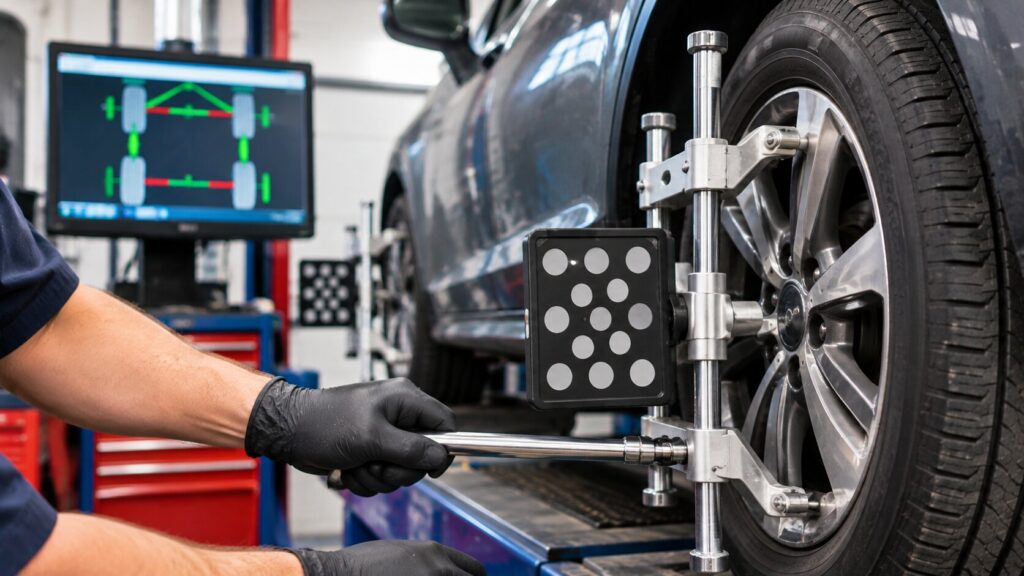
- Pre-Alignment Inspection: We verify tire pressure, inspect rim integrity, and confirm all new suspension hardware is torqued correctly.
- Sensor Calibration: Optical targets scan your wheel positions to establish baseline measurements against factory standards.
- Mechanical Adjustments: We alter tie rod lengths, adjust eccentric cams, and set subframe positioning to bring toe, camber, and caster back to spec.
- Road Test Verification: We drive the vehicle on local roads to confirm straight tracking and a centered steering wheel.
Protecting Your Suspension Components in Spring Park
Navigating severe freeze-thaw cycles and rough pavement around Lake Minnetonka puts extra stress on your vehicle’s chassis. Freshly installed suspension components need a short break-in period as new rubber bushings settle under normal road forces. Scheduling an alignment immediately after replacement prevents abnormal tread wear while these parts set.
Pairing your suspension repairs with a precision wheel alignment ensures your vehicle handles predictably, tracks straight, and preserves your tire life through every season. If you recently replaced suspension components or notice your vehicle pulling, our team uses computerized equipment to restore your suspension to factory specs. Visit us at 4700 Shoreline Drive, Spring Park, MN 55384, or schedule your alignment service today at Certified Auto Repair.
Frequently Asked Questions
Do I always need an alignment after replacing suspension parts?
Yes, replacing core components like struts, tie rods, control arms, or ball joints alters your wheel angles. Even small changes in component length or mounting position push your toe and camber settings out of factory tolerance.
Can I drive my car home before getting an alignment?
You can drive short distances at low speeds to reach an auto repair facility, but extended driving will cause rapid and irregular tire wear. We recommend scheduling your alignment service immediately after completing any front-end repair.
How long does a standard wheel alignment take?
A computerized four-wheel alignment typically takes between 45 and 60 minutes to perform. If adjusters are rusted or require specialized shims, the process may take a bit longer to ensure exact accuracy.
Will a bad alignment damage my new suspension parts?
Yes. Misaligned wheels create severe, uneven lateral forces that put immense extra stress on your fresh rubber bushings, ball joints, and tie rod ends. Aligning your wheels right away completely ensures your new, expensive components wear evenly and last as long as the manufacturer intended.