A skewed rear tracking angle forces your vehicle to track sideways, causing off-center steering wheels, unstable handling, and rapid tire wear. Driver adjustments only temporarily compensate for the offset. True correction requires a precise full-chassis alignment to reset the rear suspension geometry back within factory tolerance relative to the centerline.
When your rear suspension assembly points off to one side, your car naturally crabs down the road sideways. Driving across the Lake Minnetonka causeways around Spring Park, Minnesota, often exposes this issue when hitting frost-heaved pavement or sharp expansion joints. Our team sees this misaligned angle pull your vehicle off its natural centerline, forcing continuous steering corrections and accelerated tire wear.
Rear Suspension Orientation Dictates Primary Vehicle Direction
Your vehicle travels in a direction determined by the rear wheels, not the front ones. The rear tracking angle is an imaginary line perpendicular to the rear suspension assembly that defines the direction your rear tires push the vehicle frame.
If worn suspension bushings or an impact from a curb skews this rear wheel track position past factory tolerance (typically anything over 0.15°), the car moves along that offset path. To compensate and maintain a straight line down Shoreline Drive, you must turn the steering wheel in the direction of the thrust line drift.
Common Signs of a Skewed Rear Tracking Angle
You do not have to put your car on a lift to feel the effects of a shifted thrust angle. A skewed rear wheel track produces distinct handling problems that become immediately obvious at highway speeds:
- Off-Center Steering: The vehicle drives straight, but the steering wheel is noticeably rotated to the left or right.
- Handling Instability: The vehicle feels twitchy, loose, or unpredictable when changing lanes or crossing road seams.
- Asymmetrical Tire Wear: Tires wear down prematurely on the outer or inner edges due to continuous sideways scrubbing.
- Electronic Interference: Electronic Stability Control (ESC) systems trigger unexpectedly during normal cornering maneuvers.
- Braking Pull: The rear end feels like it wants to step out or fishtail during hard braking on uneven surfaces.
Mechanical Failures That Alter Rear Wheel Alignment
Rear alignment settings shift when supporting mechanical components take severe impacts or suffer from long-term environmental degradation. Hitting a hidden pothole under fresh snow easily bends lateral control links or shifts rear subframes.
Regional moisture and heavy winter road salt exposure accelerate wear across all supporting rear suspension points.
| Component | Failure Mechanism | Diagnostic Impact |
| Trailing Arms | Physical bends from curb strikes or deep potholes. | Shifts the wheel centerline out of position, forcing the rear axle to track diagonally. |
| Lateral Toe Links | Worn inner rubber bushings allow excessive lateral play under load. | Creates dynamic toe changes while cornering, making the rear end feel unstable. |
| Subframe Mounts | Structural corrosion or severe kinetic impacts. | Causes offset shifting across the entire rear suspension assembly, misaligning both wheels. |
Shop Floor Verdict: When measuring rear tracking angle on Minnesota vehicles, we frequently find 0.25° to 0.40° of positive drift caused by seized cam bolts on rear toe links. Before attempting geometric adjustments, we inspect the lower control arm bushings. If road salt has welded the eccentric bolt inside the steel inner sleeve, turning the bolt tears the rubber bushing rather than rotating the adjuster.
Correcting Frame Geometry with Full-Chassis Alignment
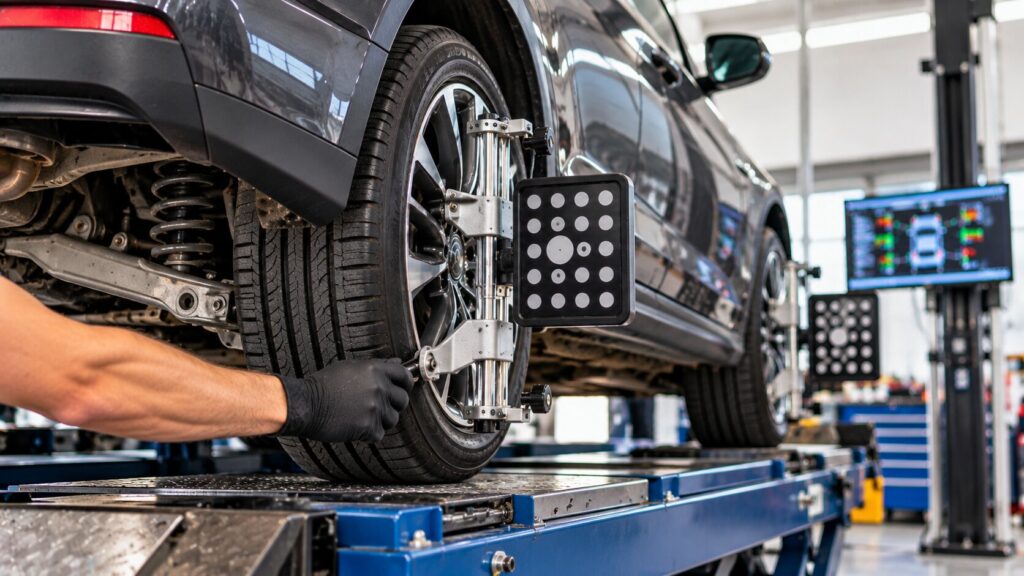
Fixing a crooked steering wheel requires measuring all four wheels together as a team rather than just adjusting the front wheels alone. Modern digital alignment systems like our Hunter Hawkeye Elite platform map the exact orientation of each axle using high-resolution optical targets.
Following Motorist Assurance Program (MAP) Uniform Inspection Guidelines, our technicians adjust the rear settings independently at each back wheel back within a tight 0.05° tolerance before centering the front steering wheel. Correcting the rear geometry ensures the front and rear wheels follow the exact same path down the road, completely eliminating steering offset.
Professional Alignment Care for Local Drivers
We regularly see rear tires scrubbed down to the cords on the inner shoulders after just 3,000 miles of severe tracking offset. Running out of alignment also places unnecessary stress on front steering racks and suspension ball joints.
Our team provides precise full-chassis alignments to restore proper rear tracking angles and keep your vehicle driving true. Contact us at Certified Auto Repair at 4700 Shoreline Drive, Spring Park, MN 55384 to set up an inspection and alignment service.
Frequently Asked Questions
Can front-only wheel alignment fix a crooked steering wheel?
No. A front-only alignment cannot resolve steering wheel offset if the underlying cause stems from the rear suspension assembly. Adjusting front toe settings while the rear tracking angle remains skewed leaves the vehicle crabbing down the road. Comprehensive total vehicle measurements are necessary to properly center the steering wheel.
What causes the rear tracking angle to shift out of specification?
Severe road impacts, such as striking deep potholes or hitting curbs, primarily cause tracking shifts. Worn or torn rubber bushings in rear control arms also allow the rear wheel position to shift under load. Age and harsh environmental exposure accelerate this mechanical wear on suspension linkages.
Is it safe to drive with an incorrect rear tracking angle?
No. Driving with an incorrect tracking angle is not safe for extended periods because it compromises overall vehicle stability. Emergency maneuvers become unpredictable because the car reacts differently when turning left versus turning right. Prompt service prevents unsafe handling characteristics and stops rapid tire degradation.
How do technicians adjust the rear tracking angle during an alignment?
Our technician corrects the tracking angle by adjusting rear toe alignment independently at each wheel until the angle reads zero degrees relative to the vehicle centerline. Loosening adjusting cams or threaded tie rods shifts the positioning of the rear wheels until the tracking line matches the vehicle centerline. If bent components or seized cam bolts prevent proper adjustment, damaged suspension parts must be replaced first.