Milled pavement drop-offs and utility covers along Sunset Drive impact steering geometry, bending tie rods and shifting control arms. Unaddressed misalignment causes inner-shoulder tire wear and persistent vehicle pulling. We use high-definition digital optical targets to recalibrate toe and camber to factory specs, protecting tires from premature wear.
Daily commutes through active construction zones around Lake Minnetonka put continuous stress on your vehicle’s front end. Hitting sharp asphalt cutouts or uneven detour pavement near County Road 15 transfers severe kinetic energy straight into tie rods, ball joints, and control arm bushings. These repeated road impacts alter factory alignment angles, causing subtle steering drift and premature tire destruction across Spring Park.
Impact Dynamics and Steering Linkage Shift on Construction Routes
Suspension geometry relies on factory specifications held to fractions of a degree. Toe angle controls parallel wheel orientation to eliminate tire scrub, while camber governs the vertical tilt to maintain an even contact patch across the tread surface. When a vehicle strikes a hard construction ledge at speed, the tire absorbs a sharp lateral vector force that forces mechanical linkages past their mechanical holding thresholds.
This kinetic impact flexes lower control arm bushings and causes eccentric adjustment bolts to slip out of position. Even a microscopic bend in an inner tie rod alters wheel geometry permanently until manually recalibrated. A toe misalignment of just 0.25° causes a tire to drag sideways over 14 feet for every mile driven down Shoreline Drive.
Suspension Damage Mechanisms from Milled Ledges and Trench Plates
Milled asphalt creates vertical ledges that strike tire sidewalls without the gradual slope of regular road transitions. Because rubber cannot fully absorb these sharp impacts, vehicle weight concentrates entirely onto a single point of the wheel assembly. Steel trench plates sitting above surrounding pavement force lower control arms upward while chassis weight pushes downward.
This opposing shear stress galls rubber-to-metal bushings, bends steering knuckles, and stretches fine tie rod threads. Detour routes around Spring Park divert heavy commuter traffic onto unreinforced shoulder pavement. These crumbling road edges collapse under load, dropping tires into sharp ruts that violently pull steering linkages beyond factory margins.
Visual and Physical Indicators of Misaligned Suspension Geometry
- Steering Wheel Off-Center: The vehicle drives straight down Shoreline Drive, but the steering wheel badge is rotated slightly to the left or right.
- Persistent Drift: The vehicle actively pulls toward the ditch or center line when you briefly release hands from the wheel on flat pavement.
- Tread Feathering: The tread blocks on your tires feel smooth when rubbed one way, but sharp and rough when rubbed in the opposing direction.
- Vibration in the Floorboard: A slight shimmy or wobble occurs at speeds over 35 mph after hitting a notable pothole or construction lip.
Digital Alignment Diagnostics and Mechanical Adjustment Workflow
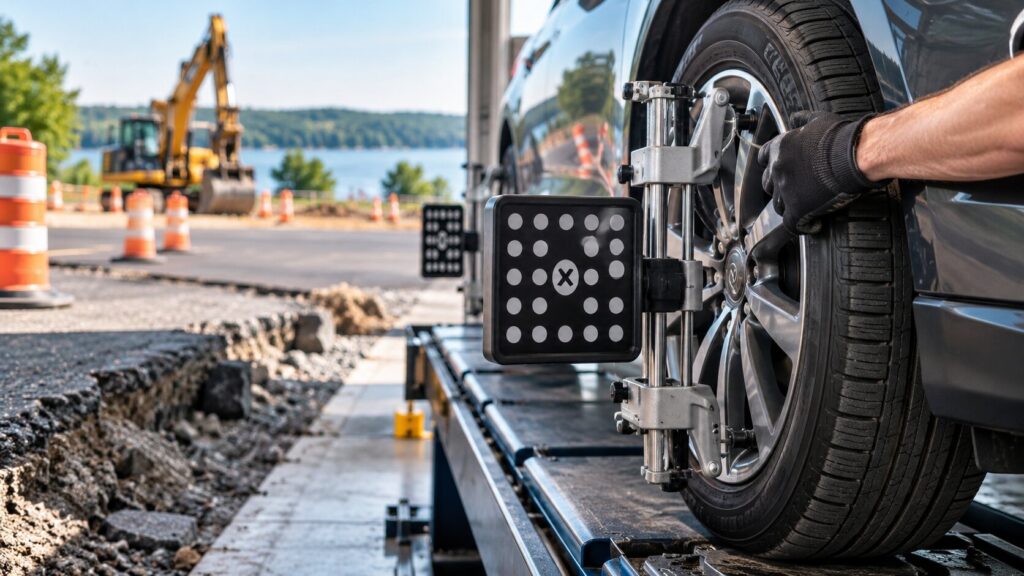
We pull every vehicle onto the hoist for a physical inspection of the steering and suspension linkages prior to mounting calibration hardware. Technicians test ball joints, tie rod ends, and control arm bushings for mechanical play, structural deformation, or torn boots.
When we inspect Lake Minnetonka commuter vehicles following a Sunset Drive impact, we routinely find right-front toes knocked out by 0.35° or more with tie rod lock nuts showing physical bottoming marks. We mount high-definition digital optical targets to all four wheels to capture toe, camber, and caster down to hundredths of a degree.
Once out-of-tolerance angles are identified, we loosen lock nuts and adjust eccentric cam bolts to restore geometry to exact factory specifications. After locking down mechanical components, we reset electronic steering angle position sensors to ensure stability control systems operate correctly.
Tread Wear Prevention and Suspension Component Protection
Running misaligned suspension components rapidly scrubs rubber off premium tires. Dragging a tire sideways at an improper angle strips away tread compounds across a single construction season.
Delaying a wheel alignment check creates compound stress across your vehicle’s front end. Worn steering geometry places uneven loads on wheel bearings, steering racks, and CV axle joints, resulting in premature mechanical failure.
Understanding the secondary damage caused by bent linkages helps drivers prioritize early maintenance. Addressing alignment shifts promptly keeps repair costs low and prevents catastrophic component failure down the road.
Schedule Your Digital Alignment Inspection in Spring Park
Ignoring minor suspension shifts allows misaligned tires to drag sideways across every mile of your commute, stripping away tread rubber and forcing premature replacement expenses. Left unchecked, that continuous lateral drag places heavy shear loads on your wheel bearings, steering racks, and CV axle joints.
Choosing a specialized local shop gives you direct access to high-definition calibration technology and agile service without the multi-week backlogs typical of regional dealership service centers. Contact us today or visit Certified Auto Repair at 4700 Shoreline Drive, Spring Park, MN 55384 to restore your steering geometry and protect your tires.
Frequently Asked Questions
How do I know if construction roads damaged my wheel alignment?
A crooked steering wheel while driving straight down flat roads is the most immediate sign of alignment damage. You may also feel the vehicle pull toward the shoulder or notice rough feathering across your tire tread.
Can a single hit on a construction ridge ruin my alignment?
Yes, striking a sharp pavement cutout or raised utility cover at speed generates enough force to bend a tie rod or shift eccentric control arm bolts. A single severe impact can instantly knock your toe or camber angles out of specification.
How often should I check my alignment during local roadwork seasons?
Check your alignment immediately after a hard road impact or at least once per year during active roadwork seasons. Catching minor geometry shifts early prevents irreversible tread wear and protects secondary suspension parts.
Will a vehicle misalignment damage other parts of my car?
Yes, driving with misaligned wheels transfers continuous vibration and uneven torque loads to surrounding front-end components. Left uncorrected, this drag accelerates wear on ball joints, control arm bushings, and wheel bearings.