A failing alternator triggers false dashboard warnings by leaking AC voltage—known as AC ripple—into the vehicle’s DC electrical system. This “electrical noise” corrupts 5-volt sensor signals, causing the PCM to log ghost codes. In Minnesota’s salt-heavy climate, internal diode bridge corrosion is the primary cause of this signal interference.
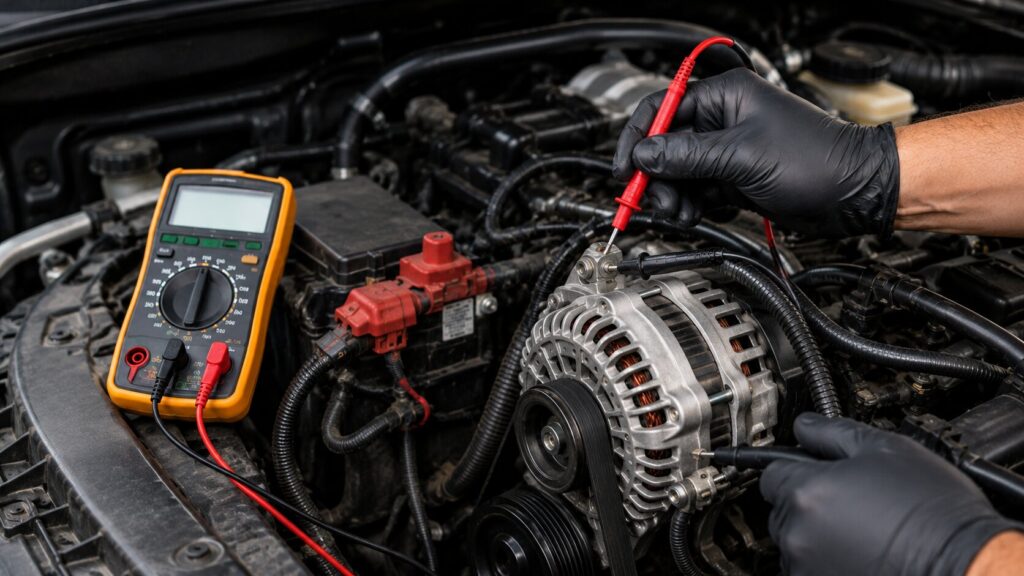
When an alternator stops maintaining a steady voltage, it floods your car’s computer network with erratic data packets. This electrical interference tricks your vehicle into flashing false warning lights across the dashboard for parts that are not actually broken. If your dash is lighting up unexpectedly, the culprit is usually a bad electrical signal rather than a mechanical failure.
The Physics of AC Ripple and Sensor Corruption
Your alternator generates electricity as it spins, creating alternating current (AC). Because your car’s computers and sensors need smooth direct current (DC), a part inside the alternator called a diode bridge acts as a gatekeeper to convert that power.
In Spring Park, the magnesium chloride used on the county roads is hyper-conductive. It doesn’t just sit on the frame; it wicks into the alternator’s rear cooling vents, specifically accelerating diode bridge corrosion on low-mounted units.
When the diode bridge fails, it stops cleaning the power cleanly and starts leaking AC voltage back into the system—a problem we call AC ripple. Because modern car sensors rely on delicate 5-volt signals, that electrical static completely scrambles their messages. Your car’s computer panics, reads the interference as a major system failure, and lights up your dashboard with warning lights even though your engine mechanicals are completely fine.
The Limitations of Battery Replacement
When the dashboard suddenly lights up with erratic warnings, most drivers immediately assume a dying battery is to blame. While a healthy battery acts as a natural buffer to absorb minor voltage dips, it physically cannot filter out a continuous stream of AC ripple pouring from a blown alternator diode. As that dirty electrical noise floods the wiring harness, the battery loses the fight to stabilize the current.
Allowing this unfiltered voltage spike to circulate through the system forces your onboard computers to operate completely blinded by electrical static. Ignoring this severe AC ripple long enough does more than trigger annoying dash lights—it will eventually fry the sensitive circuits inside your Powertrain Control Module (PCM). Swapping out a worn alternator is a straightforward maintenance procedure, while replacing a burnt-out main computer module turns into a massive diagnostic nightmare.
Our Step-by-Step Testing Process
When a vehicle rolls into my bay with a “Christmas tree” dashboard, I don’t rely blindly on basic code readers, because codes only show symptoms—not the root cause. Instead, I use a three-step testing process to track down the real problem:
The Battery Test (Checking the Foundation)
I start with the engine completely off to test the battery’s health. If the power level is sitting too low, it means we have a weak battery or a dead cell. We have to fix that foundation first before we can test the charging system accurately, because you can’t troubleshoot a charging problem on a dying battery.
The Ripple Test (Catching the Leak)
This is where I catch the main culprit. I hook up a specialized meter to check for hidden electrical “noise” (AC ripple) while running the engine at 2,000 RPM with the high beams and heater fan turned on high.
I’m looking for an AC ripple value above 100mV. Anything higher indicates a failing diode bridge; at 200mV+, you’re actively corrupting CAN-bus data packets, which explains why your ABS, traction control, and check engine lights are firing simultaneously.
The Cable and Ground Check (Looking for Corrosion)
Finally, I test the main power cables and ground wires to make sure electricity is flowing smoothly. If the path is blocked, it’s usually because road salt has eaten away at the connections. Sometimes, you don’t even need a brand-new alternator—you just need a corroded ground wire cleaned up and bolted down tightly.
Independent Expertise Versus Dealership Backlogs
Dealership service departments often rely on rigid, expensive part-swapping protocols. If a scanner points to a sensor code, they will often just replace that sensor, and when the light comes back on, they move to the next most expensive module.
I prefer a more targeted approach. By looking closely at the actual electrical signal rather than just blindly following computer codes, I can figure out whether your problem is a bad diode bridge, a weak ground, or just corroded terminals.
Precision Electrical Diagnostics in Spring Park
If your dashboard is lighting up, bring your vehicle into our shop at 4700 Shoreline Drive, Spring Park, MN 55384. I don’t swap parts on a guess; I scope the signal to prove where the leak is. Stop guessing at dashboard warnings—schedule an appointment with Certified Auto Repair and let us get your charging system back in working order.
Frequently Asked Questions
Can a bad alternator cause false check engine lights?
Yes. A failing alternator produces electrical noise called AC ripple that interferes with sensitive sensor circuits, tricking your car’s computer into setting off false warning lights across the dashboard.
Will a failing alternator drain my car battery?
Yes. A damaged diode bridge or worn voltage regulator will fail to keep the battery properly charged while driving, eventually leading to a dead battery and a no-start condition.
Can you test an alternator with a standard multimeter?
Yes. You can use a digital multimeter to check standard DC output, or switch it to measure AC millivolts under load to detect a failing diode bridge.
Do bad ground wires cause dashboard lights to flicker?
Yes. Corroded or loose ground straps create high electrical resistance, starving the vehicle’s control modules of stable power and causing erratic dashboard behavior.