Road salt and magnesium chloride brine in Spring Park create a conductive electrolyte that penetrates OEM wire loom insulation. This causes galvanic corrosion at copper terminal crimps, leading to increased circuit resistance. An oscilloscope helps us spot hidden wiring resistance so we don’t end up swapping out expensive sensors that aren’t even broken.
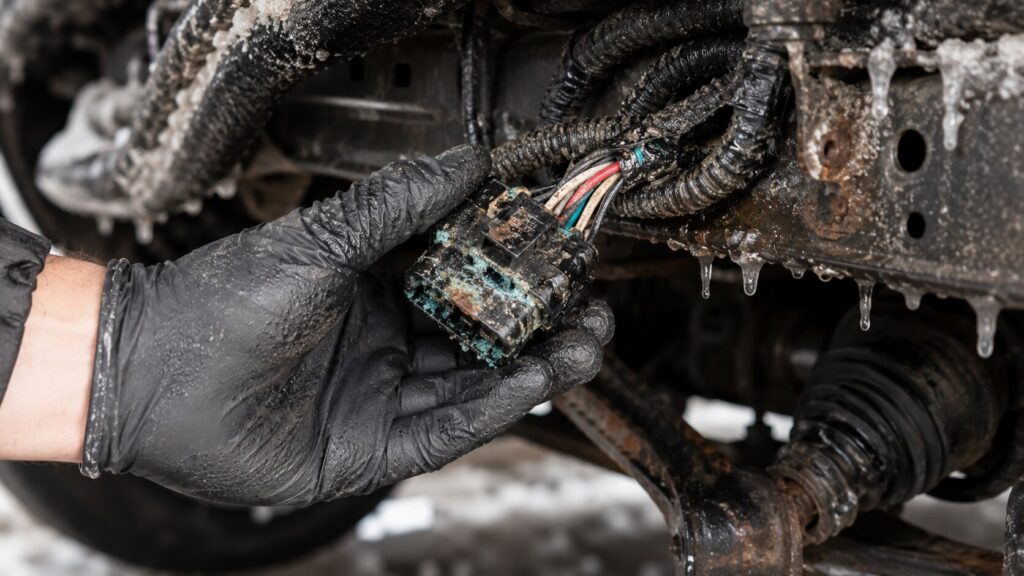
Salt and slush on Shoreline Drive are getting into the wires under cars in Spring Park, causing stubborn check engine lights. When I inspect vehicles during the winter, I often find that road treatments have soaked through brittle factory wire tape. This trapped salt eats away at the copper wires inside, dropping the electrical signal and tricking the car’s computer into throwing random fault codes.
Why Minnesota Winters Destroy Vehicle Wiring
Living near Lake Minnetonka puts your vehicle’s wiring under constant stress. Winter road salt and liquid deicers create a highly conductive, corrosive environment for your car’s undercarriage.
Here is how road salt destroys your vehicle wiring:
- How it gets in: Road salt spray forces its way into micro-fissures inside your plastic wire looms, creating a trapped, wet brine solution that never dries out.
- The chemical reaction: This trapped brine causes rapid galvanic corrosion. Dissimilar metals at terminal crimp points oxidize, turning healthy copper strands into green copper carbonate.
- The final failure: The corrosion increases circuit resistance and drops your reference voltage. This corrupts digital data packets sent to the engine computer until the circuit drops completely offline, triggering a dashboard full of warning lights.
Common Signs of Electrical Corrosion
Before your check engine light illuminates, voltage drops and packet corruption within your vehicle’s CAN bus network will manifest as distinct, intermittent physical anomalies:
- Transient Grounding and Stalls: Splashing through slush pushes moisture straight through damaged insulation, briefly grounding low-reference signals and causing the engine to sputter or stall.
- Reference Voltage Fluctuation: Internal buildup on shared 5-volt reference circuits creates voltage shifts, tricking analog-to-digital converters into sweeping dashboard gauges erratically.
- Multiplexed Data Packet Corruption: High resistance causes data packet loss on twisted-pair lines, starving the transmission of the real-time signals it needs for smooth hydraulic shifting.
- Parasitic Leakage Paths: Oxidized terminal junctions create low-level resistive paths to chassis ground, allowing micro-amperes of current to bleed continuously and slowly drain the battery with the ignition off.
When I’m probing a harness on a vehicle that’s seen five Minnesota winters, I’m not looking for a broken wire—I’m looking for ‘green crust’ at the terminal crimp. If your scan tool shows a ‘Low Voltage’ code for an O2 sensor or Crank Position Sensor, 90% of the time the sensor is fine; the issue is high resistance at the connector caused by brine wicking. Don’t replace the part until you’ve verified the signal wave with a scope.
The Problem with Quick-Fix Repairs
Many drivers assume that if they spot a frayed conductor, they can simply twist the broken strands together and wrap them in electrical tape. In my shop, I see the aftermath of these quick fixes daily, and they almost always fail. CAN bus communication lines require precise resistance values.
The factory twists these leads at a specific rate per inch to cancel out electromagnetic interference from the alternator and ignition coils. When someone cuts out a damaged section and adds a bulky splice or a basic twist, that impedance changes instantly.
How to Diagnose Sensor Wiring Failures
Finding an intermittent wiring problem requires following a step-by-step diagnostic routine instead of guessing or blindly replacing expensive sensors.
Step 1: Code Extraction and Freeze-Frame Analysis
Scanning the vehicle for Diagnostic Trouble Codes provides a starting point, but I pull the freeze-frame data to see exact engine parameters like RPM, coolant temperature, and load at the moment the fault occurred. This data immediately clarifies whether the electrical failure is triggered by thermal expansion, mechanical vibration, or moisture intrusion.
Step 2: Circuit Integrity Testing
Once the suspect circuit is isolated, a high-impedance digital multimeter measures voltage drop under a live electrical load. A healthy wire should show near-zero resistance, but a reading of even 0.5 volts across the wire itself confirms that internal corrosion is choking off the electrical current.
Step 3: Oscilloscope Signal Analysis
For modern computer-controlled systems, a digital storage oscilloscope graphs the actual square-wave patterns of the data signals moving through the wiring harness. Spotting electronic noise, signal rounding, or distorted waves on the screen proves that the physical wiring is degraded, isolating the fault away from the sensor and directly into the harness itself.
Protecting Your Vehicle from Road Salt
While avoiding Minnesota winter roads is impossible, you can minimize electrical damage with proper maintenance. The most effective defense is a thorough undercarriage wash during the coldest months. Skip the standard exterior wash and blast out the hidden wheel well crevices and frame rails where wire looms actually collect destructive road grime.
If your vehicle is older than five years, consider having a professional inspect your ground points. These locations, where the electrical system attaches directly to the vehicle chassis, are exposed to the elements and are the first places to develop rust. A simple cleaning and application of dielectric grease prevents moisture from reaching the metal contact point.
Professional Help for Complex Electrical Issues
Ignoring a check engine light caused by wiring corrosion is a risk I see drivers take all the time. A damaged wire can easily send power where it shouldn’t go and ruin your engine computer, which is expensive and a headache to replace.
In my shop, I use advanced tools like oscilloscopes and thermal cameras to track down tiny breaks in the wiring harness that standard diagnostic scanners miss, allowing me to fix the actual electrical problem the right way.
Bring your vehicle to Certified Auto Repair at 4700 Shoreline Drive, Spring Park, MN 55384 for a scope-based electrical health check.
Frequently Asked Questions
Does road salt cause vehicle sensor wiring failures in Minnesota?
Yes, road salt and liquid deicers used on Minnesota roads act as a corrosive electrolyte when mixed with winter moisture. This brine wicks past factory wire loom tape and aggressively oxidizes internal copper strands until the sensor signal is lost.
Can a basic OBD-II scanner identify a broken or corroded wire?
Yes, a standard code reader can pinpoint the specific sensor throwing a fault code, but it cannot differentiate between a failed sensor and a high-resistance wiring break. Advanced diagnostic tools like a digital storage oscilloscope are required to test the actual circuit integrity.
Is standard electrical tape an effective permanent fix for corroded wires?
No, wrapping damaged wires in electrical tape fails because moisture and road brine continue to wick underneath the adhesive. This trapped moisture accelerates internal corrosion and can eventually cause a severe electrical short circuit.
Will a damaged sensor wiring harness reduce my fuel economy?
Yes, a corroded wire sends distorted voltage signals to the engine computer, which can force your vehicle into an incorrect fuel trim state. This poor data disrupts optimal air-fuel ratios and directly reduces your overall fuel efficiency.