Winter road salt often triggers persistent P0138 and P0171 codes in Asian SUVs by corroding the exposed ground circuits. These electrical resistance spikes are frequently misdiagnosed as failed components by technicians relying solely on generic scanners. To accurately resolve these emissions issues, I always run live fuel trim checks and precise voltage drop testing to isolate the electrical fault and prevent unnecessary parts replacement.
The Real Cause Behind Asian Vehicle Oxygen Sensor Problems
Heavy road salt around Lake Minnetonka ruins the wiring on 2018 to 2023 Toyota RAV4 and Subaru Forester SUVs, throwing P0138 and P0171 codes that mimic a failed oxygen sensor. Mechanics frequently waste hundreds of dollars by firing a parts cannon at the code, missing the true culprit: localized electrical resistance spikes in the ground circuit shared by the exhaust manifold and the rear subframe.
These systems demand strict electrical continuity. When a crossover rolls off the street throwing a check engine light, skipping the wiring harness is an expensive guessing game. If the computer loses a clean signal because of a rusty ground wire or compromised connector, it assumes the sensor died.
How Asian Vehicle Oxygen Sensors Work
Modern Toyota and Honda engines use planar oxygen sensors that act like miniature chemical batteries.
- How it works: The sensor has a ceramic core that compares the oxygen level inside your exhaust pipe to the outside air. When exhaust gases flow past, it generates a steady 0 to 1-volt signal telling the computer how clean or dirty the engine is running.
- The problem: Dirt, rust, and road salt mess up this electrical signal. When that happens, your engine computer loses its real data and is forced to guess the fuel mix, which ruins fuel economy and triggers check engine lights.
Environmental Stress and Electrical Resistance
Minnesota road treatments utilize aggressive magnesium chloride and calcium chloride brine solutions that rapidly degrade automotive electrical integrity. When this highly conductive slush attacks your vehicle, the electrical breakdown happens in specific stages:
- Weather-Pack Penetration: Brine solutions slowly creep past factory rubber seals on exhaust-mounted sensors.
- Galvanic Corrosion: Salt trapped inside the connector pins promotes rapid galvanic corrosion between dissimilar metals.
- Oxidation Layers: Microscopic oxidation forms at the terminal points, acting as a highly effective electrical insulator.
- Voltage Drops: Minor resistance increases create significant voltage drops that make perfectly healthy sensors look completely dead to the central computer.
Why Generic Code Reading Fails
Diagnostic trouble codes indicate symptoms rather than exact root causes. A P0171 code flags a lean condition with excess air and insufficient fuel, while P0138 indicates high sensor circuit voltage.
Swapping the sensor just because of a code only offers a temporary fix because unplugging the wires scrapes away enough rust to make contact again. The light returns within weeks because the underlying corroded ground point remains unaddressed. True diagnostics require evaluating live data streams rather than static codes.
Three Tests You Must Run Before Swapping an O2 Sensor
True diagnosis completely ignores the trouble code until we complete three specific electrical evaluations in the bay:
- Live Fuel Trim Analysis: Connect a bidirectional scan tool to monitor short-term and long-term fuel trims under engine operation. Skewed fuel additions paired with normal sensor fluctuation point to an intake vacuum leak rather than an exhaust sensor failure.
- Snap-Throttle Test: Graph live data while quickly opening and closing the throttle. A healthy oxygen sensor reacts instantly with a sharp voltage spike followed by a rapid drop.
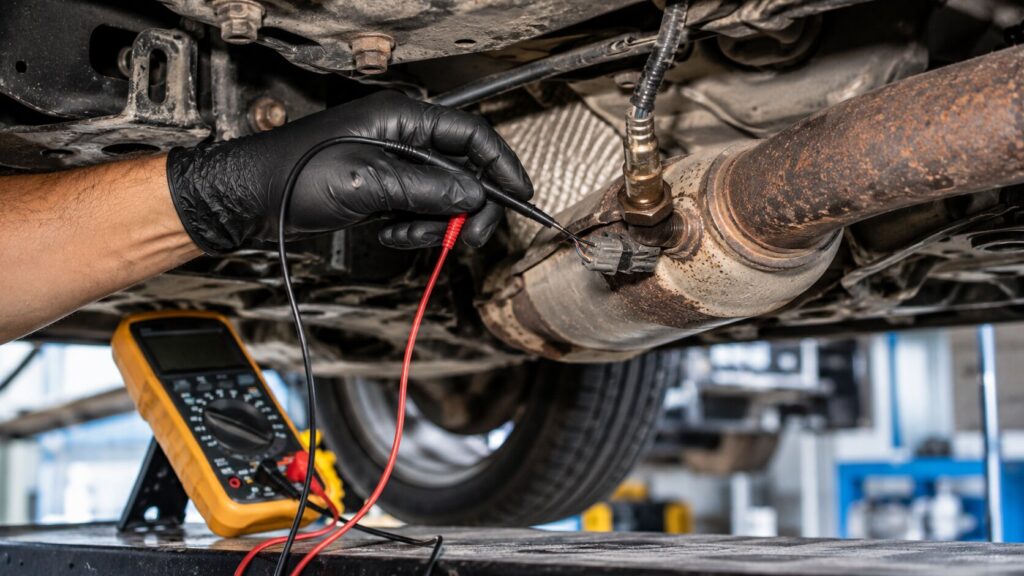
- Circuit Voltage Drop Testing: Use a multimeter to measure the voltage drop across the sensor ground circuit while running. Back-probing the ground wire at the connector reveals resistance spikes if measurements exceed thirty millivolts.
Protecting Your Catalytic Converter
Aging sensors degrade slowly over time through a process known as sensor poisoning, where silica or carbon coats the ceramic element and severely slows chemical reaction times. If you ignore a lingering fault, the engine control module is forced to run rich to prevent internal overheating. This protective measure continuously dumps excess unburned fuel directly into the combustion cylinders.
This unburned fuel inevitably travels downstream into the exhaust system and violently ignites inside the catalytic converter. The resulting extreme internal heat melts the fragile honeycomb ceramic structure, causing severe secondary damage to the emissions system. Catching a sluggish sensor early and servicing the ground circuits proactively protects the entire exhaust network from catastrophic thermal meltdown..
Skip the Guesswork and Find the Fault
Quick-lubs drop in a new OE sensor and cross their fingers, leaving the corroded ground to throw another MIL in thirty miles. We chase down high-resistance ground pins and chemical buildup before touching a single sensor.
Bring your rig to Certified Auto Repair at 4700 Shoreline Drive, Spring Park, MN 55384 for a back-probe continuity test that actually finds the hidden voltage drop before you burn cash on unnecessary components.
Frequently Asked Questions
Does a generic trouble code automatically mean my oxygen sensor is broken?
No. A diagnostic trouble code only identifies circuits falling out of factory parameters, pointing primarily to secondary symptoms like vacuum leaks, exhaust manifold cracks, or ground resistance.
Can driving with a faulty oxygen sensor damage my catalytic converter?
Yes. A corrupted sensor signal forces an improper air-fuel mixture that floods the exhaust with unburned fuel, igniting inside the converter and melting the internal honeycomb substrate.
Is live fuel trim analysis necessary for an accurate sensor diagnosis?
Yes. Watching short-term and long-term fuel trims shows exactly how your engine computer adjusts under load, which tells you much more than a simple trouble code ever could.
Will clearing the diagnostic trouble code fix the underlying sensor issue?
No. Clearing a trouble code with a scanner only erases computer memory without resolving the physical fault, causing the check engine light to return during the next drive cycle.d