Toyota hybrid battery thermistor failures trigger dashboard warning triangles during sub-zero winters. Standard scanners misdiagnose these corroded low-voltage wiring faults as dead battery packs. Professional live data monitoring, high-impedance multimeter testing, and targeted circuit-level diagnostics isolate resistance spikes, prevent unnecessary high-voltage assembly replacements, and restore hybrid powertrain performance without dealership delays.
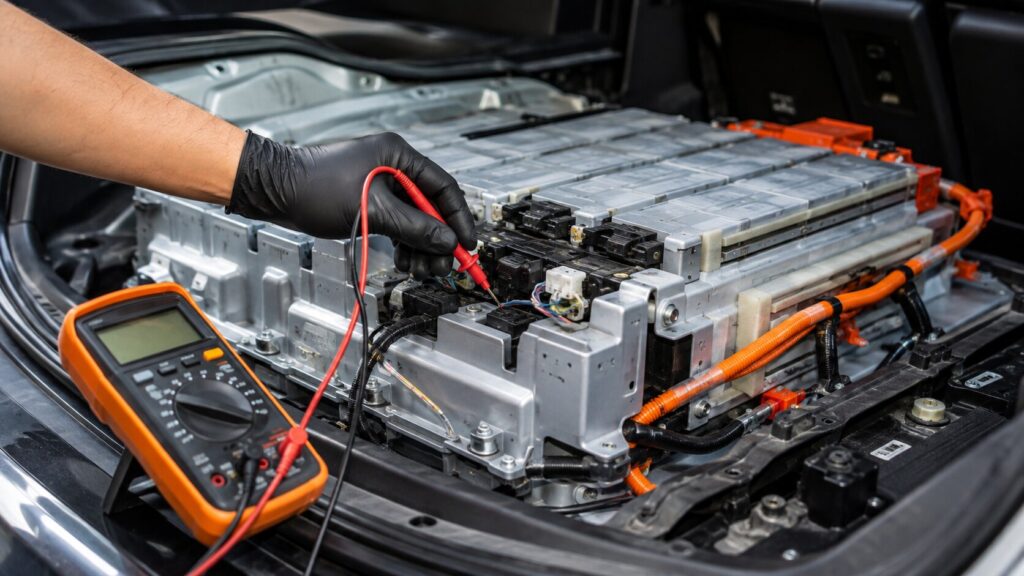
Toyota hybrid battery temperature sensor failures strand drivers along Lake Minnetonka when sub-zero Minnesota winters clash with high internal resistance packs. Corroded thermistor terminals trigger persistent dashboard warning triangles that standard OBD-II scanners misdiagnose as failing battery modules.
Understanding Toyota Hybrid Battery Temperature Monitoring
Toyota battery packs use NTC (Negative Temperature Coefficient) thermistors bolted directly to the module blocks to stream live thermal data straight to the Powertrain Control Module. When these sensors function properly, the system balances charge and discharge rates to maximize battery longevity. When they fail, the vehicle loses thermal accuracy, resulting in sudden power limitations and persistent diagnostic trouble codes.
Minnesota weather aggressively accelerates this failure mode through extreme seasonal shifts and moisture intrusion:
- Sub-zero garage starts cause thermistor internal resistance to spike unpredictably.
- Trapped condensation inside the battery casing freezes and thaws repeatedly.
- Road salt combined with moisture accelerates galvanic corrosion on the copper-to-nickel connector pins.
I spend hours checking these lines because corrosion creates hidden resistance in the wiring. The control computer reads this voltage drop as an out-of-range thermal spike and forces the powertrain into a protective limp mode.
My Diagnostic Note: Never replace a complete high-voltage hybrid battery assembly when a basic thermistor harness connector is simply corroded by localized humidity and road salt accumulation.
Recognizing Symptoms of Thermal Sensor Failure
Catching a failing temperature sensor early requires identifying specific operational anomalies during startup and highway acceleration. I always ask my customers to watch for these distinct warning signs:
- Master warning light activation (the “Red Triangle of Death”) accompanied by a hybrid system malfunction message on the dash display.
- Noticeable drop in fuel economy because the vehicle refuses to transition into electric-only mode.
- Auxiliary cooling fan behind the rear seat blasting at maximum speed immediately upon a cold start.
Ignoring these warnings or clearing codes with a basic parts-store scanner only masks the underlying electrical problem. My diagnostic challenge always involves separating real thermal events from electrical ghost signals generated by resistance spikes in the monitoring harness.
Advanced Diagnostic Techniques for Hybrid Thermistors
Pinpointing a faulty temperature sensor demands factory-level diagnostic software and high-impedance digital multimeters rather than generic code readers. When a hybrid arrives at my bay, I execute a strict testing sequence:
- Connect a computer to monitor live data from all individual battery sensors during an early morning cold check.
- Look for dramatic discrepancies where one reported block temperature jumps wildly out of sync with neighboring modules.
- Backprobe low-voltage harness connectors at the battery junction box to measure exact resistance values against factory temperature curves.
This meticulous testing exposes intermittent open circuits caused by cracked solder joints or stress fractures within the sensor assembly that only appear during chassis vibration.
Preventing Future Hybrid Battery Thermal Issues
Stopping repeat thermistor faults means sealing out moisture and repairing high-resistance wiring before it trips the inverter. Over the years, I recommend a few essential upkeep habits:
- Inspect rear battery cooling intake filters regularly to prevent dust and debris from trapping heat.
- Address minor electrical codes immediately rather than waiting for the hybrid system to shut down completely.
- Park in a garage during extreme cold snaps to minimize the thermal shock that cracks solder joints.
- Use proper dielectric grease and corrosion-resistant components during wiring repairs to block moisture intrusion.
Choosing an independent specialist ensures component-level troubleshooting that targets the exact point of failure without corporate dealership backlogs.
Resolving Toyota Hybrid Warning Lights
If you are struggling to isolate a hybrid battery warning light or a blasting cooling fan issue, a professional diagnostic check can safely identify the root cause without unnecessarily replacing parts.
If you ever need a hand tracking down a faulty thermistor or testing your hybrid’s low-voltage circuits, my team at Certified Auto Repair is always available as a local resource. You can find us at 4700 Shoreline Drive, Spring Park, MN 55384, or call us to ensure your vehicle is running safely and efficiently.
Frequently Asked Questions
Does a hybrid battery temperature sensor failure always require a completely new battery pack?
No. In my experience, most sensor issues stem from corroded wiring harnesses, damaged thermistors, or loose connector pins rather than internal cell degradation.
Can a standard generic code reader pinpoint a failing hybrid temperature sensor?
No. Generic OBD-II scanners only display general powertrain codes and lack the deep-level data streams needed to read individual thermistor resistance values in real-time.
Does extreme winter weather directly trigger these specific hybrid sensor faults?
Yes. Rapid thermal expansion and contraction combined with road salt moisture accelerate pin corrosion and cause intermittent open circuits in the low-voltage wiring.
Will driving with an active hybrid warning triangle permanently damage the vehicle?
Yes. Continuing to drive makes the computer choke engine power and disable energy recovery, wearing down the remaining electrical components.