Audi TFSI engines enter limp mode along Shoreline Drive when lakefront humidity and thermal shock contaminate MAP and MAF sensors. In our shop, we use advanced live data scanning, voltage drop tests, and smoke checks to isolate failures. Early diagnosis prevents costly secondary engine and turbocharger damage.
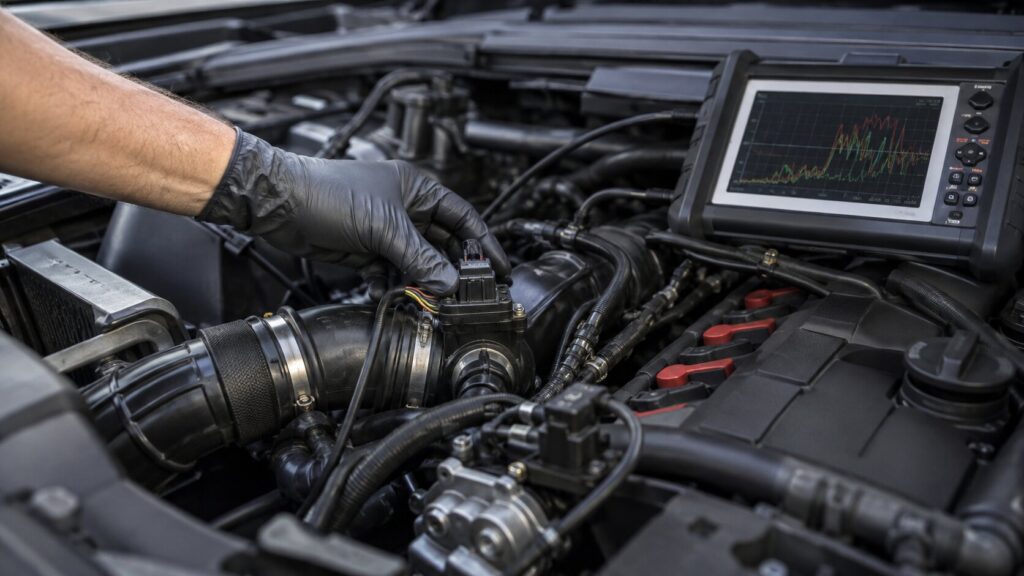
When an Audi TFSI engine suddenly drops into reduced power mode along Shoreline Drive, I usually trace it right back to lakefront humidity and thermal shock attacking the mass air flow (MAF) and boost pressure components. Instead of relying on a generic scan, I hook up live data, run voltage drop tests, and smoke the intake tract to track down the exact failure point and protect your engine from expensive secondary damage.
Wild weather swings along Shoreline Drive frequently ruin Audi turbo sensors and charge pipes. When extreme temperature drops combine with high humidity, they contaminate sensitive engine management components and force TFSI engines directly into restrictive limp mode.
Audi Engine Management Sensor Problems and Limp Mode Causes
When you lose power mid-acceleration and the pedal feels completely dead, the EPC light pops on because the engine computer spots a mismatch between requested boost and actual sensor readings. As a State-licensed Emissions Technician, I always warn drivers that ignoring these subtle shifts forces the computer onto default fallback maps, which destroys your fuel economy and spikes your emissions output.
The Mechanical Physics Behind Turbo Boost and MAF Failure
Under normal conditions, the mass air flow sensor passes a precise electrical current across a heated platinum wire, measuring incoming air mass by tracking the energy needed to maintain wire temperature as air rushes through the housing. MAP sensors also track intake vacuum and pressure shifts, giving the computer the data it needs for precise fuel injection and timing.
Wild temperature changes by the lake shock the system, cracking sensor solder joints and baking oil residue right onto the sensing wire.
This buildup traps heat around the wire, delaying its temperature response and sending skewed data to the computer. When that incoming air volume fails to match factory maps, the powertrain control module instantly cuts turbo boost and restricts the throttle to protect the engine.
My Diagnostic Verdict: I’m regularly pulling green, crusty corrosion out of the 5-pin MAP connector on B8 TFSI setups after a humid Spring Park freeze-thaw cycle. If the mass air flow numbers lag by more than 15 g/s during hard acceleration, skip the sensor cleaner and check the wire for voltage drop, as the connector pin is typically opened up.
Advanced Diagnostic Workflows For Audi Boost Pressure Issues
Fixing intermittent power loss requires moving far beyond basic code scanning, which often leads to shops blindly throwing expensive parts at your car. At Certified Auto Repair, I believe in complete transparency, which is why I follow a strict, evidence-based diagnostic routine:
- Live Data Road Testing: I hook up an advanced factory scan tool and take the car out for a test drive to compare requested boost against actual turbo output while monitoring airflow numbers.
- Voltage Drop Testing: I check sensor wires with a digital multimeter to track down hidden resistance caused by moisture inside the plastic connectors.
- Intake Smoke Testing: I pump smoke into the intake tract to reveal micro-tears in rubber intercooler boots or cracked plastic charge pipes that let unmetered air bypass the sensor entirely.
Environmental Stressors Impacting Audi TFSI Performance
Freezing morning temperatures make rubber vacuum lines and plastic charge pipes brittle, creating tiny air leaks that throw off manifold pressure readings. Summer humidity then pushes moisture straight into exposed wiring clips, building up electrical resistance that scrambles sensor signals on their way to the computer. Changing just the sensor won’t fix the issue if the surrounding wiring harness and plastic pipes are already worn out by local weather.
Preventing Secondary Damage From Audi Reduced Power Mode
Ignoring a skewed air-fuel ratio dumps unburned fuel straight into the exhaust. From an emissions standpoint, this is disastrous—it will quickly melt down your catalytic converter substrate and overspeed the turbine wheel through wild wastegate corrections.
Left unchecked, an incorrect air-fuel mixture washes protective oil films off your cylinder walls and dilutes the crankcase with unburned fuel. Catching these electronic faults early preserves your turbochargers and expensive emissions equipment while restoring smooth, reliable throttle response for your daily commute.
Skip the Dealership Backlog
Waiting to fix a flagging MAP or MAF sensor is a gamble that always ends in a heavy repair bill. It can easily turn a minor electrical connector cleaning into a melted catalytic converter or a scorched turbine housing.
While corporate dealership service centers make you wait weeks for an appointment slot just to hand your keys over to an entry-level lube tech running a basic code reader, my independent shop moves fast with deep-level diagnostic gear. I track down the wiring glitch and test the live data right here so you don’t get stranded on Shoreline Drive.
Schedule your Audi diagnostic check with me at Certified Auto Repair, 4700 Shoreline Drive, Spring Park, MN 55384 today.
Frequently Asked Questions
Does a dirty mass air flow sensor always trigger a check engine light immediately?
Yes, though minor sensor drift frequently throws off the fuel balance before a hard fault code appears, which makes the vehicle feel lazy and draggy when you drive around town.
Will cleaning a failed sensor permanently fix reduced power mode?
No. In my experience, chemical cleaning only fixes the problem for a short time if physical wire damage or internal electrical resistance has already ruined the circuit board inside.
Can cold winter weather in Minnesota directly cause sensor failure?
Yes. Severe temperature drops put heavy expansion and contraction stress on sensitive sensor wires and cheap plastic housings, causing them to crack and fail much faster.
Is it safe to continue driving an Audi while it is stuck in reduced power mode?
No. Driving under restricted power creates dangerous acceleration deficits in traffic and forces the engine to operate outside normal thermal parameters, risking expensive internal damage and catalytic converter failure.