Connected Jeep telematics use STLA Brain edge computing to monitor live CAN bus data at millisecond intervals. It flags pending issues well before the dashboard lights up by pinpointing temporary quirks, such as 7% fuel trim spikes or sub-second oil pressure drops. This allows technicians to proactively isolate humidity-induced connector corrosion and short-commute fuel dilution.
From my shop terminal, monitoring incoming over-the-air data streams from local vehicles allows for catching emerging powertrain anomalies before a dashboard light ever illuminates. Analyzing live data packets sent over the cellular network helps isolate transient communication bus errors and drops in hydraulic actuation pressure. This type of predictive maintenance lets us nail down exact mechanical issues and make small, targeted adjustments before something expensive breaks.
STLA Brain Edge Computing Detects Faults Near Sunset Cove Marina
Standing over the engine bay of a recent Grand Cherokee with my factory diagnostic laptop hooked up, I can see exactly how the environment of Lake Minnetonka alters electronic operations. The vehicle arrived without an active check engine light on the dashboard, yet the owner received an automated notification on their phone warning of an impending powertrain issue. This happens because the internal architecture moves past traditional onboard diagnostics that require an absolute mechanical failure before saving a hard trouble code.
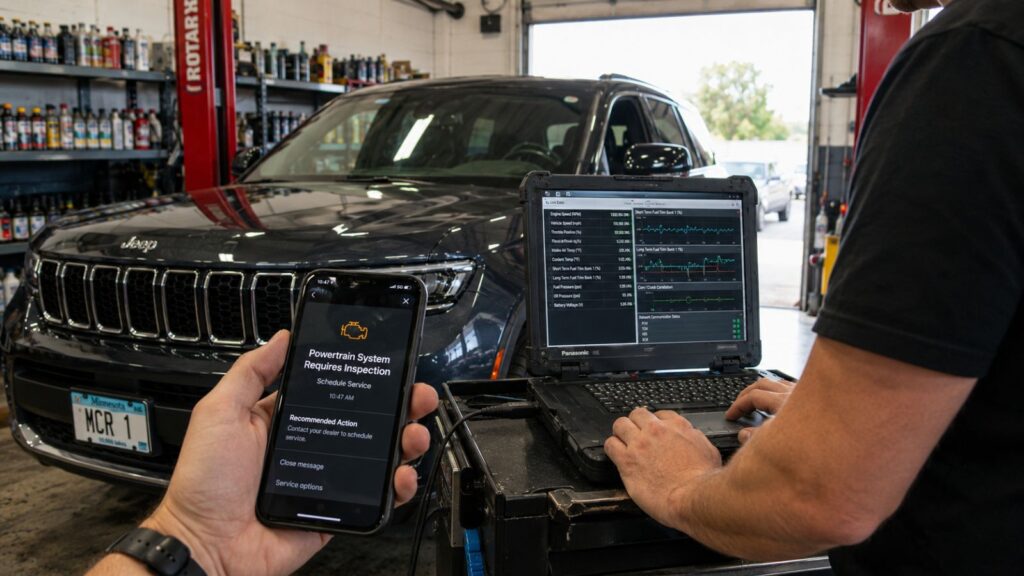
Newer connected vehicle architectures, including STLA-based platforms, combine onboard processing, vehicle networks, and telematics communication to collect and analyze operating data. As a Grand Cherokee pulls away from Sunset Cove Marina, the system continuously monitors live Parameter IDs at millisecond intervals to capture transient performance anomalies. When live fuel trim, sensor feedback, or operating parameters move outside expected patterns, connected systems can identify conditions that may require further diagnosis.
Shoreline Drive Humidity Distorts Standard Factory Diagnostic Codes
Observing a distinct disconnect between factory service manual dictates and real-world conditions around the damp shorelines of Spring Park is common. Standard reference manuals suggest that a pending P000A or P0300 code points directly to a failing variable valve timing solenoid or a mechanical ignition defect.
However, navigating low-clearance access routes along Shoreline Drive atomizes lake water into a humid mist, introducing moisture into the engine bay and targeting low-hanging wiring harness connectors. A glance at the live diagnostic monitor reveals immediate high-resistance signal noise caused by microscopic galvanic corrosion eating away at the physical connector pins in this damp climate. While the actual mechanical components remain perfectly sound, this degraded voltage drop tricks the telematics module into registering a physical timing lag based purely on circuit impedance.
Decoding Real Time Vehicle Telematics Data and Remote Workshop Diagnostics
My diagnostic process relies on modern connected vehicle technology, which taps directly into the CAN bus to stream live engine data straight to my shop terminal. Accessing this continuous loop between edge processors and cloud servers transforms how I pinpoint problems:
- Deep-Tier Parameter Tracking: Engine load, manifold pressure, and fuel injection pulse widths stream instantly to digital screens rather than staying locked in local modules.
- Edge Computing Filters: Software processes data locally in real time, filtering out normal noise to document only true transient anomalies.
- Live Waveform Analysis: Cloud streams display performance waveforms from the exact moment a vehicle stumbles or idles in traffic.
- Proactive Fault Isolation: Telemetry data flags subtle issues early, revealing microscopic electrical spikes and momentary drops in fluid density well before a check engine light gets triggered.
- Targeted Mechanical Fixes: Over-the-air data allows for precise repairs well before a vehicle breaks down or requires an expensive overhaul.
Short Commutes From Hardscrabble Point Prevent Critical Engine Warm-Up
Short-trip driving can accelerate engine oil degradation because the engine may not operate at ideal temperatures long enough to remove accumulated moisture and fuel dilution. The factory maintenance printout states that the engine oil is good for a 10,000 mile operational interval under normal usage. This standard completely falls apart during June driving profiles around the lake.
A standard 3.5-mile drive from Hardscrabble Point to Back Channel Brewing Co. ends well before the internal engine oil can sustain its optimal cleaning temperature of 212°F. Because the engine stays too cool to purge unburnt combustion blow-by from the crankcase, raw fuel mixes directly into the lubricating fluid and dilutes its hydraulic density. The STLA Brain platform flags this fuel dilution instantly, logging a slow variable valve timing response at 1.8 Bar of oil pressure before any physical hesitation occurs at the pedal.
Over-The-Air Telemetry Isolates Camshaft Lag During County Road 15 Traffic
The real diagnostic work starts on my shop terminal before ever turning a physical wrench. Instead of replacing components based only on stored fault information, technicians can use telemetry and waveform analysis to verify the actual source of the concern. Reviewing the live telemetry graphs captured over the air while the vehicle was stuck in stop-and-go tourist traffic along County Road 15 provides critical context.
Everything clicks when the cloud data shows a distinct waveform jitter. It indicates that the actual camshaft position is lagging behind the target by more than 10 degrees when the vehicle idles in intense heat. This intense thermal load degrades the thin, fuel-diluted oil, rendering it incapable of holding the hydraulic phaser steady. Utilizing these over-the-air data captures to isolate the failure makes it possible to pinpoint a clogged control screen or a corroded harness pin without performing unnecessary engine teardowns.
Certified Auto Repair at 4700 Shoreline Drive, Spring Park, MN 55384 uses advanced diagnostic equipment and vehicle data analysis to help identify developing Jeep concerns and determine the correct repair approach.
Frequently Asked Questions
Can connected vehicle technology detect an engine problem before the check engine light turns on?
Yes. The onboard telematics system monitors live CAN bus parameter data frames at millisecond intervals. It can identify subtle performance deviations, such as a 7% shift in fuel trims or minor timing lags, uploading an alert packet to the cloud before a hard fault code is triggered on the dashboard.
How does high humidity near Lake Minnetonka affect my vehicle’s engine electronics?
High seasonal humidity creates moisture condensation within the engine bay, leading to accelerated microscopic corrosion on low-hanging underbody electrical harness pins. This electrical degradation increases circuit resistance, which distorts the sensor voltage signals transmitted to the telematics control unit and triggers preventative maintenance alerts.
Why are short commutes around Spring Park harmful to modern Jeep engines?
Short driving profiles under 4 miles prevent the engine oil from reaching and maintaining its necessary 212°F operating temperature. Lacking this critical engine heat, unburnt fuel and condensation cannot evaporate from the crankcase, resulting in diluted oil that lowers hydraulic pressure and fouls the variable valve timing assemblies.
What is the difference between older Uconnect systems and newer STLA Brain architectures?
Older systems primarily acted as data relays that transmitted standard diagnostic codes after a mechanical failure occurred. The newer STLA Brain platform uses localized edge computing to continuously analyze live streams, filtering out normal operating noise to flag pending mechanical anomalies before components fail.
Do technicians use telematics data to perform vehicle diagnostics?
Yes. Modern service centers extract cloud-based data packets containing high-frequency sensor readings captured during real-world driving conditions. This allows technicians to analyze the exact vehicle parameters present during intermittent failures, such as high-temperature idling delays, without needing to duplicate the failure in the shop.