Jeep predictive diagnostics in Spring Park leverage continuous powertrain telemetry to isolate component wear before warning lights flash. Tracking live CAN-bus data and crankshaft alignment catches a stretched timing chain or failing injector early. Factoring in wiring corrosion caused by Lake Minnetonka’s intense humidity stops severe on-road breakdowns before they ruin a quick trip to the boat launch.
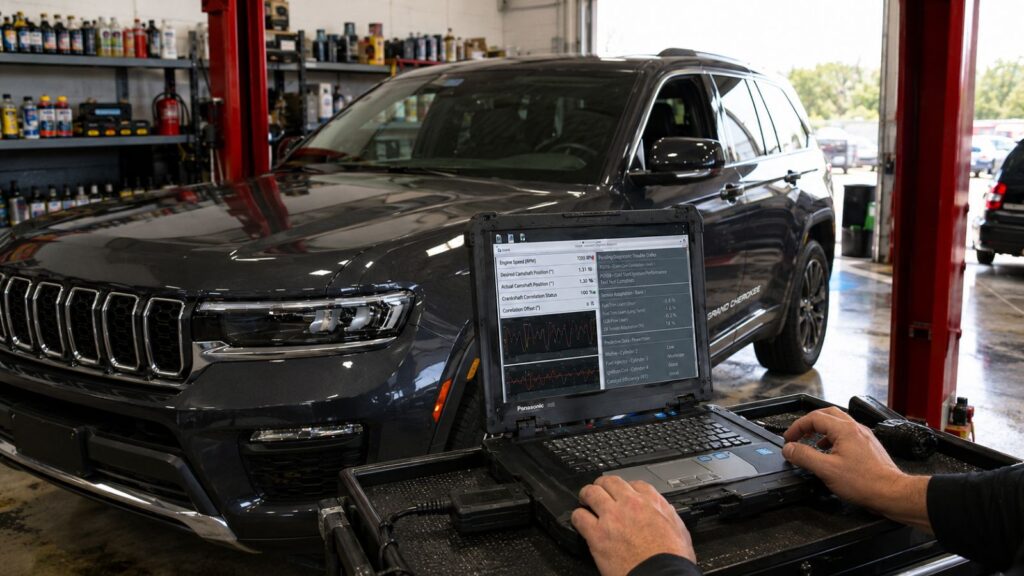
I hook up the diagnostic terminal to the secure gateway module to pull the uncompressed powertrain data stream from a Grand Cherokee WL. Despite having no active dashboard warning lights, the vehicle’s internal health logs indicate a recurring predictive fault code linked to a subtle acceleration hesitation. Capturing this telemetry in the service bay allows me to isolate the failing component before it causes a major breakdown on Shoreline Drive.
Why Your Grand Cherokee Predict Component Wear Before a Warning Light Illuminates
Traditional onboard diagnostics operate on a binary threshold. A sensor must either short circuit, lose signal completely, or register data outside of a massive pre-programmed window before the vehicle alerts the driver. Modern Jeep platforms use continuous statistical regression models instead. The powertrain control module monitors the exact relationship between the crankshaft position sensor and the dual camshaft position sensors on the 3.6L Pentastar Upgrade engine assembly.
The 4.5-degree Timing Variance Threshold
As I review the live data parameters, I look directly at the camshaft-to-crankshaft angular alignment values. The factory specification requires absolute synchronization during variable valve timing commands. However, as a timing chain stretches or a hydraulic tensioner loses pressure, the mechanical alignment shifts slightly.
During diagnostic testing, I review camshaft and crankshaft correlation data to identify changes from expected operating ranges. As timing components wear, the engine management system may compensate for small variations without immediately displaying a warning light. Monitoring these trends helps identify developing wear patterns and allows repairs to be planned before the condition progresses into a larger mechanical concern.
Is it a Failing Sensor or Lake Minnetonka Humidity
Standard factory baseline simulations cannot accurately model the unique atmospheric moisture and thermal cycling experienced by advanced propulsion networks in Spring Park. The service manuals from Mitchell1 outline precise voltage testing steps for the wheel speed and transmission speed sensors, but they often overlook local atmospheric realities. The severe influx of regional summer humidity across the Lake Minnetonka area subjects vehicle undercarriages to continuous moisture penetration, accelerating terminal insulation breakdown.
Isolating Harness Terminal Corrosion Near Shoreline Drive
When high humidity combines with residual salt dust on County Road 15, a conductive microscopic film migrates past the silicone weather-pack seals of low-voltage chassis harnesses. This moisture sits inside the connector terminals of Wranglers frequenting local boat ramps, causing fretting corrosion and high-impedance signal noise. When the resulting transmission delay across the CAN-bus exceeds 35 milliseconds, the predictive network logs a high-latency flag, revealing green oxidation on the gold-plated pins under a shop borescope before a total circuit break occurs.
Managing Internal Engine Condensation During Short Summer Boat-Launch Trips
Short trip driving profiles represent one of the harshest operating conditions for a modern internal combustion engine. When a vehicle is driven from a driveway near Minnetonka Regional Park to the Spring Park boat launch, the entire trip covers less than two miles. The engine oil never reaches its required operational temperature of 212 degrees Fahrenheit.
The Impact of Short Trips on Predictive Oil Life Algorithms
Premature engine shutdown prevents the crankcase oil from achieving full thermal stabilization, trapping atmospheric moisture accumulated overnight within the lubrication system. This remaining moisture mixes with the engine oil, forming a thin, acidic emulsion. The predictive oil life algorithm inside the powertrain control module tracks these precise parameters. It counts every cold start, measures the exact duration of the trip, monitors ambient temperature, and recalculates oil degradation.
The factory manual might suggest an oil change interval of 7500 miles, but the predictive data log in a vehicle subjected to this local short-trip cycle will often demand a fluid service at 3000 miles. When I drain the oil from these vehicles, I can physically see the milky condensation layer on the underside of the oil filler cap, confirming the accuracy of the predictive algorithm.
Probing Raw Sensor Circuit Telemetry via Oscilloscope
Bypassing the vehicle control module’s filtered data stream, hooking up an advanced oscilloscope allows for physically probing circuits and forensically verifying predictive faults at the hardware level. This approach reveals the raw electrical behavior of the sensors in real time, completely independent of the powertrain control module’s signal smoothing.
Connecting the digital oscilloscope to the mass airflow sensor and fuel injector circuits provides a way to simulate the heat-soaking, stop-and-go idling traffic along Shoreline Drive. On the digital interface, a degrading injector unmasks internal solenoid insulation failure through distinct pulse-width micro-jitter and a rounded inductive turn-off signature during smooth engine operation.
Isolating this specific electrical noise allows for targeted component remediation, finishing the replacement with a digital torque wrench to the 10 Newton-meter factory specification to mitigate catastrophic on-road failures.
Bring your vehicle to Certified Auto Repair at 4700 Shoreline Drive, Spring Park, MN 55384. Schedule an appointment to hook up the digital scope, bypass the filtered telemetry, and fix the issue before it leaves you stranded!
Frequently Asked Questions
Can a vehicle scan tool read predictive diagnostic codes before a warning light turns on?
Yes. Professional diagnostic equipment can access the internal memory of the control module to view pending codes, network latency logs, and advanced sensor adaptation values. These background parameters register systemic operational degradation long before the thresholds required to illuminate a dashboard warning light are reached.
How does high humidity near Lake Minnetonka affect my vehicle electrical connectors?
High ambient humidity introduces moisture into the underhood and chassis wiring harnesses. When this moisture mixes with microscopic salt residue on the roads, it causes fretting corrosion on the terminal pins, increasing electrical resistance and causing predictive network communication faults.
Why does the oil life monitor drop faster during short trips?
The oil life algorithm tracks engine temperature and trip duration. Short commutes prevent the engine oil from reaching the temperature required to evaporate internal condensation, causing the powertrain control module to adjust the service interval downward to prevent oil sludge formation.
What is the purpose of checking camshaft and crankshaft sensor alignment values?
Monitoring the angular alignment between the camshaft and crankshaft sensors allows technicians to detect early timing chain elongation. A variance greater than 4.5 degrees indicates mechanical wear in the timing assembly, allowing for a pre-emptive replacement before terminal engine damage occurs.
Do predictive diagnostics lower overall automotive repair costs over time?
Yes. Early detection of mechanical wear and electrical resistance drift allows operators to execute minor system interventions, such as component cleaning or isolated module replacement, neutralizing severe secondary damage across adjacent powertrain networks.